Purpose
The purpose of this policy is to create a standardized process to evaluate all situations that members encounter. The goal of the process is to maximize the likelihood of positive outcomes for all involved.
By training all members to this standardized process, the MPD seeks to instill the principles of critical thinking, the Duty to De-escalate (P&P 7-802), and Avoiding Escalation and Unnecessary Risk (P&P 7-802). The model described in this policy also embeds the Department’s Mission, Vision, Values and Goals in the decision-making process.
The Critical Decision-Making Model
Introduction to the Concept
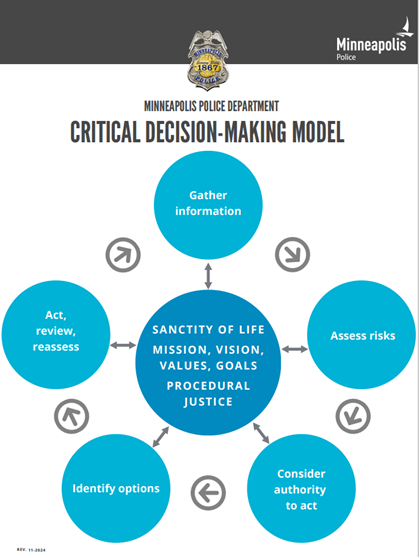
The critical decision-making model (CDM) outlines five steps that are part of the decision-making process and that are guided by a set of core values.
The CDM is simply a visual model that provides structure and vocabulary to help members better understand how they make decisions.
- The CDM is not a checklist or worksheet that members need to complete after calls or incidents. Members should see it as a visual reminder of the steps they naturally take to make decisions.
- The steps are circular, not linear, and are repeated or returned to as needed (see section [D] on spinning the model).
The Critical Decision-Making Model Core
The middle or “core” of the CDM represents the overall philosophy of the MPD and helps to guide the actions of members in all situations. These principles should be at the core of members’ considerations and decisions in each of the five steps.
The core of the CDM includes:
- Sanctity of Life (P&P 0-102).
- Mission, Vision, Values, Goals (P&P 0-102).
- Procedural Justice (P&P 5-109).
Steps of the Critical Decision-Making Model
Gather information
- Members will continually gather and process information as they apply each step of the CDM.
- Separating facts from assumptions is the foundation of effective decision-making.
- This includes assessment of the completeness, accuracy and credibility of information. Members should consider the information of this incident, information from previous incidents, and the sources of the information.
- Examples of questions members can ask themselves include:
- What is happening or has happened?
- What do my training and experience tell me about this incident?
- What additional information do I want or need?
Assess risks
- In assessing risk, the member should consider whether there is an immediate need to take action to address a threat of imminent harm (see P&P 7-804), or if the member can use de-escalation techniques and tactics to slow down and stabilize the situation (see P&P 7-802).
- Members should consider the potential risks of taking or not taking the action, including the likelihood and degree of risks to members, suspects or arrestees, victims, and the public.
- Members should consider whether the assessment of risk suggests additional resources may be necessary to assist in handling the situation.
- Examples of questions members can ask themselves include:
- What is the threat or risk?
- Is there an immediate need to take action?
- Is anyone in imminent danger of harm?
- If immediate action is not necessary, am I trained or equipped to handle the situation?
Consider authority to act
- Members must consider how applicable policies and laws authorize or restrict their actions, based on the totality of the circumstances (including the information they have gathered).
- Examples of questions members can ask themselves include:
- What is my legal authority to act?
- Does this situation require police action (by policy or law)?
- Are there policies that guide or restrict my response?
Identify options
- Members should identify what they are trying to achieve, and what options are available to best facilitate that outcome.
- Members should determine the best course of action, based on the assessment of risks and consideration of their authority to act. This includes considering whether tactical disengagement may be appropriate (P&P 7-802).
- Members should consider if they have enough information and resources and a need to act right away, or if getting more information and resources would produce a better outcome.
- Examples of questions members can ask themselves include:
- What am I trying to achieve?
- What options do I have?
- What option would have the greatest likelihood of success with the least potential for harm?
- Do I need to act now or should I wait?
Act, review, reassess
- Members should implement the option they determined to be the best course of action.
- After taking action, members should assess whether the action achieved the intended outcome and whether the action generated new information.
- Examples of questions members can ask themselves include:
- Did I achieve the desired outcome?
- Did the action generate new information, create new risks, or make new options available? (see section [D] on spinning the model)
- Is there anything more I need to do or consider?
Spinning the Model
Information collection is ongoing. As new information becomes available, members should “spin the model,” re-assessing the new information and fine-tuning their decision-making through the steps of the CDM.
Definitions
Refer to the Commonly Used Terms page for general definitions.
- Critical Decision-Making Model: A tool that allows members to organize situational factors and inform their decisions as they respond to police incidents of all degrees of complexity. All sworn members are trained in using the critical decision-making model (CDM). (P&P 7-801)
- De-escalation: Techniques and tactics to reduce the intensity of a situation. These strategies serve to increase the likelihood of voluntary compliance, minimize the need to use force, and uphold the sanctity of life by enabling members to resolve situations without the use of force or with the lowest degree of force necessary. (P&P 7-802)
- Tactical Disengagement: A strategic decision to leave, delay contact, or delay custody of a person when there is not an immediate need to detain them.
- Tactical disengagement: Tactical disengagement is a strategic decision to leave, delay contact, or delay custody of a person when there is not an immediate need to detain them.
- Totality of the Circumstances: All facts known to the member at the time, including the conduct of both the member and the person leading up to the action (such as the use of force).