7-101 Emergency Communications Center
- Summary: Defines the role and responsibilities of the Minneapolis Emergency Communications Center (MECC).
- Effective Date: 09-26-2022
Policy
The Minneapolis Emergency Communications Center (MECC) is the communications link between the Police Department and the public it serves.
The MPD acknowledges the authority of MECC to dispatch or otherwise deploy MPD resources to facilitate prompt responses to calls for police service.
7-102 Priority Call Code Numbers and Radio Call Numbers
- Summary: Establishes priority levels and radio procedures for call dispatching.
- Effective Date: 01-01-2026
- Last Review Date: 09-26-2022
Purpose
This policy establishes parameters, classification priorities, and specifications related to call code and radio call numbers of the MPD.
Policy
Priority Call Code Numbers and Procedures
Call Code Numbers
- Call code numbers are used by dispatchers and members to indicate the seriousness of an incident and the procedures for response.
- The responsibility for determining the appropriate call code number rests with the responding member based upon information communicated from MECC or other personnel.
- The call code numbers used are:
Code One: Indicates that a member cannot be located or does not answer the radio.
Code Two: A call to be answered or situation to be handled immediately. The red lights and siren shall not be used, and all traffic laws will be obeyed.
Code Three: Emergency Situation ‑ To be answered immediately, but in a manner enabling the responding units to reach the scene as quickly and safely as possible. MN Statute sections 169.03 and 169.17 require the use of red lights and siren for emergency driving.
Code Four: Situation is under control. Responding squads that have not arrived may clear.
Call Classification Priorities
- The Police Department and MECC have developed protocols and appropriate timeframes for dispatching calls and have established common working definitions about the urgency of any situation and to facilitate the most efficient delivery of service to the public.
- MECC call classification priorities are not the same as call code numbers.
- Police calls are identified by a nature code and each nature code is assigned to one of five possible priority categories. The categories are:
Priority 0 ‑ Calls classified as Priority 0 include those situations where a known crisis exists that threatens the life of an individual. This is the highest possible priority and the fastest possible response is desired. The MECC objective is to have squads en route to the call within 30 seconds of receipt by the dispatcher.
Priority 1 ‑ Calls classified as Priority 1 include situations where an imminent threat to personal safety, or the loss or damage to property exists. Conditions at the scene of the call are unstable. The MECC objective is to have a squad en route to a priority 1 event within 70 seconds of receipt by the dispatcher.
Priority 2 ‑ Calls classified as Priority 2 include situations where no immediate threat of harm exists at the scene of the call. A timely police response is still desirable. The MECC objective is to have priority 2 calls assigned at the earliest opportunity or within 45 minutes of receipt by the dispatcher. Pending priority 2 calls are assigned out of sector to an available precinct squad after 10 minutes or if known that sector squads will be unavailable indefinitely. Priority 2 calls are assigned up to the last 15 minutes of shift. If after 30 minutes the call remains in MECC due to a lack of recommended unit availability, the dispatcher may notify the affected precinct shift supervisor to review the pending priority 2 calls and recommend a course of action.
Priority 3 ‑ Calls classified as Priority 3 include situations where conditions are stable at the scene of the call. MECC may hold priority 3 calls for the squad in whose MPD district the call is occurring for up to one hour. After one hour, the situation should be reassessed by MECC and the precinct field supervisor, if necessary, to determine if the call should be reassigned to a squad outside of the MPD district in which the call is occurring. Priority 3 calls may be assigned up to the last 15 minutes of shift.
Priority 9 ‑ Calls classified as Priority 9 include administrative or service assignments. Squads on a service assignment may be reassigned to an event with a higher priority.
Radio Call Numbers
- Radio call numbers are developed by the Minneapolis Emergency Communications Center (MECC) with input from the MPD Equipment Specialist. Current listings of radio call numbers are maintained by MECC and the MPD Equipment Specialist.
For precincts, call numbers are designed to indicate the precinct, sector, and sequence within the sector. For example:
- Squad 420 ‑ Fourth Precinct, Sector Two, Primary Squad
- Squad 421 through 429 ‑ Fourth Precinct, Sector Two, Secondary Squads
- Members shall begin all radio communication using their assigned call numbers and radio prefix.
Radio Prefixes
- All vehicles using MPD radio channels will use the following prefixes which indicate their type of assignment:
- “Squad” for marked vehicle
- “Car” for unmarked or civilian vehicles
- “Portable” for members away from their vehicle
- “Chaplain” for chaplains
- “Base” for precinct, unit or division fixed operations
- “Beat” for members assigned to a specific beat
- “Bike” for Bike Patrol
- “Mounted” for members on horseback
- “Off-duty” for members working off-duty employment (under P&P 3-800)
- “Unit” for agents or community service members
- When beginning a radio transmission, members shall begin the transmission with their appropriate radio prefix (Squad 310, not just 310).
One and Two Member Designation
- In all communications with the MECC dispatcher, one member squads or cars will be designated as "Able," i.e., 321A.
- If, during an apprehension or an investigation, an member separates from a partner, the driver of the vehicle will be "A(ble)," (320A). The passenger of the vehicle shall be "B(aker)," (320B). If no vehicle is being used, the members shall decide beforehand who shall be designated as "A" and "B."
- If, during a shift, one member assigned to a two-member squad is away from duty, the remaining member shall immediately report the squad's change in designation to MECC.
FTO Squads
Squads that have an FTO and a Member in training will be designated as an FTO Squad. (Example 320 FTO or 320A FTO.) This designation will be used on the precinct line-up sheet, but standard radio call sign procedures will be used.
7-103 Calls for Service
- Summary: Outlines protocols for handling and dispatching service calls.
- Effective Date: 01-01-2026
- Last Review Date: 09-26-2022
Purpose
The purpose of the policy is to define, cover the application of, give guidelines for response and approach to, and outline the procedures for MPD calls for service.
Scope
- Calls for service include calls assigned by MECC, as well as self-initiated and any call a member self-assigns to.
- This policy applies to:
- On-duty uniformed members
- Members employed by an off-duty employer, in a law enforcement capacity as an MPD member
- Off-duty members taking any law enforcement action as an MPD member
- This policy covers uniformed member response. Response to calls for service by plainclothes members will be handled in accordance with P&P 10-202.
Prompt Response and Safe Approach
- It is the policy of the Minneapolis Police Department to respond to all calls for service within a minimum amount of time after being dispatched or notified of the need for police service.
- Members shall respond without delay to calls for police service unless otherwise directed by proper authority. Emergency calls for service shall take precedence. However, all dispatched calls shall be answered as soon as possible consistent with departmental procedures.
- If members need to temporarily go out-of-service on a detail or otherwise be unavailable for calls, they shall notify their immediate supervisor and request permission for such details.
- Members working uniformed patrol or in a marked squad who wish to go out of service for a meal break shall request OTL status from the MECC dispatcher.
- The request must include the requested OTL location.
- The dispatcher may grant or deny OTL status based on call load and staffing levels.
- Members shall not take excessive time for meals and members working two-member squads must take OTL at the same time.
- No more than three marked or unmarked squads may be OTL at the same public location unless members are also participating in a community event.
- Members shall be responsible for responding to calls in a safe manner and assessing any need for additional assistance.
Assigning to Calls
Calls assigned by MECC
- The dispatcher shall have the authority to assign calls to all available sworn personnel, including superior members. Members shall not refuse to take a call.
- When membera member is unable to respond to an assigned call for any reason, the member shall promptly notify the dispatcher and provide the reason for the change in status.
- Members shall not pass on to the succeeding shift any assigned calls without the permission of the shift supervisor.
Self-initiated calls
- Any time a member initiates a law enforcement action that was not part of a call assigned by MECC, the member shall notify MECC to generate a call for service and assign to the call.
- Any temporary detainment shall be considered a law enforcement action and requires a call for service. This includes, but is not limited to, all investigative stops and traffic stops.
- Taking a report of criminal activity shall be considered a law enforcement action and requires a call for service.
- If a member is assisting a citizen and is using MPD tools or resources to provide assistance (including a squad) or will be out of service for more than a short time, the member shall notify MECC to generate a call for service and assign to the call.
- This does not include encounters where a citizen is only filing a complaint. Such encounters do not require a call for service. If a call for service was initiated already and the encounter is determined to be only complaint-related, the call shall be cleared as PROSRV.
- The notification to MECC should be done by initiating an on-site in the Mobile Data Computer (MDC) or by radio. If the member does not have access to an MDC or a radio, the notification can be made by phone.
Self-assigning to calls
All MPD members who respond to calls for service or arrive on scene at an active call for service shall assign to the call, subject to the exceptions described below in [b].
- This includes assisting squads and supervisors through the rank of Lieutenant.
- Exceptions:
- This does not include appointed positions, except when they are performing crime scene management or are directly involved in the call for service.
- This does not include members performing the role of a Public Information Member.
- Situations may arise which require that a member decide whether to continue on an assigned call or handle a citizen's complaint, an observed event, or a higher priority call, and cause the original call to be reassigned. Such determination should be based upon the comparative urgency and the risk to life and property of the assigned call and the intervening incident.
- When it is not possible for members to handle a citizen's complaint or an observed event, they should, if circumstances permit, give directions for obtaining such assistance or initiate the necessary notifications themselves.
- When handling a call and subsequently receiving a higher priority call, members shall advise the person of the reason for leaving and of the squad's intention of returning after the call.
Acknowledging Calls
- All members assigned calls by MECC shall immediately acknowledge receipt of the call via voice radio.
- Any time a squad is responding to an event, the members shall notify the dispatcher either by radio or by pressing the “Self-assign” button.
Arriving on Calls
Members shall announce their arrival at the scene by:
- Depressing the “Arrive” status key on their MDC; and
- If the unit is the first of multiple squads to arrive, using the voice radio indicating their call number followed by the word "arrived."
Updating the Problem Nature Code
Members shall ensure the Problem Nature Code is accurate or is updated to reflect the correct code as soon as practical. The code must be updated prior to clearing the call.
Clearing from Calls
Members shall clear from all calls or other assignments as soon as the call or assignment is complete by:
- Depressing the “Clear” status key on their MDC and adding a disposition code; or
- Using the voice radio indicating their call number followed by the word “cleared” and by a disposition code.
Single Transmission
Whenever possible, all aired status changes should be accomplished on a single radio transmission (Squad 320 is clear report).
Broadcasting Descriptions
- The first members to arrive at a crime scene or other incident that warrants the broadcasting of descriptive information shall conduct a brief interview with victims and/or witnesses.
- If sufficient information is obtained to justify a broadcast, and radio traffic permits, it shall be transmitted in the following manner:
- The member will notify the dispatcher that a description is available. The member will also inform the dispatcher of the extent of dissemination of the broadcast (e.g. involved channel, citywide, regional broadcast, teletype, etc.) and will indicate arrest authority (au. probable cause, attempt to locate, etc.).
- The dispatcher will notify all squads that a description will follow and will state the location and nature of the crime. Permission will then be given for broadcast.
- Once the dispatcher has given permission, the member shall broadcast the description in the following sequence:
- Type of crime
- Time of occurrence
- Location of occurrence
- Number of suspects
- Description of suspects
- Weapons involved
- Direction and method of flight
- Description of vehicle, if applicable
- Description of loss, if applicable
Request for Back-Up
- Additional squads will be dispatched when requested by a member or when department policy dictates a back-up be sent automatically for an "Able" squad responding to certain types of incidents.
- Members requesting a back-up shall give their squad number, location and code priority.
- If the requesting member or the on scene superior member determines that back up squads are not needed, the back-up squad should be canceled.
Emergency or “Member Needs Help” Procedure
- When an emergency situation arises, members shall notify the dispatcher by doing the following:
- Stating their radio call number, followed by "EMERGENCY" or "Member needs help."
- Giving the location of the member needing help.
- Giving the reason for the emergency, if time permits.
- Whenever an emergency or "member needs help" is announced, all other members shall immediately clear the airway and keep the frequency clear until the dispatcher acknowledges the call.
- Responding vehicles should wait to give their numbers until it is obvious that the member calling the emergency is finished giving information.
- When responding vehicles do give their numbers, they should be brief and then remain off the air until they arrive at the scene.
- Once aired, the emergency commands the channel until the dispatcher announces a Code 4 and normal radio traffic is resumed.
7-104 Radio Contact and Use
- Summary: Provides regulations for officers using department radios.
- Effective Date: 01-01-2026
- Last Review Date: 09-26-2022
Purpose
This policy defines the parameters of working with a radio, including the use of an Mobile Data Computer (MDC).
Policy
Radio Contact
- Members working on the street (including when at lunch or any other break) shall be in radio contact at all times.
- Members handling an assigned call shall remain available for emergency or higher priority calls by maintaining radio communication via a portable radio.
Use of Base Units
- Base unit radio transceivers located in divisions, precincts and units shall not communicate directly with their mobile or portable personnel or other base units, except on the designated car to car channel, or with the approval of MECC.
- For MECC approval to communicate directly, the base unit operator shall contact the dispatcher by radio and request use of the air for the necessary transmission.
Unnecessary Use of Radio or Mobile Data Computer (MDC)
- The police radio and MDC are for police business only. They shall not be used to conduct personal business or to transmit personal messages.
- MDC messages are public information and are subject to public disclosure.
- These communications are subject to the provisions in other policies that cover electronic communications, (such as the policies in P&P 5-100 Code of Conduct). Inappropriate language or remarks shall be immediately reported to a supervisor, Inspector or Commander, or Bureau Head.
- Communication about incidents over the radio or MDC shall only include the information, questions or comments necessary to handle or respond to the incident. Commentary shall not be included.
- Information checks shall be requested only on the channel designated for such purposes. In most instances, Channel 7 will be the designated channel. When requesting information from Channel 7 or the precinct base, members should try to include the nature of service in the initial transmission ("Squad 320, REGISTRATION," wait for acknowledgment; then "Squad 320, David Adam Paul 543").
- Members shall use Channel 5 or any other designated channel for non‑emergency squad-to-squad or squad-to-precinct radio communications.
- Requests for interoperable radio channels (MPD detail, Metro or State talk-groups) shall be made through the MECC Duty Supervisor.
7-105 Command Staff Notification Protocol
- Summary: Details procedures for notifying command staff of critical incidents.
- Effective Date: 11-28-2025
- Last Review Date: 11-28-2025
Policy Change Notice:
Purpose
The purpose of this policy is to ensure the Chief and other command staff are notified of events that may need their attention.
Notification Requirements
Page to Command Staff
Whenever a significant event happens, the MPD requestor shall request that MECC make notifications to the Chief and command staff.
Requesting the notification
- The MPD requestor shall be the Initial On-Scene Supervisor (IOS), their designee, or the Watch Commander.
- The request shall be made as quickly as possible once the scene is secured and life-saving measures have been rendered.
- The requestor shall request that MECC send a PDVIP page to the above-listed personnel. Notifications by MECC will be made by e-text on the Department-issued cellphones.
Significant events
Significant events/incidents include, but are not limited to:
- Critical incidents (as defined by P&P 7-810).
- Homicides.
- In-custody deaths.
- MPD personnel with serious injuries or hospitalization.
- Natural or manmade disasters.
- Acts of terrorism.
- Any other event that should be brought to the Chief's and command staff's immediate attention.
Personnel to be notified
The following personnel shall be notified of such events:
- Executive Committee (Chief, Assistant Chief, Deputy Chiefs, Chief of Staff).
- Appropriate Inspector(s).
- Watch Commander.
- VCID Commander.
- Lieutenant of Homicide.
- Department City Attorney.
- Department Public Information Officer.
- Internal Affairs Commander.
Notification content
The requestor shall provide the following content for the notification:
- Date, time and location of the incident.
- A brief assessment of the event.
- A listing of other units or commanders contacted for assistance.
- Requests for other resources as deemed necessary.
- Name of contact person and their phone number.
Response after notification
The notifications will be made to a large number of command staff personnel but only those associated with the event need to respond.
- The contact person should not be called or asked for incident-specific information except by those required to respond to the incident.
- The requestor should expect a call back from the Chief, Deputy Chief of Patrol and the affected Inspector.
Memo from requestor
The requestor shall also submit a memo to the Chief and command staff detailing the incident.
- Information to be included is:
- The on-scene supervisor's name and assignment.
- A logical narrative of the sequence of events (date, time, and place).
- Details of the initial call: member’s response, resources deployed, other command or unit assistance, members or other people injured or killed, known hazards, extensive property damage, and any other significant facts that would best describe the incident.
- The time MECC was notified (e.g., 14:00).
- The requestor shall submit the memo via email to the appropriate members of the command staff.
- The memo shall be submitted as soon as possible or by the end of the work shift.
Other notification protocols
This policy is in addition to and does not supersede other applicable notification protocols such as Explosives, Weapons of Mass Destruction, Phase I, II or III Alert notification protocols (P&P 7-900 Large-Scale Emergency Response Procedures).
Direct Notification to the Chief
This policy does not alter any requirements in other policies to notify Internal Affairs (P&P 2-101) or other entities such as the Watch Commander (P&P 7-202), etc. The below requirements apply only to direct notifications to the Chief.
The notification to the Chief shall be made the highest ranking on-scene supervisor.
Notification by phone
The Chief shall be immediately notified directly by phone call in the following situations:
- Arrest of an MPD member anywhere.
- A member is alleged to have committed serious misconduct.
- A member is alleged to have committed criminal conduct, including but not limited to, domestic abuse or threats.
- A member is cited or arrested for DUI or DWI.
- Death, great bodily injury, or life-threatening emergency of an MPD member.
- Serious injuries to an on-duty MPD member.
- Injuries or illness to an on-duty MPD member resulting in transportation by ambulance or hospitalization.
- A member is a victim or presumed victim of a violent crime anytime when on or off duty.
- Any threats or threatening social media posts are directed against an MPD member.
- Use of deadly force.
- Use of force resulting in great bodily injury.
- Any crimes occurring at religious venues, including threats.
- Hostage or barricaded persons.
- High-profile shooting incidents (e.g., active shooter, mass shooting, shooting of a child, etc.).
- Violent crime pattern (e.g., multiple shootings or robberies close in time or by the same suspects).
- Significant protests.
- Any incident involving an elected or high-profile public official.
- Pursuit-related injuries.
Written notification
The Chief shall be immediately notified directly by written notification (text or email) in the following situations:
- Homicides.
- Shootings.
- Stabbings.
- Bias crimes.
- Crash involving an MPD vehicle.
- Prisoner escape.
- Potential threats to public safety (e.g. bomb threat, etc.).
- Major incidents on school grounds.
- Major fires.
- Any other newsworthy events/media presence at scenes.
7-106 KOPS (Keeping Our Police Safe)
- Summary: Establishes policies for officer safety alerts and coordination.
- Effective Date: 09-26-2022
Policy
- The Minnesota Department of Public Safety's "alert file" called KOPS (Keeping Our Police Safe) enhances officer safety by alerting officers of unsafe situations when encountering a vehicle or person involved in a recent incident by disseminating safety information statewide.
- The standard CJIS (Criminal Justice Information System) queries that check person or vehicle files also hit on KOPS alerts, immediately warning officers of potentially dangerous situations. Officers should respond to the KOPS alerts in the same manner as any other CJIS hits. The message will be accompanied by the caveat "For officer safety purpose only, this is not a warrant."
- If the officers want to relay any message to alert fellow law enforcement officers, they will forward the message, with pertinent information, to their immediate supervisor for approval. Upon approval, the supervisor will forward the message to MECC (Minneapolis Emergency Communication Center) for entry into the KOPS system.
- There are three KOPS alert options available:
- Officer Safety
- Safety to Individual (other than officer), i.e., suicidal person
- Informational
- Alerts may be flagged to indicate when weapons may be involved.
- All KOPS file information is automatically purged from the system after 72 hours except in the case of 12-hour domestic abuse pick up and hold cases.
7-107 Communications Record Keeping
- Summary: Defines requirements for maintaining communications records.
- Effective Date: 09-26-2022
Policy
- All electronic communications, (telephone calls, radio transmissions, MDT traffic, computer networks, etc.) that are conducted using the facilities of the City of Minneapolis are subject to being recorded.
- Communication records shall only be disseminated in accordance with the MN Government Data Practices Act and MPD policy (including P&P 4-501 Confidential Department Records, Reports and Information).
7-201 Watch Commanders
- Summary: Defines when a watch commander is to be notified.
- Effective Date: 11-02-2016
Purpose
The Watch Commander is an extension of the Chief’s office and acts as the Chief’s adjutant during non-business hours. Watch Commanders work under the general direction of the Assistant Chief in providing nightly supervision for all MPD operations.
Policy
- Watch Commander duties will be assigned to all personnel holding the rank of lieutenant unless the assignment is excused by the Assistant Chief.
- Limited duty Lieutenants shall be excused from Watch Commander duties, as Watch Commanders are expected to be visible and to respond to major scenes/ incidents.
- Watch Commanders shall work in full MPD uniform.
- Personnel assigned as Watch Commander are responsible for ensuring that their obligation is fulfilled.
- If a scheduled Watch Commander is unable to fulfill his/her immediate duties, he/she shall contact an MECC supervisor as soon as possible.
- MECC will assist in locating a substitute Watch Commander.
- A substitute Watch Commander will notify a MECC supervisor of the change at the start of the shift.
- If a scheduled Watch Commander is unable to fulfill his/her future duties, he/she shall locate a substitute or arrange a trade.
- The scheduled Watch Commander shall advise the designee of the Assistant Chief of the future substitution.
- The designee shall forward a copy of updates or changes to the Watch Commander schedule to the Records Information Unit and to MECC.
- If the need arises, a senior on-duty uniformed sergeant may be asked to assume full-time Watch Commander duties, and contractual agreements shall be followed.
- Assigned Watch Commanders will normally use a department vehicle from their assignment.
- If a Watch Commander uses a vehicle equipped with MVR, all policies related to MVR use shall be followed.
- All Watch Commanders are required to have their department issued cell phone and an MPD police radio as part of their equipment.
- Watch Commanders shall be available immediately by cell phone or police portable radio during their entire shift.
- Watch Commanders should base out of their normal work site when not in the field.
Procedures/ Regulations
Scheduling Watch Commanders
- The Watch Commander schedule is completed on an annual basis.
- Scheduling annual Watch Commander assignments is the responsibility of the designee of the Assistant Chief.
- Copies of the Watch Commander schedules will be sent to all commands by November 1st of each year for the following year.
- The Watch Commander schedule, including all updates or changes, i.e., substitutions, trades, etc. will be kept by the designee of the Assistant Chief and the MECC supervisors.
- Watch Commander Schedules
- There are two Watch Commander tours per week:
- Sunday through Wednesday
- Thursday through Saturday
- For Lieutenants who work 10 hour shifts, the Watch Commander shift is 10 hours (1800 – 0400). For Lieutenants who work 8 hour shifts, the Watch Commander shift is 8 hours (2000 – 0400).
- If events necessitate, the Watch Commander may extend his/her shift until relieved by command staff.
- Between 0400 and 0800 hours when no Watch Commander is on duty, the precinct inspector where an incident is occurring shall be notified if a command decision, advice or response to the scene is required. Senior uniformed sergeants may be contacted for general assistance (questions, on scene, etc.).
Duties of Watch Commanders
Watch Commander duties include, but are not limited to:
- Immediately at the start of the duty, Watch Commanders must contact the on-duty MECC supervisor with the following information:
- Name;
- Badge number;
- Log onto MDT/MDC if available;
- Other information should be relayed as the Watch Commander deems necessary or as requested by MECC.
- Watch Commanders are expected to:
- Inquire as to the status of events.
- Provide representation for Police Administration.
- Monitor all MPD activities citywide.
- Check in with each precinct, 710, other MPD areas and MECC.
- Maintain contact with MECC.
- Respond to all officer-involved shootings, other shootings, and all other significant situations.
- Respond to the hospital or medical facility when an officer is injured, and notify the Assistant Chief by phone.
- Monitor major events.
- Respond as requested by MECC, SWAT or precinct/unit/division supervisors.
- Provide assistance to the SWAT Commander in SWAT operations or other situations as requested.
- Upon arrival, and after a brief assessment of the scene, coordinating with SWAT, the Watch Commander may be requested to notify an MECC supervisor, provide details and request that they make notifications.
- Provide field representation for Police Administration by responding to all major police operations or events, especially those involving more than one precinct or division.
- When notified, the Watch Commander shall normally detail a supervisor to command and direct activities of police personnel at the scene.
- If the need arises for the Watch Commander to relieve the incident commander, his/her decision will be justified and documented in writing to the Police Administration.
- The Watch Commander then shall detail a supervisor to act as citywide Watch Commander until the situation is resolved and the Watch Commander can assume his/her normal duties.
- Coordinate requests for assistance from other agencies, other departments, etc.
- For major issues, decide if a VIP page should be issued.
- Such issues may include, but are not limited to, officer-involved shootings, homicides, children shot, and incidents involving diplomats, celebrities, politicians, law enforcement personnel or other notable persons.
- Contact the Assistant Chief with any other significant issues.
- Address issues of alleged and discovered acts of misconduct and violations of MPD rules and procedures.
- Take immediate action following all normal procedures;
- Contact on-duty investigators or Internal Affairs Unit, precinct/unit/division commander for advice or as needed.
- Notify the appropriate precinct/unit/division commander.
- Manage MPD staff city-wide, including but not limited to:
- Make staffing adjustments between precincts.
- Activating Response cars (one or two per precinct per shift noted on line-ups), which may be used as first responders to assist with major events, other precinct call loads, etc.
- May approve immediate overtime for sworn or civilian employee if a situation arises. Send information to the employee’s commander via email or memo, stating reason and estimated hours.
- Provide other consultations as requested.
- Procedure adjustments, i.e., limit 911 responses to Priority 1 calls in inclement weather.
- Accomplish other tasks and assignments as directed by the Chief, Assistant Chief or Deputy Chiefs. (12/28/06)
- Complete a Watch Commander Daily Activity Report (MP-6936) for each shift and provide an accurate account of activities.
- Report on Bar Close (especially Downtown, Uptown and U of M areas).
- CCNs for events shall be included on the Daily Activity Reports.
- The Daily Activity Report shall be in Microsoft Word format and forwarded to the email group “WCLog” at the end of each shift.
- If the email system is malfunctioning, a hard copy shall be delivered to Police Administration in Room 130 of City Hall.
*Note: Watch Commander logs, email, MDT/MDC messages and most radio communications are public data.
Public Information Officer (PIO) related Watch Commander duties
- The Watch Commander shall defer media requests to the PIO for situations including, but not limited to:
- Officer-involved shootings
- Incidents where officers were shot
- Fatal pursuits
- Incidents with a child victim
- Homicides with multiple victims
- Homicides with high-profile victims
- The Watch Commander may handle on-scene media requests for information or interviews at their discretion for situations including, but not limited to:
- Fatal vehicle accidents
- Homicides with a single victim
- Missing children
- Shootings
- Armed robberies
- Press releases shall be handled by the PIO.
- All other requests from the media, including calls or requests for follow-up, may be deferred to the PIO.
Procedures for Operation 100, Major Events and Non-Operation 100 Emergencies
- The Watch Commander shall designate a supervisor to be the Incident Commander (if one has not been established) during an emergency, disaster or other large-scale incident, including Operation 100’s, Phase Alerts, etc.
- The Watch Commander shall assist the Incident Commander with directing the operations, including establishing a command post, deciding on a course of action, directing personnel and equipment, and coordinating resources with other agencies, i.e., Fire Department, etc.
- The Watch Commander shall remain in contact with the command post. The Watch Commander shall ensure that the Chief, Assistant Chief, Deputy Chiefs and Inspector of the affected precinct are notified as outlined in the MPD’s callback procedures.
7-202 Incidents Requiring the Notification of a Watch Commander
- Effective Date: 11-02-2016
Policy
- Upon completion of their duty shift, all Watch Commanders shall make a comprehensive report for any critical incident or major event and forward the report to the Chief of Police, Assistant Chief and Deputy Chiefs. Unusual or other unique situations should be noted on the log.
- Supervisors/officers shall notify the Watch Commander of incidents that may be of unusual concern to the department or require large-scale police action.
- When warranted, the Watch Commander shall notify and instruct the Minneapolis Emergency Communications Center (MECC) to make the necessary notifications.
- Such incidents include but are not limited to:
- Arrests of MPD employees.
- Notify employee’s commander, assist with any action needed (secure work area, keys, etc.). Note name of commander/supervisor contacted on log.
- Briefly note incident on log. Do not list employee’s name on the log.
- Send a memo or separate email to employee’s Bureau Head.
- Death or injuries to MPD employees or citizens seriously injured during a police action.
- A seriously ill MPD employee.
- Incidents involving diplomats, celebrities, legislators, law enforcement personnel or other notable persons.
- Hazardous material emergencies.
- Provide assistance to Fire Department (usually the lead agency) or other HAZMAT agencies.
- Disasters:
- Weather
- Major fires
- Major traffic accident
- Aircraft crashes, etc.
- Disturbances:
- Mass arrests
- Demonstrations
- Riots
- Strikes, etc.
- Explosives and incendiary, nuclear, biological and/or chemical incidents.
- Tactical situations including multiple high-risk warrants.
- Requests from other agencies for assistance outside the city.
- Emergency escorts outside the city. **Note: MPD does not transport for other agencies unless MPD has specifically requested pick up. This includes juveniles, requests to meet at the border, etc. See P&P 6-100 on Specific Call Procedures.
- Missing/found children of a young age:
- See Amber Alert Administrative Announcement—state or nationwide broadcast information of missing children. (710 will coordinate issuance of Amber Alerts.)
- When State Patrol helicopter assistance has been requested.
- Note: Any supervisor can contact the State Patrol for helicopter assistance.
- Homicides, suicides, all DOA’s, aggravated assaults with great bodily harm, life-threatening serious felonies, business robberies.
- Vehicle pursuits.
- Note name of sergeant responsible, for memo to Assistant Chief or Deputy Chief.
- Respond to scene of pursuit conclusion as requested (except in the event a pursuit is terminated by officers/ supervisor).
- Cases with complex information.
- Personnel (shift) holdovers, unit closures, etc.
- Pre-planned major events taking place during a Watch Commander’s shift such as presidential visits, large concerts, etc.
- Notification from Secret Service, FBI or similar agencies.
- Ensure communiqués are forwarded to Police Administration via email or hand delivered.
- If the situation requires an immediate response, contact the Chief/Assistant Chief or Deputy Chief(s) and take action as required.
- Information or incidents regarding Homeland Security.
- Ensure information is forwarded immediately to the Strategic Operations & Intelligence Division, Emergency Preparedness Unit and Police Administration.
- Complete a CAPRS report entitled “HOMLND.”
- If the situation requires immediate administrative response or advice, contact the Strategic Operations & Intelligence Division commander.
- If the situation requires immediate field or tactical response, contact 1) Strategic Operations & Intelligence Division commander, 2) the Chief /Assistant Chief and Deputy Chiefs.
- Inability to contact officer after “emergency radio trip.”
- Coordinate attempts to contact with MECC (see MECC procedures).
- Officer discharge of firearm (see MPD P&P 5-300).
- Officer-involved shooting (see MPD P&P 5-300).
- 36/48 Hour Holds.
- In unique circumstances, the Hennepin County Adult Detention Center (HCADC) may contact the Watch Commander for direction.
- Watch Commanders shall coordinate needed actions with the unit supervisor or investigator.
- Assist with Judicial Review if requested (Normally Car 710 will handle Judicial Review).
- Any incident an employee feels should be brought to the attention of the Watch Commander and/or MPD Administration.
7-301 Accidents – Non-Vehicular (NVA)
- Summary: Requires an Offense/Incident report for serious non-vehicular accidents and mandates MECC notification of the Homicide Unit.
- Effective Date: 01-01-1996
Policy
In non‑vehicular accidents where serious injury or death has occurred, the responding squad shall request that the MECC notify the Homicide Unit. The responding squad shall complete an Offense/Incident report with the title (NVA) for all non‑vehicular accidents.
7-302 Animal Calls
- Summary: Outlines procedures for handling animal-related incidents, including assistance from Minneapolis Animal Care and Control.
- Effective Date: 01-01-2026
- Last Review Date: 12-30-2010
Purpose
The purpose of this policy is to establish procedure and protocol surrounding police calls that involve animals.
Policy
Minneapolis Animal Care and Control (MACC) Assistance
- Minneapolis Animal Care and Control has the primary responsibility for enforcing City ordinances relating to animals. Animal Control Officers (ACO’s) are on duty:
- Monday through Friday – 0730 hours to 2200 hours
- Saturday and Sunday – 0730 hours to 1700 hours
- Animal Control Officers are on-call seven days a week during non-business hours, and will only respond in the following situations:
- When Animal Control assistance is required during a police action;
- A person is taken into custody and an animal will otherwise be left with no caretaker or in a manner that endangers the animal’s health or safety;
- An animal was incidentally killed or injured as the result of a police action and no owner is present or the owner is unable or refuses to provide veterinary treatment;
- An animal was intentionally killed by police because it was a danger to the public.
- When an animal, dead or alive, needs to be impounded as evidence in animal neglect or cruelty cases.
- An animal is found which requires emergency veterinary treatment and no owner is present, or the owner is unable or refuses to provide treatment.
- When a person has been bitten and the animal is at large, or the animal and owner are present but there is reason to believe the owner will flee with the animal.
- When the members on a scene request assistance regarding an animal that is creating an immediate safety hazard to the public. In such cases, the on-call ACO may first call the reporting party or the member to evaluate the public safety risk based upon the reported animal behavior.
- In the event a situation does not fit the above criteria, and members believe a response from Animal Control is necessary, members may request the on-duty or on-call ACO via Channel 7. The ACO will assess the circumstances and determine the appropriate course of action.
- ACO’s will not enter any scene until it has been secured by members. MECC personnel will communicate to the ACO when the scene is safe. Members will remain on the scene until the ACO has completed his/her duties.
Animal Bites
- A squad will be dispatched to an animal bite if;
- the attack is in progress;
- the attack was directed by a person;
- the injuries require medical attention;
- the animal is normally wild (i.e. bear, raccoon); or
- An ACO requests assistance.
- Members responding to the scene of an animal bite shall:
- Attempt to identify the animal (including obtaining a basic description) and locate or determine its direction of travel from the scene.
- Attempt to determine ownership if the animal is a pet.
- Inform the owner that the biting animal must be quarantined per Minneapolis City Ordinance 66.40 and that an animal control member will contact them to make arrangements for the ten-day quarantine.
- Advise the bite victim to seek medical treatment for any injuries received from the bite and to contact Animal Care and Control the following day via 311.
- If the biting animal dies or is killed, members shall request that MECC Channel 7 contact Animal Control to respond.
- Responding member(s) shall complete a CAPRS report titled ABITE.
Animal Fighting
- Animal fighting constitutes a felony and includes the activity of dog fighting, cock fighting, or violent pitting of one domestic animal against another.
- Animal Control shall be called out to the scene for the purpose of impounding animals and assisting in determining items of evidentiary value.
- Members shall photograph the scene or contact the Crime Lab for assistance, when needed.
- Members shall property inventory all items determined to be of evidentiary value.
- ACO’s will not enter the scene until it has been secured by members. MECC personnel will assist in communication with Animal Control when the scene is properly secured. Members will remain on the scene until the ACO has completed his/her duties.
Domestic Violence Intervention Initiative – Kenneling Animals
The Domestic Violence Intervention Initiative is a partnership between the Minneapolis Police Department and Minneapolis Animal Care and Control. The purpose of this program is to provide free pet kenneling to individuals who want to leave a violent domestic relationship but are reluctant due to concerns for their pet’s safety.
- During MACC regular hours:
- Members will request an Animal Control Officer (ACO) to come to the scene via MECC Channel 7.
- The ACO will have the victim fill out and sign the necessary forms.
- When no ACO is on-duty members have two options to complete the kenneling process:
- Members may request an ACO to assist by contacting MECC Channel 7, or
- Members may elect to handle the kenneling process themselves. Members choosing to complete the kenneling process shall have the victim complete the following forms, available on MPDnet under Forms/Domestic Violence Intervention Initiative – Forms for Kenneling (Form MP-9064):
- Domestic Violence Animal Release Form
- Domestic Violence Visitation Form, and
- Domestic Violence MN AFAS Waiver Form (optional).
- Bring the animal to the MPD animal drop at MACC. Animals may be brought to MACC 24 hours a day.
- Complete a MACC Impound Form (located in the box on the wall by the kennel). The CCN must be written on the form. Place all completed forms in the box on the wall.
- Request to have Channel 7 notify the on-call ACO that an animal has been impounded under the Domestic Violence Initiative.
MPD Animal Transport Option
- Members have the option of transporting a mild-mannered animal to the Minneapolis Animal Care and Control (MACC) facility (212 17th Ave No) rather than waiting for an ACO to respond to the scene.
- When transporting an animal to the Minneapolis Animal Care and Control facility:
- The animal shall be transported in the backseat of a squad car;
- The animal shall be secured in a cage provided at the MACC facility, (located on the west side of the building inside the entrance marked for MPD);
- No items (including leashes) shall be placed in the cage with the animal;
- Follow the posted instructions at the Animal Control facility and complete the necessary form provided;
- Members shall not leave an animal at the MACC facility without the proper form(s) completed.
Dead Animal Pickup
- Animal Control may transport dead animals during regular operating hours.
- When no ACO is on-duty, members should make sure the dead animal is not obstructing traffic and notify Animal Control of the location for pickup by leaving a message at 311.
- If the dead animal bit a person before it died or was killed, members shall contact MECC Channel 7 to request that an ACO respond to the scene.
- If criminal activity is suspected (e.g. animal cruelty, dog fighting) members shall contact MECC Channel 7 to request that an ACO respond to the scene.
Barking Dogs
All barking dog complaints shall be referred to 311.
7-303 Arson
- Summary: Provides guidelines for handling arson cases, including investigative responsibilities.
- Effective Date: 11-06-2007
- Last Review Date: 11-06-2007
Policy
The Minneapolis Fire Department's Fire Investigation Team, Car 1050, shall respond to all fires within the city of Minneapolis, to determine the cause and origin of the fire. Car 1050 shall complete a CAPRS report on the suspicious fire.
Car 1050 shall collect and inventory all evidence found at the scene of a suspicious fire. If serious damage or personal injury has occurred, the Crime Lab may be called to the scene to collect and process evidence. Once the evidence is processed, the Fire Department Fire Investigation Team shall property inventory the evidence at the approved flammable liquid storage area.
When sworn employees are called to or come across the scene of a fire that has been extinguished prior to the arrival of the Fire Department, and is suspicious in nature or may have been fueled by an incendiary device (for example, a Molotov Cocktail), Car 1050 shall be requested to the scene to make the CAPRS report. Sworn employees shall assist Car 1050 by locating and interviewing witnesses and completing a CAPRS supplement.
In incidents where a vehicle is burned, Car 1050 shall have the vehicle towed and is responsible for completing the Vehicle Impound Report.
All arson cases shall be referred for further investigation to the Minneapolis Police Bomb/Arson Unit.
7-304 Bias Crimes
- Summary: Establishes reporting requirements and procedural responses for bias-motivated incidents.
- Effective Date: 08-12-2021
Purpose
Proper investigation of bias crime incidents is the responsibility of all Minneapolis Police Officers. The actions taken by the MPD after a bias crime has occurred are visible signs of our concern and our commitment to the community.
Policy
Report required for bias crimes
- In accordance with MN Statute section 626.5531, officers shall complete a Police Report for violations of the MN Criminal Code (Chapter 609) or related Minneapolis Ordinances, if the officer has reason to believe, or if the victim alleges, that the offender was motivated to commit the act by the victim's race, religion, national origin, sex (including gender identity), age, disability, or characteristics identified as sexual orientation.
- Sworn employees shall be aware of the following criteria which may also be used to determine whether a criminal act falls within the mandatory bias (prejudice) crime reporting requirements:
- The motivation of the perpetrator, as expressed in statements made to the victim, (e.g., slurs, epithets).
- The victim’s stated viewpoint that the actor’s comment or conduct was motivated by bias.
- The nature of the symbols used to deface public or private property indicate bias or prejudice.
- The date and time of the occurrence corresponds to a holiday or date of significance.
- Observations made by the sworn employee and a commonsense review of the circumstances of the incident that indicate bias or prejudice. Such observations may include the group or groups involved, the manner and means of the crime committed, and recurring patterns of similar incidents in the same area or against the same victim.
Monthly agency report required on bias crimes
In accordance with MN Statute section 626.5531 subd. 2, MPD must file a monthly report describing crimes reported under this section with the Department of Public Safety, Bureau of Criminal Apprehension. The report shall be coordinated through the Commander who oversees the Business Technology Unit.
Public Accommodation denial
In accordance with MN Statute sections 363A.11 and 363A.30, it is a misdemeanor to deny any person the full and equal enjoyment of the goods, services, facilities, privileges, advantages, and accommodations of a place of public accommodation because of race, color, creed, religion, disability, national origin, marital status, sexual orientation, or sex, or for a taxicab company to discriminate in the access to, full utilization of, or benefit from service because of a person's disability; or for a place of public accommodation not to make reasonable accommodation to the known physical, sensory, or mental disability of a disabled person based on factors in MN Statute section 363A.11. In determining whether an accommodation is reasonable, the factors to be considered may include:
- the frequency and predictability with which members of the public will be served by the accommodation at that location;
- the size of the business or organization at that location with respect to physical size, annual gross revenues, and the number of employees;
- the extent to which disabled persons will be further served from the accommodation;
- the type of operation;
- the nature and amount of both direct costs and legitimate indirect costs of making the accommodation and the reasonableness for that location to finance the accommodation; and
- the extent to which any persons may be adversely affected by the accommodation.
Procedures
On-scene officer in bias crime incidents
When an on-scene officer makes a determination that an incident is a criminal act in accordance with the section of this policy regarding bias crimes [II-A], the officer shall:
- Provide necessary assistance to the victims.
- Conduct a preliminary investigation.
- Take enforcement action (including arresting suspects) as appropriate in accordance with existing laws and policy.
- Protect and preserve the crime scene and evidence.
- Notify a supervisor of the incident so the supervisor can respond to the scene.
- Ensure the victims receive a Victim Assistance Card (Blue Card), in accordance with P&P 4-608.
- Complete a detailed Police Report, and ensure that:
- The BIAS indicator on the Offenses section of the front page is set to the correct bias category, and
- The BIAS INFO section of the front page is completed.
Supervisor response in bias crime incidents
Upon notification of a bias crime incident, the supervisor shall:
- Respond to the scene.
- Determine the seriousness of the incident and make appropriate notifications (including possible notification of the Watch Commander in accordance with P&P 7-300).
- When the nature of the incident may warrant it, request a Crime Lab response to photograph the scene and victims and recover any possible evidence.
- Ensure that officers complete a canvas for witnesses and potential video evidence of the incident.
- Complete a supplement in the Police Report.
On-scene officer in public accommodation denial incidents
Officers who receive information that an individual is denied public accommodation based on factors in MN Statute section 363A.11 shall:
- Investigate the potential discrimination as a possible misdemeanor.
- Notify a supervisor.
- Ensure the victim receives a Victim Assistance Card (Blue Card), in accordance with P&P 4-608.
- Complete a detailed Police Report with the offense code “DISCRP” documenting their investigation. The Police Report shall identify witnesses to the alleged discriminatory conduct.
Supervisor response in public accommodation denial incidents
Upon notification of a public accommodation denial incident, the supervisor shall:
- Respond to the scene.
- Determine the seriousness of the incident and make appropriate notifications (including possible notification of the Watch Commander in accordance with P&P 7-300).
- Ensure that officers complete a canvas for witnesses and potential video evidence of the incident.
- Complete a supplement in the Police Report.
7-305 Bicycles – Stolen and Recovered
- Summary: Requires police reports for all bicycle thefts and provides recovery procedures.
- Effective Date: 09-06-2007
Policy
A police report shall be completed for all bicycle thefts:
- 311 personnel or desk personnel at the precincts will complete the report unless unusual circumstances require an on‑site investigation.
- By the responding sworn employee when a bicycle is taken in a burglary or robbery. It will be included in the loss.
Persons reporting bicycle thefts occurring on Metro Transit property (light rail stations) shall be referred to Metro Transit Police to have a report completed.
Police reports relating to stolen bicycles must include a detailed description reported in the following sequence:
- License or serial number;
- Operation Identification information;
- Brand, make and style; and
- Color and other identifying data
Bicycles recovered by officers shall be property inventoried in the precinct stations by completing a Property and Evidence (P&E) Unit Pick-up Request Form (Form MP-9005, available on the MPD Intranet) and faxing it to the P&E Warehouse.
7-306 Boundary Disputes
- Summary: Advises that officers should not make arrests for trespassing in property boundary disputes.
- Effective Date: 09-06-2007
Policy
Officers shall not make arrests for trespassing in boundary disputes. Parties should be advised that the dispute must be settled through civil litigation, and that any criminal violations will warrant police action.
7-307 Burglary
- Summary: Requires officers to conduct preliminary investigations and determine if evidence collection is necessary.
- Effective Date: 09-07-2007
Policy
Officers responding to a burglary shall complete the preliminary investigation and CAPRS report. If information for the Modus Operandi (MO) space cannot be obtained, the word “none” should be written in that space. The report shall be appropriately titled either BURGB or BURGD.
If officers find that there is a good probability of recoverable evidence, they shall notify their supervisor who shall make the determination if the Crime Lab should be notified. If evidence cannot be moved or secured, the Crime Lab should be notified. If Car 21 is not available, officers trained in latent processing can process the scene at the discretion of their supervisor.
7-308 Burglary of Banks, Federal and Railroad Property
- Summary: Specifies procedures for handling burglaries involving federal or railroad properties.
- Effective Date: 07-02-1990
Policy
Officers investigating crimes to banks, federal or railroad properties during hours when that facility is closed shall, in addition to completing the Offense report, notify the appropriate Property Crimes Unit.
7-309 Burglary – Property Loss Form Packets
- Summary: Requires officers to provide victims with necessary documentation for property loss claims.
- Effective Date: 09-07-2007
Policy
When victims are unsure of a total loss at the time that they report a burglary, the responding officer(s) shall provide a Property Loss Form Packet along with the case control number. The packet allows the victim to add additional property losses to the original police report at a later time. The victim(s) shall be directed to return the Property Loss Form to their Precinct Investigations Unit or to the Property and Evidence Unit.
7-310 Checks
- Summary: Details procedures for investigating fraudulent checks and related financial crimes.
- Effective Date: 08-14-2007
Policy
When blank checks are reported lost or stolen, the offense/incident code used should be appropriate to the circumstances (LOSTPR, THEFT, TFMV, BURGD, ROBPER, etc). If the victim is aware that the lost/stolen checks have been used in a transaction, that information should be included in the narrative.
The victim of check forgery (FORGCK) is the person or business that accepted the check in exchange for goods or services, not the owner of the checking account.
If a merchant receives a check that is returned by their bank marked NSF (Non-Sufficient Funds), Account Closed or Return to Maker, the merchant, before making a police report (BADCHK), must first send the check issuer a Notice of Demand and Payment (available from most banks or the Forgery/Fraud Unit). The complainant should be referred to the Fraud Information Center on the City of Minneapolis Police Department website.
7-311 Check the Welfare/Medical Emergencies
- Summary: Provides guidelines for making forcible entry into dwellings for welfare checks or medical emergencies under specific conditions.
- Effective Date: 12-06-1992
Policy
Officers are authorized to make forcible entries into dwellings on "Check the Welfare," medical "panic alarm," or other medical emergency situations when they follow the procedures below:
- The officers can determine from their own observations that someone inside needs help or call is received, and, if possible, the caller is identified;
- Facts are evident or presented by the caller that make it reasonable to believe that the subject is inside the dwelling and needs assistance;
- Officers are unable to elicit a response from inside the dwelling after knocking, phoning or calling out;
- A supervisor is notified prior to entry, except in circumstances demanding immediate attention. In such circumstances a supervisor will be notified as soon as possible after entry.
Entry will be made with as little force and damage as possible, and the building will be secured in accordance with Section Securing Open Buildings. The entry will be documented on an Offense/Incident report, and entitled "Forcible Entry," with "BOARD" listed as a second or third incident code if BOARD UP PLUS was called to secure the building.
7-312 Clearing Condemned Buildings
- Summary: Establishes procedures for removing occupants from condemned buildings when requested by city officials.
- Effective Date: 12-06-1992
Policy
Officers shall assist with removing the occupants of buildings posted with a placard of condemnation when called by the Commissioner of Health, Director of Inspections, Chief of the Fire Department or any of their representatives. It is unlawful under Minneapolis Code 244.1450 to occupy any building posted with a placard of condemnation.
7-313 Deaths and Serious Injury – Department Employees
- Summary: Details the procedures for handling deaths or serious injuries involving department employees.
- Effective Date: 07-21-2016
Policy
All on-duty employee deaths and serious injuries will be reported by telephone to ECB and to the Watch Commander. The Watch Commander shall notify the Chief of Police or his/her designee.
Although it is the legal responsibility of the Hennepin County Medical Examiner's office to provide proper notification to relatives of the deceased, the Chief shall inform the Medical Examiner of the special circumstances involved.
The family of the deceased shall be referred the Personnel Section or to the Employee Assistance Program Coordinator for sources of emotional support and benefits assistance.
7-314 Domestic Abuse
- Effective Date: 01-01-2026
Purpose
The purpose of this policy is to establish departmental protocol and procedures for responding to and processing information regarding domestic violence in accordance with Minnesota State Statutes.
Policy
It is the policy of the Minneapolis Police Department to:
- Thoroughly investigate all allegations of domestic violence, make appropriate referrals, and take action according to the totality of the information known.
- Aggressively utilize the arrest powers granted by the State Legislature. Criminal laws will be enforced without regard to the relationship of the parties involved.
- Discourage dual arrests in Domestic Abuse situations, in accordance with MN Statute section 629.342.
Procedures/Regulations
Domestic Abuse- Preliminary Investigation
- In the event a domestic 911 call is cancelled officers shall respond to the location and check welfare.
- Officers shall attempt to determine the Primary Aggressor in a domestic assault.
- Arrests for domestic abuse, based on probable cause, are expected if any of the following circumstances exist:
- Signs of injury or impairment;
- Dangerous weapon involved;
- Alleged assault- no signs of injury;
- Victim alleges actions by the suspect that were intended to put the victim in fear of immediate bodily harm;
- Terroristic threats (refer to MN Statute section 609.713 Subd.1);
- Criminal sexual conduct (refer to MN Statute sections 609.342, 609.343, 609.344, 609.345).
- A police officer may arrest a person without a warrant, even in the person’s own residence, if the officer has probable cause to believe that in the preceding 72 hours a domestic assault occurred.
- The 72 hour time period begins at 0001 hours the day after the incident occurred.
- Officers must have an independent reason to enter the suspect’s residence, such as exigent circumstances or consent. MN Statute section 629.341 does not provide independent authorization to enter a suspect’s residence.
- An officer may make an arrest for a misdemeanor domestic assault even if the assault did not occur in their presence.
- An officer may not issue a citation in lieu of arrest and detention for a defendant charged with harassment, domestic abuse, violation of an Order for Protection, or violation of a Domestic Abuse No Contact Order. See MN Statute section 629.72, Subd. 1(a).
- Officers shall follow the MPD’s Domestic Abuse Incident Response Protocol (see below) when responding to all domestic abuse related calls.
- Officers shall check the PC Felony Enhanced List on all domestic calls including cases where the suspect is gone on arrival (GOA). Failure to do so will result in a notification to the officer’s commander.
Domestic Abuse- MPD’s Domestic Abuse Incident Response Protocol
- The Minneapolis Police Department has adopted the following protocol for patrol officers responding to adult arrest and suspect cases for the following offenses:
- Felony 1st degree assault, if the parties are family or household members, which includes those in a significant romantic or sexual relationship.
- Felony 2nd degree assault, if the parties are family or household members;
- Felony 3rd degree assault, if the parties are family or household members;
- Felony domestic assault by strangulation;
- Felony terroristic threats, if the parties are family or household members;
- Misdemeanor, gross misdemeanor or felony domestic assault;
- Misdemeanor, gross misdemeanor or felony violation of an Order for Protection;
- Misdemeanor, gross misdemeanor or felony violation of a Domestic Abuse No Contact Order;
- Misdemeanor, gross misdemeanor or felony violation of a Harassment/Restraining Order, if the parties listed in the order are family or household members;
- Gross misdemeanor or felony stalking, if the parties are family or household members; and
- Gross misdemeanor interference with an emergency call.
- As part of this protocol, patrol officers shall complete the following preliminary investigative tasks when responding to any calls as described above:
- Check for existence of Order for Protection, Harassment/Restraining Order or Domestic Abuse No Contact Order on every domestic related 911 call.
- Ask victim if suspect or arrestee has access to any guns or ammunition or if there are any in the home.
- If victim indicates yes, ask if victim has any safety concerns. Document responses in the Police Report.
- If the victim has safety concerns, officers may property inventory the guns and ammunition for safe keeping.
- Obtain a signed medical release with shaded areas completed from victim if victim is seeking medical treatment. Scan the release and attach it to the Police Report. Send the hard copy to the City Attorney’s Office.
- Ask victim to complete domestic violence victim’s supplement. Property inventory supplement on completion. Scan the release and attach it to the Police Report. Send the hard copy to the City Attorney’s Office.
- Take photographs. Examples of things to photograph include, but are not limited to: the arrestee; victim; injuries; scene, including any damaged property; and the arrestee in an Order for Protection or Domestic Abuse No Contact Order case at a prohibited address.
- Collect any physical evidence and property inventory it.
- Obtain contact information from witnesses to the incident including name, address, and phone number.
- Question witnesses regarding the incident.
- If suspect is gone on arrival, remind victim to call police if suspect returns within 72 hours of the incident.
- If the case is misdemeanor or gross misdemeanor level, check the PC Enhanced Felony. Follow the instructions pertaining to the arrested party or suspect if they are on the list and add the additional charge listed.
- If the case is misdemeanor or gross misdemeanor level, obtain a squad video Mirandized Scales statement from suspect or arrestee. Document results of the interview in the Police Report. (Miranda statements Do Not need to be taken on felony level cases).
- Language access
Officers shall provide language assistance when needed, in accordance with the Limited English Proficiency (LEP) policy (P&P 5-601) and the Communicating with Deaf or Hard of Hearing Individuals policy (P&P 5-602).
Victim Advocacy Services
- Officers on scene shall inform the victim of domestic violence resources on the Victim Assistance Card (Blue Card), in accordance with P&P 4-608.
- While on scene, officers shall offer the advocacy services of Cornerstone to victims of intimate partner violence and domestic abuse against other family or household members.
- Officers shall inform the victim that they will likely be contacted by victim witness staff the following week during business hours, to discuss the case and provide resource referrals.
- If a victim indicates they would like to speak with an advocate right away, officers shall call the Cornerstone hotline (612-255-9740) from the victim’s phone, identify they are calling from MPD, and hand the phone back to the victim. Officers do not need to remain on scene while victim speaks with the advocate.
- If a victim has serious safety concerns and does not have a cell or house phone to call Cornerstone, officers shall use their city-issued phone to call the hotline (612-255-9740) so that the victim may speak to an advocate.
- The officer should identify themselves to Cornerstone and indicate the victim is speaking on the officer’s phone.
- Cornerstone has been instructed to limit phone calls when an officer’s phone is used and only provide the most urgent of resources.
- If a victim declines to speak with a Cornerstone advocate, officers shall highlight the Cornerstone number on the Blue Card in case victim decides services are needed later.
- Officer shall document in the Police Report whether a phone call was placed on scene or if victim declined services.
Arrests for Violation of Domestic Abuse No Contact Order
- Officers shall verify the existence of the Domestic Abuse No Contact Order.
- If the suspect or the victim does not have a valid copy of the Domestic Abuse No Contact Order, the existence of the court order may be verified by contacting the Hennepin County Jail Records Unit 612-596-8080.
- If no telephone is available to the officer, the officer may ask the MECC (Channel 7) for assistance.
- Domestic Abuse No Contact Orders are stored in the same database as Orders for Protection, and can be verified by following the procedures described in the Order for Protection section in this policy [F].
- If an officer determines an individual is in violation of a Domestic Abuse No Contact Order, an arrest shall be made.
- Officers shall complete a Police Report and supplement entitled “Violation of a Domestic Abuse No Contact Order” (VDNCO). Include the Hennepin County Jail SILs number (HCJ's computer ID# of the arrestee) and the original charge which the arrestee had been previously booked on and released.
Domestic Abuse and Domestic Violence- Reporting Requirements
- In all cases of domestic violence or alleged acts of domestic abuse, a Police Report and supplement shall be completed immediately.
- If no arrest is made, the supplement shall clearly show sufficient reasons for not making the arrest.
Order for Protection- Short Form Notification
Order for Protection service
An Order for Protection (OFP) that has not been served cannot be enforced.
- MN Statute section 518B.01 Subd. 8a allows any law enforcement officer in Minnesota to effect instant service of process through the Order for Protection Short Form Notification.
- Regardless of the OFP status, the officer may arrest an individual for other offenses if probable cause exists.
- The Minnesota Department of Public Safety maintains a CJIS “Hot File” database in conjunction with the FBI “Hot File” database to access Orders for Protection information.
- These files are queried every time an officer queries the wanted person files.
- At the top of these “hits,” there is a data field indicating if the Order has been served or not.
Hits on unserved OFPs
If an officer encounters a person and receives a “hit” on an unserved OFP through a CJIS Hot File query, the officer shall use the following procedures to verify the hit and serve the respondent by Short Form Notification:
- Verify that information on the “hit” matches the information on the person’s driver’s license or state-issued ID card, or from appropriate databases (such as DVS).
- If the information matches, the officer shall ask the Channel 7 dispatcher to perform a “hit confirmation” with the agency of origin (usually a county sheriff’s office). The originator of the message will be identified in the “hit.”
- After determining that the person the officer has contacted is the same person described in the “hit” the “Order for Protection Short Form Notification” shall be completed by the police officer.
Completing the Order for Protection Short Form Notification
- The information that the officer needs to provide on the form may be available from the person’s driver’s license or appropriate database (such as DVS) and the CJIS “hit.”
- There is a data field on the form for the respondent to sign and date for receipt of the form.
- The respondent does have the right to refuse to sign the form.
- If the respondent refuses to sign the officer shall check the box marked “Respondent refused to sign acknowledgement.”
- The officer must fill in both respondent sections on page one and on the “Certificate of Service.”
- Copies of the form should be ordered from Police Stores by each Precinct or unit. The forms come from the state, in sets of three copies (one for court, one for the respondent and one for the officer). An example copy of the form can be found on the MPD’s internal CityTalk page under Forms (but cannot be used for distribution).
Submitting the form and providing copies
- The officer shall give the Respondent Copy of the form to the respondent regardless of whether they signed it or not.
- The officer shall advise the respondent to go to the originating agency to obtain a full copy of the Order for Protection.
- The officer shall scan and email the Order for Protection – Short Form to police.ofp.shortform@minneapolismn.gov.
- The Domestic Assault unit or other designated person shall E-file the OFP-Short Form with Court.
Procedures with respondent and petitioner after completing the form
- The officer shall inform the respondent that the Order for Protection is now enforceable.
- If the Petitioner is with the Respondent at the time of service, the officer shall ensure the Petitioner goes to a safe place (separate from Respondent).
Documenting the OFP service
- After serving an OFP, officers shall note in the comments of the call that an OFP was served.
- If a report is made, officers shall include the offense code OFPSF when serving an OFP. If a routing screen is displayed, HDASLT should be selected.
7-315 Divorce Evidence
- Summary: States that MPD does not assist individuals in obtaining information related to adultery for divorce cases.
- Effective Date: 01-01-1996
Policy
It is department policy to not assist persons involved in divorce suits or to obtain information pertaining to adultery situations. Officers shall not demand that a hotel registry be displayed or assist a party in entering a hotel room for the purposes of obtaining divorce information. Persons with domestic problems should be advised to seek the assistance of a private agency or legal counsel.
7-316 Eviction of Cohabitant
- Summary: Advises that officers cannot force a party to leave a shared home without a court order.
- Effective Date: 10-11-1992
Policy
A home is community property. Neither party can be forced to leave without a court order. A possible solution is for the officer to advise one party to leave the home for the night. If one party is locked out of the house for the night, the complainant will be advised to contact an attorney as the matter is an eviction and therefore a civil matter. Officers will not assist in breaking in the house.
7-316.01 Eviction
- Summary: Describes MPDs role in evictions
- Effective Date: 10-11-1992
Policy
Under Minn. Stat. §387.03, the Sheriff of the county has the authority and duty to serve eviction notices. Upon request of the Sheriff, MPD officers may assist them in executing an eviction. MPD officers can only assist in the serving of an eviction notice when accompanying an officer from the Sheriff's Department.
7-317 Removing Personal Effects
- Summary: Provides guidelines for officers assisting individuals in retrieving personal property during disputes.
- Effective Date: 10-11-1992
Policy
Officers may enter a home at the invitation of one cohabitant that is moving while that person removes personal effects from the residence. The officers' responsibility is to ensure that neither party violates the law.
If the ownership of property is disputed, the property shall remain at its original location. In such situations, officers will inform the persons to contact their private attorneys, as a violation of community property rights is a civil matter.
7-318 Custody of Children
- Summary: Details procedures for responding to child custody disputes, including cases of potential danger.
- Effective Date: 01-01-2026
- Last Review Date: 06-20-2022
Purpose
The purpose of the policy is to establish protocol and procedure related to custody of children, both parental and non-parental.
Policy
Custody of Children by a Parent
Requests to remove child from parent custody
Only a court of record may take a child from the custody of one or both of the child’s parents.
- If an member reasonably concludes that a child is in no danger, as to health and welfare, the complaining party should be advised to initiate a court action.
- In the event of threats or actual physical violence, members shall take whatever action is necessary to protect the child. Members shall inform their supervisor if the actions taken included removing the child.
Visitation violations
MN Statute section 609.26 states that a person is in violation of visitation rights of a parent when that person “takes, obtains, retains, or fails to return a minor child from or to the parent in violation of a court order, where the action manifests an intent substantially to deprive that parent of rights to parenting time or custody.”
Member on-scene response
- Members shall verify the status by checking records such as NCIC, Odyssey and paper records, if possible. If an member cannot access the court orders, the member shall contact the Strategic Information Center (SIC) or MECC Channel 7 for assistance in verifying the status.
- Members shall also check for Domestic Abuse No Contact Orders (DANCOs) and Orders for Protection (OFPs) in accordance with P&P 7-314.
- If members have reason to believe that the child may be transported out of the state by the non-custodial parent, immediate enforcement actions will be initiated.
- If any transfer of custody is going to happen as a result of the visitation violation situation, including if the transfer is for health and welfare (in accordance with P&P 8-205), the member shall notify a supervisor to respond to the scene and approve the transfer.
- If transfer of custody is not authorized at the scene, the member may still refer the victim to the Crimes Against Children unit.
- Members shall make a Police Report on visitation violations, with the code DEPCPR.
Supervisor response
- Supervisors who are notified of an incident involving visitation violations shall respond to the scene.
- The supervisor shall review and approve the transfer of custody in accordance with MN Statutes or determine that custody should not be transferred (MN Statutes Chapter 518D, Uniform Child Custody Jurisdiction and Enforcement Act).
- Supervisors needing assistance should contact First Response or the City Attorney’s Office for possible advice.
Referrals to the Hennepin County Attorney’s Office
- Hennepin County has indicated they will review referrals for criminal charging in these situations on a case-by-case basis. Some of the factors they consider include, but are not limited to, the following:
- Substantial effort made to hide child
- Removal from state to deprive of custody
- Child was in custody of county
- If any of these factors are part of the case facts, members shall make sure they are part of the referral.
Custody of Children by a Person Other Than a Parent
If a person who is not a parent has a court order for custodial time and there is a request or dispute regarding custody, members shall follow the same procedures listed above as they would for a parent.
7-319 Espionage or Sabotage Activities
- Summary: Establishes reporting requirements for officers receiving information about espionage or sabotage.
- Effective Date: 07-31-2007
Policy
Officers receiving any information regarding espionage or sabotage shall interview the informant and include the following information on a memorandum to the Intelligence Sharing and Analysis Center (ISAC):
- Name, address and telephone number of subject
- Type of business and business address
- Make of vehicle and license number
- Any information regarding subject
- Reliability of informant
- Officer's name and assignment
7-320 Hold-Up Alarms
- Summary: Provides procedures for responding to commercial hold-up alarms, including silent approaches and call-backs.
- Effective Date: 08-16-1997
Policy
Officers assigned to holdup alarm calls shall proceed safely to observatory positions near the site, taking care not to alert possible suspects or lookouts.
The first officer to arrive shall determine if there are any accomplices outside the site. If there are, the dispatcher will be notified.
If it is not evident that a robbery is in progress, the officers shall wait until a "callback" to the site is attempted. When callback arrangements have not been made with the site or a callback cannot be completed, the officers must proceed as if a robbery is in progress.
During a robbery in progress, officers will maintain their observatory positions until the suspects leave the interior of the business or site. Exceptions are limited to actions ordered by superior officers or circumstances which dictate action to protect someone from great bodily harm. Every effort should be made to prevent a hostage situation. When hostages are taken, officers will remain in position and a superior officer will immediately call for an Operation 100.
The on-site MPD supervisor has the authority to make the final determination of any action that need to be taken during the holdup call by the Department and ECB staff.
7-320.01 Hold - Up Alarm – Callback Procedures
- Summary: Establishes procedures for verifying hold-up alarms through callbacks before dispatching officers.
- Effective Date: 08-16-1997
Policy
A "callback" is calling the facility by telephone to verify that the holdup alarm is indeed a call for police service, checking to make sure that the alarm was not sent in error.
Once a squad is dispatched to a holdup alarm call, ECC shall immediately contact the MPD supervisor to do a callback to the facility, giving the supervisor a contact person, phone number and other necessary information. If for any reason, the MPD supervisor cannot make the callback, he/she shall direct ECC to do so, and the ECC supervisor shall immediately take responsibility for the callback. ECC shall maintain constant contact with the dispatched squads, advising them of callback and/or robbery status.
7-320.02 False (Holdup) Alarms
- Summary: Outlines protocols for responding to false hold-up alarms and reporting requirements.
- Effective Date: 09-01-1992
Policy
Officers who responded to a holdup alarm and found the call was not a holdup alarm, shall inform the ECC dispatcher of the exact type of call (medical, customer disturbance, shoplifting, accidental/panic alarm signal, etc.). Businesses are charged for false holdup calls.
7-321 Food Poisoning
- Summary: Requires officers to notify health authorities when responding to cases of suspected food poisoning.
- Effective Date: 09-01-1992
Policy
Cases of suspected food poisoning shall be reported by telephone to the Minneapolis Health Department. When the Health Department is closed, cases shall be reported to Hennepin County Poison Control (347-3141). Poison control will contact the Health Department to follow up on the case.
7-321.01 Food or Product Tampering
- Summary: Establishes guidelines for investigating suspected cases of food or product tampering.
- Effective Date: 10-15-1991
Policy
When officers arrive on a call in which suspected product and/or food tampering has caused bodily harm or there has been an attempt to cause harm by tampering, officers shall complete an Offense/Incident Report and it shall be entitled "Adulteration."
7-322 Forgeries
- Summary: Details procedures for handling cases involving forged documents or fraudulent financial instruments.
- Effective Date: 08-14-2007
Policy
Forgery is the making or altering of a document, writing or object with intent to defraud. The victim of forgery is a person or business that suffers a loss. An Offense/Incident Report shall be completed in all suspected forgery cases.
Officers shall attempt to recover the original forged instrument or a photocopy if the original is not available, taking care to preserve all evidence in the condition in which it was received. All recovered evidence shall be inventoried at the Property and Evidence unit, not at precincts.
7-323 Gunshot/Shots Fired
- Summary: Provides investigative procedures for responding to reports of gunfire and gunshot victims.
- Effective Date: 03-11-1994
Policy
Officers responding to any call in which there is verifiable indication that a firearm has been discharged shall complete an offense report. Verifiable indication of shots being fired includes witness statements, physical evidence, or multiple complaints which indicate that a firearm was actually discharged.
If the weapons discharge is the primary offense, the report shall be title "DISWEA". If the weapons discharge is incidental to another offense, the other offense shall be listed first followed by "DISWEA" as a secondary offense code. In the case of a "MURDR" code, "DISWEA" shall not be listed as a secondary offense code.
7-323.01 Gunshot/Deadly Weapon Wounds
- Summary: Requires officers to report and document all incidents involving gunshot wounds or injuries from deadly weapons.
- Effective Date: 06-24-1988
- Last Review Date: 06-24-1988
Policy
Officers responding to an incident of injury inflicted by a firearm/deadly weapon or receiving information that a person has been treated at a medical facility for an injury inflicted by a firearm/deadly weapon as a result of an aggravated assault or any other crime shall complete an Offense/Incident Report regardless of whether the victim wants to cooperate. The report shall include the following:
- Name of wounded person;
- Physical description of wounded person;
- Description of injury and suspected weapon used;
- Crime involved (if known);
- Date, time, and location injury occurred; and
- Name, address, and business phone of the physician treating the injured party.
7-323.02 ShotSpotter Calls (SPOTS)
- Summary: Directs officers on response and investigative protocols for ShotSpotter alerts.
- Effective Date: 03-13-2007
Policy
ShotSpotter is a gunfire detection and location system that uses a combination of electronic sensors and software to quickly triangulate the approximate location of an outdoor gunfire event. Once a gunfire event is received and acknowledge by MECC, it will be dispatched to the closest available squad. Officers shall immediately respond to the event location and provide any needed emergency services required.
It is important to note that the ShotSpotter system has a self-learning capacity and needs accurate and timely feedback. Officers shall make every reasonable effort to confirm a gunfire event has occurred. Other operational points to consider;
- Officer shall not respond to a SPOTS call in-service (INS)
- Officers shall not clear the call unfounded (UNF) or firecrackers (FC) unless direct evidence is found to the contrary. If so, officers shall add remarks to the call and inform dispatch of the change in call nature.
- Locations of sensors shall be kept covert.
- Precinct Commanders will direct staff to conduct appropriate follow-up to SPOTS calls as deemed necessary.
This policy is in addition to and does not supersede procedures delineated in the following policies; P&P 7-323 Gunshot/Shots Fired or P&P 7-323.01 or Gunshot/Deadly Weapon Wounds.
7-324 Hazardous Material Incidents
- Summary: Establishes safety procedures and outlines MPD's role in hazardous materials incidents.
- Effective Date: 01-01-2026
- Last Review Date: 01-12-2015
Policy
An MPD district squad will be dispatched to the scene of any complaint regarding hazardous material spills. The on duty watch commander shall be notified and will assist the ranking Minneapolis Fire Department official. Personnel first arriving on the scene shall avoid committing themselves to a hazardous position or situation, and will ensure the Fire Department HazMat Team has been dispatched at the earliest possible time.
When approaching the incident squads shall slow down or stop, depending on the available information, and cautiously assess the situation. As part of this assessment:
- Evaluation of any visible activity shall include the effects of wind, topography and location of the problem;
- Always approach from an upwind direction;
- Avoid walking on or touching material;
- Avoid inhaling fumes, smoke or vapors; and
- Do not assume odorless/colorless gases, vapors or fumes are harmless.
The primary police role in hazardous material incidents will be to support the Fire Department in perimeter security, evacuation, traffic and crowd control, and first aid. The priorities shall be:
- Removing and keeping unnecessary persons from the scene (denying entry); and
- Isolating the hazard area (establishing a perimeter).
Any additional information obtained regarding the hazardous material shall be provided to the Emergency Communications Center (MECC). If it is safe to do so, officers shall survey the scene and take steps to identify the material. Such steps include:
- Checking the Safety Data Sheets (for fixed sites); or for transportation related incidents, DOT ID Number, shipping manifest, bill of lading, or information from the driver/operator; and
- Contacting those responsible for storage, shipping or receiving the material.
If it is not safe to proceed or you are not able to identify the product, treat each unknown as an immediate hazard, isolate the area and deny entry to anyone but those with an authorized response or operational need.
When the Minneapolis Fire Department arrives, they will assume the primary role of incident command. However, if it is determined that the material is an explosive compound and capable of detonating in its present state, the incident becomes the responsibility of the Police Department's Arson/Bomb Squad. Assigned officers shall remain at the scene until relieved by a superior officer and shall complete required reports.
7-325 Hotel or Motel Owner/Client Disputes
- Summary: Clarifies police involvement in disputes between hotel/motel owners and clients, including eviction rules.
- Effective Date: 03-22-2018
Policy
MPD officers do not intervene in hotel or motel owner/client disputes, except where required by statute.
- In the absence of a court order, a hotel/motel owner may not take possession of a tenant's property for failure to pay the bill.
- With good cause, a hotel/motel owner may evict a client from the premises without a court order for reasons outlined in Minn. Stat. §327.
7-326 Labor Management Disputes
- Summary: Establishes officer responsibilities for maintaining law and order during labor disputes.
- Effective Date: 07-02-1990
- Last Review Date: 07-02-1990
Policy
The main responsibility of police officers assigned to duty at a labor dispute site is to maintain law and order. In no manner, word or action shall police officers display partiality toward either of the parties involved. Officers will maintain a courteous but firm attitude in the performance of their duties.
The purpose of a peaceful, orderly labor dispute shall be deemed to be legal, unless advice is received to the contrary from the courts or other authority. When notified of a strike or labor trouble in a precinct, the commanding officer will notify the Chief of Police.
The following procedures will be adhered to by all officers in dealing with disputes relating to strikes and picketing. All officers shall:
- Prevent interference with the free and uninterrupted use of public roads, streets, highways, or methods of transportation or convenience and use such force as may reasonably be necessary for that purpose.
- Prevent disorderly conduct, assault, malicious destruction of property, riot and other similar crimes and misdemeanors defined by law or ordinance and to make arrests for such violations when committed in their presence.
- Use such force necessary to prevent injuries to persons or destruction of property.
- Make arrests for warrants issued by courts.
- Police enforcement action on court orders shall come only after the Police Department Administration consults with the City Attorney's Office. (07/02/90)
7-327 Landlord Tenant Disputes
- Summary: Outlines police response to disputes between landlords and tenants, emphasizing civil resolution.
- Effective Date: 03-19-1993
- Last Review Date: 03-19-1993
Policy
Under Minnesota State Statue 609.606, a landlord, agent of the landlord, or person acting under the landlord's direction or control cannot intentionally remove or exclude a tenant from lands or tenements or intentionally interrupt or cause the interruption of electrical, heat, gas, or water services to the tenant with intent to unlawfully remove or exclude the tenant from lands or tenements. Such unlawful exclusion is a misdemeanor under this statute. (03/19/93)
Officers called to a situation where the tenant alleges a lockout or unlawful exclusion may not make a forced entry into the building. If the landlord is present and refuses to allow the tenant entry, the tenant may make a citizen's arrest. The landlord may be booked or issued a citation. (03/19/93)
If the landlord is issued a citation for unlawful exclusion, officers shall complete an Offense/Incident report (MP 6833) using the offense code "UNEXCL." If the landlord is not present, officers may make an Offense/Incident report using the offense code "UNEXCL." Officers completing on Offense/Incident report shall list the landlord or agent of the landlord as the suspect and the tenant as the victim. (03/19/93)
A landlord also has no authority to take possession of a tenant's personal property. A court order is required even when a tenant has failed to pay rent or overstayed a lease.
A landlord has no right of entry into a tenant's dwelling unless the tenant grants permission or emergency repairs are needed.
7-328 Missing Persons – Adults
- Summary: Defines procedures for investigating missing adult cases, including risk assessment and reporting.
- Effective Date: 01-01-2026
- Last Review Date: 09-09-2023
Purpose
The purpose of this policy is to establish guidelines and procedures for responding to and investigating reports of missing adults.
Policy
Jurisdiction
Jurisdictional conflicts are to be avoided when a person is reported missing.
- Any missing person believed to be in imminent danger shall have a squad response and NCIC Entry protocol initiated, regardless of jurisdiction. Officers shall complete a Police Report with the code ARMISP.
- If a missing person either resides in or was last seen in this jurisdiction, the MPD will immediately initiate the required reporting process.
- If a person resides in this jurisdiction and was last seen in another jurisdiction, MPD will confer and coordinate with the law enforcement agency covering that jurisdiction.
Procedures
Initial Response
Reporting and MECC Response
- Adult missing person reports may be made at precinct desks, or a reporting party may call 911/the Minneapolis Emergency Communications Center (MECC).
- If a missing person report is made at a precinct desk, the officer shall call MECC.
- MECC will then dispatch a squad to the incident address.
- A squad shall respond as soon as possible to verify the status of the missing person.
- If the person is found at the incident scene, the report shall be considered unfounded.
- If the officer confirms the person is missing, the officer shall inform notify MECC.
- MECC staff, reporting officers, and investigators shall advise the reporting person to call 911 if the missing person returns or is located.
Scene of the Incident
Upon arriving at the incident address, officers shall:
Permission to search
If reasonable, officers shall ask for permission to search the residence to verify that the person is missing.
Confirm missing person status
Officers shall contact MECC Channel 7 upon determining whether the report of the missing person is confirmed or unfounded.
- If no contact is made or the status of the missing person is not determined, officers shall notify MECC that the call was not serviced, so that MECC can attempt a callback and if necessary, return the call to pending until contact is made.
- If the missing person report is determined to be unfounded, the officer shall inform MECC Channel 7 so that MECC can clear the missing person record from NCIC.
Complete a report
If the person is confirmed missing, officers shall complete a Police Report with the code MISPER or ARMISP (for “at-risk” missing people) and document if a search was conducted and who gave consent.
- The report shall include the following information regarding the missing person:
- Complete name (including any aliases or nicknames).
- Date of birth.
- Full physical description (including height, weight, hair/eye color, scars, marks or tattoos).
- Clothing description (if available).
- Driver license and Social Security numbers (if available).
- Date of last contact.
- The report shall include the following information regarding the reporting party:
- Complete name.
- Date of birth.
- Address and contact phone number(s).
- The report shall also include a description of circumstances relating to the missing person including any prior disappearances or “at-risk” factors.
Broadcast description
Officers shall decide if it is necessary to request that MECC broadcast a description.
Determine “at-risk” status
While conducting the initial investigation, responding officers shall determine whether the missing person is considered “at-risk.”
- An adult shall be considered “at-risk” when one or more of the following suspicious or unusual circumstances are present:
- The person is:
- A vulnerable adult (MN Statute section 626.5572 and see P&P 7-344).
- In a life-threatening situation.
- Dependent on a care provider.
- Taking critical medication.
- Believed to be with people who could endanger the missing person’s welfare.
- A potential victim of foul play or sexual exploitation (as suggested by credible information).
- Absent under circumstances inconsistent with established patterns of behavior. OR
- The missing person’s disappearance involves circumstances that would cause a reasonable person to conclude that the missing person should be considered at-risk.
- If the missing person is determined to be “at-risk,” the officers shall contact and inform the on-duty precinct shift supervisor of the circumstances.
- The officers shall describe the reasons for their determination in their Police Report.
- The code ARMISP shall be used for the Police Report if the missing person is determined to be “at-risk.”
At-risk missing person response
If a missing person is determined to be “at-risk,” the following shall occur:
- The Precinct Shift Supervisor shall notify the MECC on-duty supervisor that the person has been determined to be “at-risk” (MECC can add an alert to the call as necessary).
- The Precinct Shift Supervisor shall notify the Watch Commander or Inspector (when the Watch Commander is not on duty), and Car 710/Car 712.
- The supervisor shall evaluate facts as they are known at the time and determine if the totality of the circumstances requires further action.
- Depending on the situation, the supervisor may determine that additional personnel, including specialized units, should be called to the scene or otherwise assist in the investigation (including the Watch Commander or Car 710/Car 712).
- The supervisor may also determine that using the MN Crime Alert Network (see Section 8-202 Amber Alerts and MNCAN Activations) is necessary.
- If further action is needed, the Precinct Shift Supervisor shall assume Incident Command of the call and:
- Coordinate search and investigative efforts, and through the Precinct Lieutenant or Watch Commander request additional resources deemed necessary.
- The Watch Commander will monitor the missing person case and assist the Incident Commander with resource management.
- Ensure that Precinct or Patrol responders continue the response and search.
- Investigators are there to assist the Incident Commander with the search.
- At the time the missing person is found or located, contact MECC to provide a brief summary and request MECC make required notifications.
- The “at-risk” missing person case shall be noted on the Watch Commander Log and the Precinct shift bullets.
NCIC Entry
- Missing adults of any age (over 18) will be entered into NCIC by MECC immediately after the report is made, or within 2 hours of the time reported if the report or squad was delayed. A copy of the NCIC Initial Entry Report is available for guidance on the MPD’s intranet under “Forms.”
- For all missing adult cases officers shall contact MECC Channel 7 upon determining whether the report of the missing person is confirmed or unfounded.
- If no contact is made or the status of the missing person is not determined, officers shall notify MECC that the call was not serviced, so that MECC can attempt a callback and if necessary, return the call to pending until contact is made.
- MECC will enter the missing person into NCIC within 2 hours of the time reported, including cases where the status of the missing person has not been confirmed.
- If the missing person report is determined to be unfounded, the officer shall inform MECC Channel 7 so that MECC can clear the missing person record from NCIC.
Investigating Missing Persons
Responsibility for investigation
- The respective precincts shall be responsible for the follow-up investigations on all adult missing person cases.
- If the initial investigator determines there is information that the case might be a homicide, they shall then route the case to the Homicide Unit.
Contact reporting party
- The investigator shall contact the reporting party by phone or in-person within 24 hours of the initial contact by the reporting party, or as soon as reasonably possible.
- The time and summary of the contact shall be documented in the case file for Audit purposes.
Follow-up investigation
- The investigator shall determine if the person has returned or if additional information is available and shall contact the Terminal Agency Coordinator (TAC) in the Business Technology Unit (BTU) or MECC if changes need to be made in the NCIC entry.
- The investigator shall perform necessary follow-up as prompted by the nature of the case.
- The investigator shall document in the case file all systems used during the investigation and follow-up.
- At a minimum, RMS, DVS, Criminal History and the Jail Management System information must be available in the case file for audit purposes.
Provide materials to reporting person
- The investigator shall provide the following materials (available on the MPD intranet under “Forms”) to the reporting person no later than two weeks after the date of the NCIC entry:
- A packet titled “NCIC Missing Person File Data Collection Entry Guide.”
- The investigator shall document in the Police Report the date these materials were distributed.
- The Missing Person Data Collection Guide shall be kept on file with the Terminal Agency Coordinator (TAC) in the Business Technology Unit (BTU) once it is returned to the MPD.
Missing person located
- Officers receiving information that a missing person has been located shall add a narrative text to the Police Report documenting the circumstances.
- The supervisor approving the Police Report change shall notify the assigned investigator regarding the change in status of the missing person.
- The investigator shall contact the Terminal Agency Coordinator (TAC) in the Business Technology Unit (BTU) to ensure the NCIC entry has been removed.
Kidnapping
- Officers responding to a reported kidnapping shall conduct a preliminary investigation and shall complete a Police Report entitled "Kidnapping".
- When a juvenile has been taken by a person determined to be a non-custodial parent or other family member (in accordance with P&P 7-318 Custody of Children), officers shall complete a Police Report entitled "Deprivation of Custodial or Parental Rights".
- In each of the above cases the assigned investigator shall mail a BCA Missing Person Photo Request Form to the parent or other reporting person.
- For incidents regarding the abduction or kidnapping where the victim is 17 years or younger, refer to P&P 8-202 Amber Alerts.
7-329 Motor Vehicle Theft Reports
- Summary: Details procedures for reporting and investigating motor vehicle thefts.
- Effective Date: 01-01-2026
- Last Review Date: 09-26-2007
Purpose
The purpose of this policy is to outline codes and procedures to follow when handling motor vehicle theft reports.
Policy
CAPRS Offense/Incident Codes:
- AUTOTH: To be used for motor vehicle thefts involving vehicles licensed to be driven on streets/roadways.
- MVTHFT: To be used for motor vehicle thefts involving vehicles not licensed to be driven on streets/roadways. (Examples: 3-wheelers, garden tractors, snowmobiles, golf carts, gators, some scooters, and construction equipment.)
Prosecution for Theft of a Motor Vehicle
The following procedures shall apply when the victim will prosecute for the theft of a motor vehicle:
- Upon receiving a request to take a police report for a motor vehicle theft the Member shall first ascertain whether the Auto Desk is aware of the matter before completing a report.
- A police report titled AUTOTH or MVTHFT shall be completed immediately if the information provided by the person reporting indicates the vehicle is stolen. (See Breach of Trust, P&P 7-329.04.)
- If the person reporting names or identifies a suspect, the member shall attempt to determine whether the suspect had lawful access to the vehicle. An AUTOTH or MVTHFT report will not be taken if the suspect had lawful access to the vehicle. (See Breach of Trust, P&P 7-329.04.)
- After the AUTOTH or MVTHFT report is completed, the member shall notify the Auto Desk with the assigned Case Control Number (CCN).
- The AutoDesk shall make the entry into NCIC.
No Prosecution for the Theft of a Motor Vehicle
The following procedure shall apply when the victim will not prosecute for the theft of a motor vehicle:
- The responding member shall refer the case to the Auto Desk as a ‘locate’ only.
- No reports are required.
If a vehicle is stolen during the commission of another offense, the AUTOTH or MVTHFT shall be reported on the same police report, in order of the most serious offenses.
Recovery of Stolen Vehicles
All recovered stolen vehicles shall have a CAPRS report entitled RECVEH and a tow sheet completed, regardless of the originating jurisdiction. This includes recovered vehicles missing the Vehicle Identification Number (VIN), license plates, or both; as well as vehicles that have been significantly stripped.
The Vehicle Identification Number (VIN) entered on all reports shall be obtained directly from the vehicle.
In situations where an arrest takes place prior to the vehicle being reported as a ‘Minneapolis Stolen’ vehicle, and the arresting members also take the AUTOTH or MVTHFT report, the CAPRS report shall then be entitled #1 AUTOTH or MVTHFT and #2 RECVEH.
A new CCN with a completed RECVEH CAPRS police report shall be done for all other incidents involving recovered stolen vehicles, referencing the original AUTOTH or MVTHFT CCN. This is necessary to track locations where stolen vehicles have been recovered.
If the motor vehicle theft occurred in another jurisdiction, that agency shall make the motor vehicle theft report.
Arrests/Case Control Numbers
Stolen Vehicle – Minneapolis
- The charge listed on the arrest report for a person arrested in control of a ‘Minneapolis Stolen’ vehicle shall be AUTOTH, MVTHFT, or R&C.
- The CCN from the original AUTOTH or MVTHFT report shall be included in the space “Original CCN” on the RECVEH report.
- The original CCN for the AUTOTH or MVTHFT can be obtained from the MDC NCIC screen following the letters ‘OCA.’
Stolen Vehicle - From Another Jurisdiction
- The charge listed on the arrest report for a person arrested in Minneapolis, in control of a stolen vehicle from another jurisdiction shall be STOLMV (Stolen Motor Vehicle) or R&C.
- The other jurisdiction’s CCN (OCA) and city shall be included in the narrative section of the RECVEH report.
7-329.01 Motor Vehicle Locates
- Summary: Establishes procedures for locating and verifying stolen or abandoned vehicles.
- Effective Date: 09-26-2007
Policy
On vehicles that are missing but do not qualify as a Motor Vehicle Theft, a ‘locate’ may be placed on the vehicle. This is done through the Auto Desk upon the request of an officer and/or owner. A ‘locate’ is active for 30 days.
7-329.02 Motor Vehicle License Plate Theft Reports
- Summary: Requires reporting and verification procedures for stolen vehicle license plates.
- Effective Date: 05-08-2020
Policy
- Officers who respond to take a report on stolen license plates shall take the following actions:
- Take a police report entitled TMVP (Theft of Motor Vehicle Parts).
- The report shall include a completed vehicle screen in PIMS, including the vehicle description.
- The vehicle shall be listed as “other” on the PIMS vehicle screen.
- The stolen plates shall be listed on the Stolen Vehicle Detail page.
- Notify the Auto Desk of the license plate number and the assigned CCN.
- The Auto Desk will make any necessary entries into NCIC.
7-329.03 Motor Vehicle Theft Reports – Leased Vehicles
- Summary: Defines reporting protocols for leased vehicles classified as stolen.
- Effective Date: 09-26-2007
Policy
A leased vehicle obtained under a written agreement that is not returned to the rental agency (lessor) by the agreed upon return date cannot be considered stolen until five days after the rental agency demands return of the vehicle in writing to the lessee. (See Minn. State. §609.52(9)). Written demand for return of the vehicle may be served personally in the manner provided for service of process of a civil action, or sent by certified mail to the last known address of the lessee. (05/23/90)
No report will be taken until a copy of the lease agreement is provided to officers along with proof that the written demand for return of the vehicle was issued. 311 may not be used to complete the police report in these circumstances. (05/15/89) (05/23/90) (03/10/95) (09/26/07)
7-329.04 Motor Vehicles – Breach of Trust
- Summary: Clarifies when unauthorized vehicle use is classified as a breach of trust rather than theft.
- Effective Date: 09-26-2007
- Last Review Date: 09-26-2007
Policy
Breach of trust is defined as the taking of a vehicle for temporary use when prior authority has been granted or can be assumed, such as with former or current members of the same household. Breach of trust is also unauthorized use by chauffeurs and others having lawful access to the vehicle. These types of situations are not classified as motor vehicle thefts. In these cases, officers should advise the complainant that:
- No report can be taken for at least 30 days from the date of discovery. A ‘locate’ may be called in to the Auto Desk by the officer. The complainant should also be advised to take substantive steps to recover their vehicle. (05/23/90) (09/26/07)
- After thirty (30) days, if the vehicle is still missing and the complainant still wishes to file a report, a CAPRS report, titled AUTOTH or MVTHFT shall be completed. The officer shall contact the Auto Desk and check if a ‘locate’ was placed on the vehicle and the date of entry to verify if thirty (30) days has expired. (05/23/90) (07/02/90) (03/10/95) (09/26/07)
- 311 may not be used to complete a police report in these circumstances. (05/23/90) (07/02/90) (09/26/07)
7-330 Motor Vehicle Theft During the Commission of Another Crime
- Summary: Requires documentation when a vehicle is stolen in the commission of another crime.
- Effective Date: 07-02-1990
Policy
Whenever a vehicle is taken in the commission of another crime, an Offense/Incident Report (MP-6833), titled Motor Vehicle Theft. The same Case Control Number shall be used.
7-331 Narcotics
- Summary: Establishes procedures for handling, seizing, and inventorying controlled substances found during arrests or searches.
- Effective Date: 08-10-2007
When controlled substances or the equipment to prepare or use them are found on the person of an arrestee or are in plain view at the place of an arrest or search, the officers shall seize and immediately inventory the evidence. Narcotics shall be inventoried using a narcotics bag or a sealed envelope. Separate envelopes shall be used for each suspect. Narcotic paraphernalia shall not be included in the envelope.
If items seized are in the room, apartment, or premises occupied by the arrestee, the officers shall:
- Identify any other persons present.
- Determine the name and address of the manager or landlord.
- Attempt to determine the location of the key to the premises. When the key is in the possession of the arrestee, it shall be inventoried as evidence.
- Inventory all physical evidence gathered.
- Secure the premises and get a search warrant for further evidence if probable cause exists.
The Narcotics Unit/Precinct Community Response Teams gathers and tracks narcotics intelligence information. Officers receiving information about the purchase or sale of controlled substances shall inform the Narcotics Unit/Precinct Community Response Teams.
7-332 No ‑ Pays – Service Stations
- Summary: Individuals reporting failure to pay for gasoline may be referred to 311.
- Effective Date: 04-18-2008
Policy
Individuals wanting to file a police report for Failure to Pay for Gasoline may be referred to 311.
7-333 Open Fire Hydrants
- Summary: Directs MECC to notify the Water Department for unauthorized hydrant openings.
- Effective Date: 03-20-2000
Policy
MECC personnel shall refer incidents in which the general public has illegally opened fire hydrants to the Minneapolis Water Department, who is responsible for closing fire hydrants. If Water Department personnel need police assistance, they will contact MECC. MECC shall dispatch officers to deal with harassing or threatening individuals on the scene, or if the opening of a hydrant is in progress and the person opening the hydrant can be identified by witnesses. MECC shall not dispatch a squad if there are people loitering or playing in the area of an open hydrant. Responding officers are not responsible for closing hydrants.
7-334 Party Calls – Chronic Problem Address
- Summary: Guides police response to repeated disturbances at the same address, including potential enforcement actions.
- Effective Date: 05-19-2008
Policy
Officers respond to a large number of party disturbance calls. Some addresses generate a high number of calls. In an effort to reduce the number of return calls, officers shall take aggressive action when responding to “Chronic Problem Addresses”. Officers should arrest or issue a citation when responding to a substantiated party call at a Chronic Problem Address.
Upon making a determination of how the call will be resolved, officers shall document in the corresponding CAPRS report or VisiNet comments (if advising only) the following information:
- Party incident address;
- Distance from which disturbance could be heard;
- Estimated number of people in attendance;
- Other disruptive behavior related to the party;
- Name, address and DOB of the resident with whom officer(s) spoke, and if they were identified as a renter or property owner.
MPD Crime Prevention Specialists shall be responsible for reviewing CAPRS reports and/or associated comments in VisiNet and determining the appropriate follow-up action(s) to take, including:
- Mailing warning letters and/or citations to the property owner under Minneapolis Ordinance 389.65.
- Notifying MECC to place an alert on the address. The ‘remarks’ section of the alert will state:
- “The above address is being investigated as a chronic party house. Per Lt. (name of supervising Lt. for Sector), if violation of Minneapolis City Ordinance 389.30 Noisy Assembly exists, responding officers shall tag and arrest those responsible.”
MPD Crime Prevention Specialists may utilize the Rental Licensing Revocation process under Minneapolis City Ordinance 244.2020 to address on-going chronic parties. Repeated documented violations at a rental property can result in a loss of the owner’s rental license, and right to rent the property.
7-335 Prowlers
- Summary: Officers should document prowler incidents and notify affected precincts for awareness.
- Effective Date: 06-24-1988
- Last Review Date: 06-24-1988
Policy
Prowlers may be potential burglars or criminal sexual conduct suspects. If an adequate description is given or a suspect is known, a memorandum shall be made and distributed to the affected precincts, divisions and units
7-336 Repossessions
- Summary: Clarifies repossession procedures and restrictions on repossessors committing criminal offenses.
- Effective Date: 06-24-1988
- Last Review Date: 06-24-1988
Policy
In many commercial transactions, the buyer signs a purchase contract agreeing to a repossession, without judicial process, by the seller if there is a default in the payment. However, the seller cannot commit criminal offenses in order to make a repossession. Sellers should have a copy of purchase contract at the repossession.
7-337 River and Lake Operations – Rescue and Immediate Response
- Summary: Outlines emergency response protocols for water-related incidents.
- Effective Date: 06-24-1988
- Last Review Date: 06-24-1988
Policy
The lock and dam offices are staffed 24 hours a day. Should an incident occur requiring an immediate response, the lock and dam offices and the Fire Department should be called immediately.
When an incident occurs that requires the use of boats, the Hennepin County Sheriff, the Department of Natural Resources, and the Minneapolis Fire Department may be able to provide emergency service. The Hennepin County Sheriff's Office will also provide divers.
7-338 Police Response to School Bus and School Bus Stop Incidents
- Summary: Establishes MPD’s response to incidents occurring on school buses or at bus stops.
- Effective Date: 01-01-2026
- Last Review Date: 08-30-1999
Policy
The Minneapolis Police Department works closely with the Minneapolis School District to create and maintain a safe environment for students on school buses and at school bus stops.
The MPD will respond to emergency and all other 9-1-1 calls for police service to incidents on Minneapolis Public School transportation buses and at school bus stops with MPD district squads in accordance with existing 9-1-1 response procedures.
Response to on-going situations of a minor nature on school buses and at school bus stops will be referred to the appropriate precinct unit for follow-up. Direct written notification of these situations will be sent to the School Programs supervisor.
7-339 Securing Open Buildings
- Summary: Provides procedures for securing and reporting unsecured buildings.
- Effective Date: 06-28-2002
Policy
Officers shall attempt to notify the owner or other contact person when they encounter unsecured homes or buildings. If such notification cannot be made, officers shall attempt to secure the building in a reasonable manner on their own. If they are unable to secure the building, the contract service provider may be called to secure the building in the following situations:
- When the building is unsecured as a result of a lawful police action that includes activities such as serving a search warrant or making a forcible entry to "check the welfare," etc.
- When a business is unsecured as a result of a burglary or damage to property.
- In other serious or emergency situations when authorization is obtained from the supervisor prior to notifying the contract service provider.
When officers encounter an unsecured building that must be boarded up, but which does not meet the above listed criteria, they shall notify the Inspections Department. The notification will be made to Inspections via inter-office mail by sending a memo to Inspections Department, Public Health Center, Room 300.
The contract service provider shall be contacted through Channel 7 after a supervisor’s approval. The contract service provider has been contracted to respond within 30 minutes. An officer shall remain at the scene until they arrive. In all cases where the contract service provider is called, a CAPRS report shall be made; included in the report shall be the time the call to the contract service provider was made and also the time they arrived at the scene. Officers shall also note the reason the contract service provider was called and the name of the supervisor authorizing the board up if his/her authorization was necessary. The name of the occupant of the property, and the name, address and phone number of the owner shall also be included if known.
The CAPRS report shall be titled "BOARD" if the board up is the primary incident. If the board-up is incidental to another offense or incident, the other offense shall be listed first, followed by "BOARD" as a secondary incident code.
The white and yellow copy of the Minneapolis Police Authorization to Board and Secure Building form (MP-8843) shall be given to the vendor. The vendor will send the white copy, attached with photographs, to the Inspections Department. The pink copy of the form, copies of all CAPRS reports involving the contract service provider, and copies of any supporting documentation given to officers by the contract service provider, shall be immediately forwarded to the Transcription Unit, Room 29.
To cancel a board-up call, the officer shall contact MECC. MECC personnel will contact the vendor to cancel the call. The board-up form for the cancelled call shall be completed by MECC, and the white and yellow copies shall be sent to the Inspections Department. The pink copy shall be forwarded to the Transcription Unit.
Form MP-8843 is available from MPD Stores.
7-340 Shoplifting – Adult Suspects
- Summary: Requires officers to cite or arrest shoplifting suspects based on offense level.
- Effective Date: 01-01-2026
- Last Review Date: 01-01-2009
Purpose
This policy is to establish procedure and protocol surrounding shoplifting, for adult suspects.
Policy
All shoplifting calls require a squad response. Responding members shall cite and release the suspect or transport the suspect to HCJ. A CAPRS report shall be completed for all shoplifting cases.
If a report has been completed by store Loss Prevention personnel, it shall be property inventoried. Members may utilize information contained in the Loss Prevention report, for the CAPRS report. Reports from Loss Prevention personnel shall not be obtained in lieu of completing a CAPRS report.
Misdemeanor Arrests
Suspects apprehended with merchandise valued under $500 may be cited and released by members after a proper identification is made and a warrant check is completed. Misdemeanor shoplifting suspects who cannot be properly identified shall be transported to HCJ. If the suspect has committed other misdemeanor offenses (trespass, disorderly conduct, etc.) and can be properly identified, a citation may be issued for all offenses.
Note: The City Attorney’s office will not charge cases when the suspect has not been properly identified. Proper identification includes but is not limited to:
- MN DVS site
- State issued ID or DL card
- Identification made by HCJ
Gross Misdemeanor Arrests
Suspects apprehended with merchandise valued from $500 to $1000 shall be arrested for PC Gross Misdemeanor Theft and transported to HCJ. CAPRS reports will be routed to the appropriate Precinct Investigations Unit.
Felony Arrests
Suspects apprehended with merchandise valued in excess of $1000 shall be arrested for PC Felony Theft and transported to HCJ. CAPRS reports will be routed to the appropriate Precinct Investigations Unit.
7-340.01 Shoplifting – Juvenile Suspects
- Summary: Establishes juvenile processing procedures for shoplifting offenses.
- Effective Date: 01-01-2009
Policy
Juvenile suspects shall be processed according to the policies and procedures set forth in P&P 8-300 Juvenile Arrest Procedures.
7-341 Stake-Out and Decoy Operations
- Summary: Guidelines for conducting armed stake-outs and decoy operations with public safety considerations.
- Effective Date: 09-01-1989
Policy
In any situation where a crime is anticipated and officers decide to employ an armed stake‑out or decoy operation within a building or on private property, the safety of the public shall be the major concern.
The manager of the property shall be contacted for permission and on‑scene employees or residents notified for maximum personal safety should they choose to remain. Any employee or person who is expected to be on the scene who is under the age of eighteen or who is unable to give informed consent because they are mentally impaired or physically helpless shall be barred from the area before any stake‑out or decoy operation begins.
Apprehensions of armed or dangerous suspects shall not be attempted inside a building where non‑police personnel are present unless it is obviously necessary to protect human life.
When officers have advance information that causes them to:
- establish a stake‑out or surveillance,
- recognize potential suspects from descriptions or prior knowledge
- have probable cause to believe that a crime of violence is about to occur,
- have any reason to believe that the suspects may be armed and/or dangerous,
An attempt to arrest shall be made before the suspects enter the building if time and circumstances make it possible to do so safely.
7-342 Theft
- Summary: Requires superior officer notification for extensive theft investigations.
- Effective Date: 06-24-1988
- Last Review Date: 06-24-1988
Policy
Officers conducting a preliminary investigation of a theft in which there is an extensive loss shall, in addition to completing the required offense report, notify their immediate superior who shall decide whether the appropriate Property Crimes Unit shall be notified.
Officers conducting a preliminary investigation of a theft or attempted theft from a bank, federal government or railroad property during hours in which the property is closed shall, in addition to completing the offense report, notify the appropriate Property Crimes Unit and the Emergency Communications Center.
7-343 Vice
- Summary: District officers must enforce vice laws and report habitual offenders.
- Effective Date: 01-01-2026
- Last Review Date: 06-17-1997
Policy
Officers assigned to a specific MPD district are responsible for enforcing laws in that area. Arrests shall be made for vice offenses committed in an officer's presence. If an officer finds that an establishment is habitually violating laws or suspects vice activity in an area, the Precinct Community Response Teams, Organized Crime Unit, and License Division shall be notified.
7-344 Vulnerable Adults
- Summary: Establishes procedures for investigating abuse, neglect, and financial exploitation of vulnerable adults.
- Effective Date: 07-01-2015
Policy
A vulnerable adult is defined as any person 18 years of age or older who is unable to adequately care for themselves without assistance due to a physical, mental, or emotional disability. This includes any adult who is a temporary or permanent resident of a health care facility or licensed group home.
Abuse, neglect, or financial exploitation of a vulnerable adult is a crime. Abuse resulting in substantial bodily harm, great bodily harm, or death is a felony. All other abuse is a gross misdemeanor. Neglect is a gross misdemeanor. Financial exploitation may be a misdemeanor, gross misdemeanor, or felony depending on the dollar amount lost. The dollar amounts are equivalent to those used to determine charging level in the theft statute 609.52.
Officers who receive complaints or become aware of abuse, neglect, or financial exploitation of a vulnerable adult shall complete a CAPRS report using one of the following offense codes as the primary offense. Secondary offense codes may be added as appropriate. A caregiver, as mentioned in the descriptions below, is defined as any person or organization that has agreed to provide assistance with any portion of the vulnerable adult’s care.
- VABUSE: This code applies when a vulnerable adult is physically or sexually assaulted by a caregiver. This code should not be used if the suspect is not a caregiver for the vulnerable adult.
- VANEG: This code applies when a caregiver fails to provide necessary food, clothing, shelter, health care, or supervision to a vulnerable adult. This code does not apply in cases where the vulnerable adult is neglecting his or her own needs by refusing services or assistance.
- VAFIN: This code applies when an individual who is legally responsible for the finances of a vulnerable adult via power of attorney, conservator ship, or guardianship, intentionally fails to use those financial resources for the care of the vulnerable adult. It also applies when any individual acquires possession of money or property belonging to a vulnerable adult through undue influence, harassment, or duress.
Officers should document the relationship between the suspect and victim as well as the victim’s status as a vulnerable adult in the narrative portion of their reports. This information should also be reflected in the description and relationship portions of the CAPRS report.
Minnesota law mandates that law enforcement personnel immediately report all cases of abuse, neglect, or financial exploitation of a vulnerable adult via the Minnesota Adult Abuse Reporting Center at 844-880-1574. Officers should document in their CAPRS report the date and time of this notification. Intentional failure by law enforcement personnel to report abuse, neglect, or financial exploitation to the Minnesota Adult Abuse Reporting Center is a misdemeanor. If it results in the death of a vulnerable adult, the failure to report becomes a gross misdemeanor. Officers are immune from any civil or criminal liability that might result from their actions provided they are acting in good faith.
7-345 Patrol Responses to Special Events/Incidents
- Summary: Provides guidance on police responses to special events, including use of precinct response teams.
- Effective Date: 01-01-2026
- Last Review Date: 12-01-2008
Purpose
The purpose of this policy is to establish definitions and protocol relating to special events and incidents, including appropriate response by MPD.
Patrol Response to Special Events/Incidents
- The responsibility for precinct situational awareness lies with the on-duty precinct supervisor (may be lieutenant or sergeant).
- The affected precinct supervisor will notify the on-duty Watch Commander or Precinct Commander as appropriate.
- The affected precinct supervisor will assume the incident command, assess the situation and plan for an appropriate operational response using Precinct Response Teams. (The composition of Precinct Response Team is listed below).
- The Incident Commander will contact an on-duty SOD Patrol Supervisor or the 1280 supervisor to determine availability of SWAT personnel to assist.
- Watch Commanders will continue to maintain their city-wide responsibilities and assist the Incident Commander with issues requiring their authority. Watch Commanders will also notify the police administration as necessary. (For additional details, see section 7-200, Watch Commanders).
- The Incident Commander will direct the other precinct supervisors to put together a Response Team from their precinct personnel. The Response Team will either stand by at their precinct or be deployed as instructed by the Incident Commander.
- If time permits, a staging area will be designated and the Precinct Response Teams will respond there for briefing and assignments by the Incident Commander. If adequate time is not available, Precinct Response Teams may be assigned via radio enroute.
- Normally, the Incident Commander will assign Precinct Response Teams specific duties and allow the response team sergeants freedom to implement them.
- At the conclusion of any short notice incident, an After Action Report should be completed by the Incident Commander and forwarded up the chain-of-command.
Precinct Response Teams
Upon request of the Incident Commander, the precinct supervisor(s) charged with the formation of a Precinct Response Team will ensure the that following is completed:
- A group of available members is gathered at the precinct (from any shift currently on duty).
- Group size will depend upon the request of the Incident Commander.
- One sergeant will be included (if no sergeant is available, a senior member may be designated to be in-charge of the team.
- Names and badge numbers of the team are recorded.
- The Response Team has any special equipment requested by the Incident Commander, in addition to all other necessary equipment (e.g. helmets, riot batons, gas masks, 8-point hats, prepared for weather).
- The Response Team is transported to the scene using as few vehicles as possible. Booking vans should be utilized as part of the response if available.
- Incidents involving multiple arrests shall have a supervisor designated to oversee arrest reports and statements. The Booking Team should document each arrestee with an on-scene photograph.
7-346 Trespass
- Summary: Outlines procedures for trespassing enforcement, including documentation and body-worn camera use.
- Effective Date: 01-01-2026
- Last Review Date: 08-15-2022
Purpose
The purpose of this policy is to establish protocol and procedure surrounding trespassing.
Policy
Sidewalks
A person can never be issued a trespass notice for a public sidewalk, nor can they be trespassed from a public sidewalk.
On-Duty
- If a property owner or authorized agent of the owner legally requests that a person be trespassed from their property, members shall require that the property owner/agent complete and sign a trespass notice.
- This form can be supplied by the owner/agent or a MPD Trespass form (MPD-9018) can also be used.
- Once the form is completed it must be given to the offender by the member or property owner/agent with an explanation of the conditions.
Off-Duty
- If a member is working in off-duty/part-time capacity, they can complete and issue trespass notices to the offender provided the member has been given express consent by the property owner to do so and there is a valid legal reason to do so. This only applies when the member is working in an off-duty capacity.
- The member should be prepared to report who gave them such consent and when it was given.
Yellow Placarded Properties
- When a member observes or responds to a call of a non-authorized person present on property that has been properly posted with “Minneapolis Police No Trespassing” or “MNDOT No Trespassing” signage, the member shall:
- Determine if there is any legal justification for the person to be on the property.
- Determine if the person had notice or should have had notice they were not allowed on the property. This includes documenting the number and location of the “No Trespassing” signs.
- If the person had proper notice and understanding of the notice, proper enforcement action (citation or arrest) can occur.
- If the person did not have proper notice or understanding, the member shall properly advise the person that they cannot be on the property.
Enforcement
Verbally read notice
- Members shall verbally read to the offender:
- The trespass notice, word-for-word.
Or
- At a minimum, the portion of the notice (verbatim) stating that the offender must leave and not return for the specified time.
- In either case, the verbal reading shall inform the offender that they “must leave” and that they “must not return” for the specified time period. Using the phrase “trespassed” is not sufficient.
- In both cases, the members should then ask the offender to confirm that person’s understanding.
- The written notice shall still always be served on the person and their acceptance of the notice sheet shall be documented.
Report required
A Police Report is required if any enforcement action is taken (citation or arrest).
Documentation
Document in Police Report
When taking appropriate enforcement action (citation or arrest) members shall document the following information in the Police Report:
- the name of the property owner/authorized person that approved the trespass notice,
- the number and placement of “no trespassing” signs,
- the portion of the notice that was read verbatim,
- that the person was in a position to have heard it read verbally (e.g. no excessive noise, no evidence the person was hard of hearing, the person appeared to be paying attention, etc.),
- that the person acknowledged that they understood what was read (if applicable),
- the offender’s acceptance of the notice sheet,
- the date the applicable notice was issued to the offender, and
- the name of property owner/authorized person that is asking for the current trespass to be enforced.
Document on trespass notice
The listed information shall also be documented on the trespass notice whenever feasible.
Body worn cameras
Members shall ensure their body worn cameras are activated and capture the members verbally reading the required language and serving the notice (in accordance with P&P 4-223).
Inventory notice
- Any time enforcement action is taken (citation or arrest), a copy of the written trespass notice shall be scanned and attached to the Police Report.
- The original notice shall be sent to the Property and Evidence unit for verification.
Charging under Statute or Ordinance
- MN Statute section 609.605 is generally (but not exclusively) used for charging persons refusing to leave upon demand of a lawful possessor or returning after a demand to depart and not return for one year. The State statute is enhanceable to a gross misdemeanor after a person has been convicted two times.
- Minneapolis City Ordinance 385.380 is generally employed for charging violations of Minneapolis No Trespassing signs and is not enhanceable.
Detention
Members must list a Rule 6 reason for continued detention on the authority to detain. If no Rule 6 reason is listed, the offender will be released without bail.
7-347 Incidents Involving Injuries to a Traffic Control
- Summary: Requires officers to document and report injuries sustained by traffic control agents.
- Effective Date: 04-19-2017
Policy
- When an officer is dispatched to a call for service involving injuries to a Traffic Control Agent (including injuries from a vehicle, physical assault or other means), an on-duty supervisor shall also respond.
- Responding officer(s) protocol:
- Officers shall immediately, or as soon as reasonably practical, administer first aid consistent with training and request Emergency Medical Services (EMS) as necessary.
- Officers shall not issue a citation for the incident, even if the suspect is still at the scene. The City Attorney can charge by complaint based on the Offense Report.
- If the injuries are serious and a suspect is still at the scene, officers shall follow standard arrest and citation procedures.
- Officers shall take further direction from the on-duty supervisor.
- Officers shall complete an Offense Report, and send a copy directly to the City Attorney’s Office.
- The report shall include the names and phone numbers of any witnesses to the incident.
- Officers shall mark the copy “Attention” when sending to the City Attorney’s Office.
- The copy may be sent electronically to complaint.intake@minneapolismn.gov.
- Supervisor protocol
- The responding supervisor shall direct the officer to locate any potential video evidence of the incident.
- The supervisor shall complete a supplement to the Offense Report before a copy is submitted to the City Attorney’s Office.
- If the incident requires mapping or other Traffic Investigation techniques or procedures, the responding supervisor shall notify a supervisor from the Traffic Investigation unit.
7-348 Naloxone (Narcan) Administration and Maintenance
- Summary: Details MPD’s Naloxone program, including training, use, and documentation.
- Effective Date: 01-01-2026
- Last Review Date: 05-04-2018
Purpose
Opiate overdose fatalities may be preventable if interventions are introduced quickly. The purpose of this policy is to establish broad guidelines and regulations governing the use of Naloxone by trained personnel within the MPD. The objective is to render aid and ultimately reduce injuries and fatalities associated with opioid-involved overdoses.
Policy
- Department-issued Naloxone shall only be administered by authorized personnel who have completed the training required by this policy.
- Department-issued Naloxone shall only be administered according to the procedures outlined in this policy.
- Employees that have received Naloxone Training and have been issued a personal Naloxone Kit shall carry the Naloxone Kit on their person or have it readily accessible for use, at all times while working in an MPD Uniform.
- If an officer does not have Naloxone, MN Statute § 604A.04 provides immunity for a person who acts in good faith in administering an opiate antagonist to another person whom the person believes in good faith to be suffering from a drug overdose.
- All administration of Naloxone shall be documented as outlined in this policy.
- Naloxone kits shall be carried in a manner consistent with proper storage guidelines for temperature and sun exposure, as outlined in training.
- The kit shall be inspected for damage or expiration when removing from storage.
- Expired, damaged and missing kits shall be reported to an immediate supervisor as soon as possible.
Procedures
Department-issued Naloxone Administration
- Naloxone shall only be administered by intranasal route.
Trained personnel administering Naloxone shall adhere to the following procedures:
- Request standard EMS response if not already in progress.
- Maintain scene safety and personal universal precautions.
- Perform victim assessment to determine unresponsiveness, absence of breathing, pinpoint pupils, and/or no pulse.
- Provide basic life support practices as needed.
- Perform situation assessment to determine whether it is more likely than not the victim’s condition is an opiate overdose.
If it is more like than not the victim’s condition is an opiate overdose:
- Administer one half of the Naloxone capsule (1 mg) to one nostril as trained.
- If the patient has no improvement in breathing or has not regained consciousness in 2-5 minutes, a 2nd dose of Naloxone may be administered to the other nostril. If the victim’s condition markedly improves prior to the administration of the 2nd mg of Naloxone, the 2nd mg does not need to be administered.
- Continue to provide basic life support care to the victim.
- Update responding Paramedics of:
- Amount of Naloxone given, and
- Any change in victim’s condition.
- Obtain a refill for the Naloxone kit as soon as possible.
Documentation
Any personnel who administered Naloxone shall complete the following documentation:
- Complete an Offense/Incident report titled “OD,” including the EMS run number and hospital to which the individual was transported.
- Describe efforts to revive the overdosed individual (e.g., rescue breathing, chest compressions, administered Naloxone, other).
- Amount of Naloxone administered.
- Change in individual after the administration of the Naloxone (e.g. regained consciousness or failed to regain consciousness).
- If the individual regained consciousness, the individual’s behavioral reaction (e.g. aggressive, yelling, calm, confused, or seemed normal).
- Fill out and submit the Naloxone Deployment Reporting Form to the Naloxone Program Administrator prior to the end of your shift.
Supervisor Responsibilities
- Respond to calls when Naloxone is being administered, whenever possible.
- Ensure proper protocols are being followed.
- Review reports documenting the use of Naloxone.
- Ensure subordinates attend Naloxone training when required and appropriate.
- Submit a memorandum to the Naloxone Program Administrator after being notified by a subordinate of any used, expired, damaged or missing Naloxone kits.
Naloxone Program Administrator Responsibilities
Training
- Coordinate and implement initial Naloxone training for personnel, as well as re-certification training as required by policy.
- Ensure all personnel have successfully completed Naloxone training prior to treating individuals with Department-issued Naloxone.
- Maintain training records of personnel allowed to carry and administer Department-issued Naloxone.
Naloxone kit supply
- Ensure an adequate, non-expired supply of Naloxone is available for MPD use.
- Replace Naloxone kits that are damaged, unusable, expired or deployed after being made aware of issues with the kit supply or via a memorandum from a supervisor.
Administrative Records
- Maintain records to comply with the requirements of reporting the receipt and administration of Naloxone in accordance with the State of MN and MPD Medical Director.
- Maintain administrative records regarding departmental use of Naloxone and disseminating these records to the appropriate authorities.
Training and Education
- Those authorized to administer Department-issued Naloxone shall complete an initial training course prior to receiving and administering Naloxone. This education will include both didactic and practical formats or as required by the Medical Director.
- Recertification shall be attended every two years as required by the Medical Director.
Expired Naloxone kits
Expired Naloxone will be:
- Maintained by the department for use in training; or
- Properly documented and disposed of by the Leadership and Organizational Development Division.
7-349 Sexual Assault Response and Investigations
- Summary: Establishes protocols for investigating sexual assaults, including victim rights and evidence collection.
- Effective Date: 01-01-2026
Purpose
- The Minneapolis Police Department recognizes sexual assault as a serious problem in society and it is the MPD’s policy to protect victims of sexual assault by ensuring its peace officers understand the laws governing this area.
- Sexual assault crimes are under-reported to law enforcement and the goal of this policy is, in part, to improve victim experience in reporting so that more people are encouraged to report.
- This agency will strive to:
- Afford maximum protection and support to victims of sexual assault or abuse through a coordinated program of law enforcement and available victim services with an emphasis on a victim-centered approach;
- Reaffirm peace officers' authority and responsibility to conducting thorough preliminary and follow up investigations and to make arrest decisions in accordance with established probable cause standards;
- Increase the opportunity for prosecution and victim services.
- It shall be this agency’s goal to decrease the victim’s distress, increase the victim’s understanding of the criminal justice system and process, and promote public safety. All employees should take a professional, victim-centered approach to sexual assaults, proactively investigate these crimes, and coordinate with prosecution in a manner that helps restore the victim’s dignity and autonomy.
- This agency will aggressively enforce the laws without bias and prejudice based on race, marital status, sexual orientation, economic status, age, disability, gender, religion, creed, or national origin.
Policy
- The Minneapolis Police Department shall accept any report of sexual assault, regardless of when or where the offense occurred. The officer receiving the report shall take the report regardless of which precinct or jurisdiction the offense occurred in.
- By accepting any report, MPD’s goal is to have a victim-centered response. This policy also ensures a timely response which will provide the best chance for evidence collection.
- This policy ensures compliance with MN Statute section 609.3459.
- Investigators or MPD partners should maintain regular contact with the victim regarding the process of the investigation, so that the victim does not believe it is futile or demeaning to file a report.
- Individuals making a report of sexual assault will not be cited for underage consumption or other minor offenses, including prostitution, occurring at the time of the report or the reported incident, whenever reasonable.
Procedures
Initial officer response
In addition to following standard incident response procedures (including providing any necessary medical assistance), officers shall also do the following:
- Recognize that the victim experienced a traumatic incident and may not be willing or able to immediately assist with the criminal investigation.
- Make every effort to bring victims into a secluded or protected area to take the report, affording them privacy and dignity.
- Desk officers should avoid taking the report through the glass, at the desk or at a workspace.
- Desk officers should notify their supervisor they will be taking the report away from the desk.
- When notified by a desk officer, the supervisor will ensure the report is taken in a private setting and may reassign resources to the desk as necessary.
- Make a report titled “CSC”.
- Responding officers should generally limit their initial interview to questions that will establish only the basic facts of the assault and provide the information necessary for the immediate needs of the investigation and safety of the victim, such as the suspect identity and elements of the crime.
- Ask about and document signs and symptoms of injury, including strangulation.
- Identify and attempt to interview potential witnesses to the sexual assault and anyone the victim told about the sexual assault.
- Inform the victim that a second interview may occur at a later time by a trained investigator.
- Request preferred contact information for the victim for follow-up. Ask if the telephone number is a safe one (if it is used by others), if it is safe to leave a voicemail message, and if it is safe for the victim if callers identify themselves as members of the Minneapolis Police Department.
- Indicate in the report whether the victim received a sexual assault exam and the health care facility the victim was seen at.
- Attempt to determine the location or jurisdiction where the assault took place.
- If the incident occurred outside of Minneapolis but is being reported in Minneapolis, the officer receiving the information shall prepare a report.
- For incidents occurring in other jurisdictions, the officer shall use the location where the report is being taken as the incident location (e.g. the precinct, HCMC, etc.).
- A copy of the report shall be sent to the law enforcement agency having jurisdiction, as soon as practical.
- If the crime was recently committed, the suspect’s description should be broadcast over the radio.
- If the crime was committed within the last 96 hours, the officer should attempt to locate and identify the crime scene.
- If the incident occurred outside of Minneapolis, the officer shall contact their supervisor. The supervisor will coordinate with the other agency to ensure proper notifications and where applicable, scene response.
- If a crime scene in Minneapolis is identified, it should be thoroughly investigated and processed, to include photographs and evidence collection, as scene investigation will be a major factor in determining prosecution.
- The officer shall secure the scene and shall notify a supervisor.
- The supervisor shall respond to the scene and shall request that Crime Lab respond and process the scene.
- On extensive or complex crime scenes or in unique circumstances, a supervisor or senior officer shall remain on the scene to direct the Crime Lab.
- In all other cases, an officer shall remain on the scene to direct the Crime Lab. If available, Sex Crimes investigators or Car 710 may be called to direct the Crime Lab at the crime scene.
- The supervisor should consider using additional department resources, such as Canine.
- If the Crime Lab is not available, the officer shall collect any evidence in a paper bag and inventory the evidence in accordance with P&P 10-400.
- Investigative efforts should focus on the collection of video, DNA, and other trace evidence used for analysis to identify the perpetrator.
- Reassure the victim that other evidence may still be identified and recovered even if they have bathed or made other physical changes.
- Explain the reporting process and the availability of confidential victim advocates.
- Provide the victim with contact information for the local victim advocate.
- Upon victim request the officer can offer to contact local victim advocate on behalf of the victim.
- Officers shall obtain a signed medical release from the victim or shall document that the victim either declined or was unable to sign the release.
- Advise the victim about the importance of a sexual assault exam at the hospital. Offer to arrange for transportation for the victim, if practical.
- Date rape drugs
"Date rape drugs" may be a contributing factor in cases of sexual assault.
- Officers responding to a suspected sexual assault should take note of any of the following symptoms being displayed by the victim:
- A loss of memory or blackouts with minimum use of alcohol
- Severe drowsiness
- Difficulty in walking and other motor movements
- Slurred speech and impaired judgment
- Symptoms similar to intoxication may indicate the use of date rape drugs.
- All symptoms shall be documented in the report.
- If the victim complains of any of the above symptoms or similar symptoms, they should be transported immediately for a sexual assault exam. When the victim arrives at the hospital for the exam, the officer should immediately notify the hospital staff of the possible use of a "date rape drug."
- Hospital staff will be responsible for drawing blood or urine samples from the victim for later processing.
- It should be noted that the body metabolizes most of these substances within 12 hours, so the samples must be drawn immediately.
- If possible, officers shall note the time of ingestion of the substance and the time of the sample draw in their reports.
- If available, the samples should be collected along with the victim’s clothing and property inventoried by the officer. If circumstances do not allow the transfer of evidence at that time, the hospital may retain the samples or clothing for an investigator or Property and Evidence Unit personnel to pick up and inventory later.
Booking suspects
- When a suspect is apprehended for sexual crimes, officers shall inventory all the suspect's clothing, including undergarments and personal effects. All items shall be packaged separately in paper containers and properly marked for identification.
- In accordance with MN Statute section 629.73, officers shall complete a Criminal Sexual Assault Victim Notification form (located in the jail intake area) when booking a suspect for CSC (the statute requires that jail personnel notify victims of criminal sexual assaults prior to the release of the alleged suspect).
- Officers shall be required to complete this form in full; including name, address and phone number of the victim.
- If a suspect is arrested on a P.C. Pick-up, the officer shall be responsible for obtaining the victim's name, address and phone number for the Criminal Sexual Assault Victim Notification form.
- Officers shall contact either the Records Information unit or Sex Crimes unit to obtain this victim information.
- If the victim is a minor, the officer shall list the minor's parent or guardian as a contact person.
Victim interviews
- The MPD recognizes that victims of sexual assault are best served through trauma informed interviewing techniques and strategies.
- In recognizing the need for non-traditional interviewing skills for sexual assault victims, officers should consider doing the following:
- Offer to have a confidential victim advocate present if the victim would benefit from additional support during the process.
- Whenever possible, conduct victim interviews in person.
- Make an effort to conduct the interview in a warm, welcoming environment.
- Let the victim share the details at their own pace.
- Recognize that victims of trauma may have difficulty remembering incidents in a linear fashion and may remember details in the days and weeks following the assaults.
- After the initial interview, consider reaching out to the victim within a few days, after at least one sleep cycle, to ask if they remember any additional details.
- Additional interviews might be needed to gather additional information. Offer support from a victim advocate to help facilitate engagement with the investigative process and healing.
- During initial and subsequent victim interviews, officers should note the following information:
- Whether the suspect was known to the victim.
- How long the victim knew the suspect.
- The circumstances of their meeting and if there is any indication of the use of drugs or alcohol to facilitate the sexual assault.
- The extent of their previous or current relationship.
- Any behavioral changes that led the situation from one based on sexual consent to one of submission, coercion, fear, or force.
- Specifics actions, statements or thoughts of both victim and suspect immediately prior to, during and after the assault.
- Relevant communication through social media, email, text messages, or any other forms of communication.
Special considerations- minors, vulnerable adults, and family and household members
Minors and vulnerable adults
- Officers should be alert for victims who would be best served by the use of specialized interview techniques. In making this determination officers should consider:
- the nature of the offense,
- the length of time since the assault,
- the victim’s physical, mental, and emotional state,
- the victim’s age, level of maturity, communication skills, cognitive and intellectual capacity, and
- any other observable factors that would indicate specialized interview techniques would be appropriate for the particular victim.
- When an officer determines that a victim requires the use of specialized interview techniques, the officer should limit their actions to the following:
- Ensuring the safety of the victim;
- Ensuring the scene is safe;
- Safeguarding evidence where appropriate;
- Collecting any information necessary to identify the suspect; and
- Addressing the immediate medical needs of individuals at the scene.
- Unless evidence or the investigation would be compromised, initial responding officers should not attempt to interview the victim in situations in which a minor or vulnerable adult is involved. Instead, officers should attempt to obtain basic information and facts about the situation, including the jurisdiction where the incident occurred and whether a crime most likely occurred. Officers should seek to obtain this information from parents, caregivers, the reporting party, or other adult witnesses, unless those individuals are believed to be the perpetrators.
- Officers responding to victims with special considerations must comply with the mandated reporting requirements of MN Statute sections 626.556 and 626.557 and the Vulnerable Adult policy (P&P 7-344), where applicable.
- Officers investigating cases involving victims with special considerations should coordinate these investigations with the appropriate local human services agency as required.
- Any victim or witness interviews conducted with individuals having special considerations should be audio and video recorded whenever possible.
- Not all sexual assaults of minor victims require a mandatory report to social services.
- The MPD recognizes that in certain cases, notifying or involving parent or guardian can cause harm to the minor or impede the investigation.
- Officers responding to the sexual assault of a minor victim that does not trigger a mandated report under MN Statute section 626.556 should assess the potential impact on the victim and the investigation of notifying parents or guardians before deciding to involve them.
- Officers should obtain necessary follow-up contact information for the victim’s caregiver, guardian or parents as well as how or where to locate the victim later.
- Officers should advise the victim and any accompanying adults, guardians or caregivers that an investigating officer may follow up with information on a forensic interview.
- The officer should advise the victim’s caregiver, guardian or parent that if the victim starts to talk about the incident they should listen to them but not question them as this may influence any future statements.
Victims of domestic abuse
Officers responding to a report of sexual assault committed against a family and household member shall also follow the Domestic Abuse policy (P&P 7-314) in addition to the guidelines in this policy.
Protecting victim rights
Confidentiality
Officers should explain to victims the limitations of confidentiality in a criminal investigation and explain that the victim’s identifying information is not accessible to the public, in accordance with the MN Government Data Practices Act (specifically MN Statute section 13.82 Subd. 17b).
Crime victim rights
- Officers shall provide the following information to the victim by providing them with the Victim Assistance Card (Blue Card), in accordance with P&P 4-608:
- Crime victim rights and resource information required to be provided to all victims as specified by MN Statute section 611A.02 Subd. 2b.
- Crime victim rights and resource information required to be provided to domestic abuse victims as specified by MN Statute section 629.341 Subd. 3, if the suspect is a family or household member to the victim.
- The report or incident number and contact information for the Sex Crimes unit.
- Officers shall provide the victim with the Sexual Violence Resource Card (Teal Card) in addition the Victim Assistance Card. The Teal Card will be stocked at the Precincts and can be ordered from Police Stores.
- Officers shall also notify the victim of their right to be informed of the status of a sexual assault examination kit upon request as in accordance with MN Statute section 611A.27 Subd. 1.
- The Lieutenant of the Sex Crimes unit or their designee will be the liaison between MPD and the forensic laboratory and will respond through the Records Information Unit to requests for data from sexual assault victims in accordance with MN Statute section 611A.27.
- MPD will respond to such requests within thirty days of receipt, unless the release of the data will interfere with the investigation.
- Releases under this section are limited to:
- date a sexual assault examination kit was submitted to the forensic laboratory for testing
- the date MPD received notice of the results of that testing, and
- whether a DNA profile was obtained from the testing.
- The Records Information unit will handle the request and response and will coordinate with the Lieutenant of the Sex Crimes unit to collect the data.
- In accordance with MN Statute section 611A.27, the sexual assault victim can designate another person to request information on the victim's behalf by providing written authorization to the agency.
Language access
Officers shall provide language assistance when needed, in accordance with the Limited English Proficiency (LEP) policy (P&P 5-601) and the Communicating with Deaf or Hard of Hearing Individuals policy (P&P 5-602).
Considerations for evidence collection
- If the victim chooses to participate in a sexual assault exam, the collection of evidence on or from the victim would occur during this examination.
- Officers may attempt to collect evidence in addition to what might be collected through a sexual assault exam by doing the following:
- Collect evidence regarding the environment in which the assault took place, including indications of isolation and soundproofing.
- Document any evidence of threats or any communications made by the suspect, or made on behalf of the suspect, to include those made to individuals other than the victim.
- In situations where it is suspected that drugs or alcohol may have facilitated the assault, officers should assess the scene for evidence such as drinking glasses, alcohol bottles or cans, or other related items.
- If the victim has declined a sexual assault exam or one will otherwise not be conducted the officer should request victim consent, and once granted, should take photographs of visible physical injuries, including any healing or old injuries. The victim should be given directions about how to document any bruising or injury that becomes evident later after these photographs are taken.
Sexual assault exams
- Prior to the sexual assault exam, the officer should do the following:
- Provide the victim with general information about the exam and encourage them to seek further detail and guidance from the sexual assault medical forensic examiner, health care professional, or a victim advocate.
- Ensure the victim understands the purpose of the sexual assault exam and its importance to both their general health and wellness and to the investigation.
- Instruct the victim not to wash, change clothes or clean the crime scene until evidence can be gathered.
- Inform the victim that the sexual assault exam is free and provide information about evidence collection, storage and preservation in sexual assault cases (P&P 10-400 and MN Statute section 299C.106).
- Ask the victim for a signed release for access to medical records from the exam.
- Officers should be aware that there might be additional treatments or medications that victims are entitled to and if necessary, officers should relay that to victims who do not want to undergo an exam or have evidence collected.
- Victims can seek that information from a health care provider or a victim advocate.
- If possible, officers should transport or arrange transportation for the victim to a hospital for the additional treatments or medications.
- If the victim undergoes an exam, officers should make arrangements for the victim’s transportation home or to the Sex Crimes Unit after the exam.
- Officers and investigators cannot deny a victim the opportunity to have an exam.
- Officers should not be present during any part of the exam, including during the medical history.
- When the designated person in the Sex Crimes unit (the kit coordinator) is notified by a health care professional that an unrestricted sexual assault examination kit is available for pickup, the designated person will ensure the kit is retrieved within ten days of receiving notification.
- Within sixty days of receiving an unrestricted sexual assault examination kit, the designated person in the Sex Crimes unit (the kit coordinator) will ensure the kit is submitted to the forensic laboratory for testing, unless MPD deems the result of the kit would not add evidentiary value to the case (in accordance with MN Statute section 299C.106 Subd. 3). If a kit is not submitted during this time, MPD shall make a record, in consultation with the county attorney, stating the reasons why the kit was not submitted.
- Restricted sexual assault examination kits will not be submitted for testing.
- Restricted sexual assault examination kits will be handled in accordance with the standards in P&P 10-400.
- The kits will be recorded under the assigned case number for restricted sexual assault examination kits.
- When a victim who has a restricted sexual assault examination kit chooses to report the sexual assault to law enforcement and convert the kit to an unrestricted kit, the Sex Crimes unit will:
- Ensure that MPD has a signed medical release from the victim.
- Provide the signed medical release to the associated health care facility with a request for the nurses’ Sexual Assault Nurse Examiner (SANE) report.
- Update the case information for the report and the newly unrestricted kit. This includes reassigning the kit from the assigned case number for restricted kits to the new case number (as needed).
- Ensure the kit is sent to the forensic laboratory for testing.
- Contact the victim for any needed information or follow-up.
Contacting and interviewing suspects
- Prior to contacting the suspect, investigators should do the following:
- Conduct a background and criminal history check specifically looking for accusations, criminal charges, and convictions for interconnected crimes, especially crimes involving violence.
- Consider conducting a pretext or confrontational call or messaging.
- Involvement of a victim in contacting suspects should be based on strong consideration of the victim’s emotional and physical state.
- A victim advocate should be present whenever possible to offer support.
- When possible, investigators should attempt to interview the suspect in person.
- In situations where suspects do not deny that a sexual act occurred, but rather assert that it was with the sexual consent of the victim, officers should do the following:
- Collect evidence of past communication, including but not limited to all relevant interaction (including through social media) between the suspect and victim.
- Identify events that transpired prior to, during, and after the assault to help locate additional witnesses and physical locations that might lead to additional evidence.
Forensic examination and the collection of evidence from the suspect
- Prior to or immediately after the preliminary suspect interview, the officer or investigator should photograph the suspect to include any injuries or the absence of injuries.
- Officers and supervisors should communicate with Car 710, the Watch Commander or the Commander of the Special Crimes Investigation Division to determine whether a sexual assault exam of the suspect should be conducted.
- Officers and investigators are strongly encouraged to consider obtaining a search warrant, which should include specific details about what evidence will be collected, and which should include forensic evidence collection.
- Investigators or Crime Lab personnel should do the following:
- Collect biological and trace evidence from the suspect’s body;
- Document information about the suspect’s clothing, appearance, scars, tattoos, piercings, and other identifiable marks;
- Seize all clothing worn by the suspect during the assault, particularly any clothing touching the genital area;
- Document the suspect’s relevant medical condition and injuries.
Role of the Supervisor
Supervisors should do the following:
- Assist officers investigating incidents of sexual assault or if requested by an officer, when possible.
- Provide guidance and direction as needed.
- Review sexual assault reports to ensure that necessary steps were taken during initial response and investigations.
- Contact Car 710, the Watch Commander or the Commander of the Special Crimes Investigation Division for further information or advice if needed.
Case Review/Case Summary
The Sex Crimes unit supervisor should ensure cases are reviewed on an on-going basis. The review process should include an analysis of:
- Case dispositions
- Decisions regarding evidence collection
- Submissions of evidence for lab testing
- Interviewing tactics and decisions
7-350 Emergency Medical Response
- Summary: Outlines MPD’s role in providing emergency medical response and assistance.
- Effective Date: 01-01-2026
- Last Review Date: 01-01-2026
Policy Change Notice:
Purpose
The purpose of this policy is to describe the roles and responsibilities of MPD members in MPD incidents involving a medical emergency.
Sanctity of Life
MPD and its members shall uphold the sanctity of life (P&P 0-102) by striving to protect and preserve human life in all situations and keep the community and MPD members safe from harm.
In accordance with the sanctity of life, sworn members have a duty to provide appropriate medical treatment to those who need it (as described below).
Policy
Assess the Situation
Members arriving on scene or encountering an incident shall, as soon as reasonably practical, determine if anyone displays a visible injury or signs of medical distress, has lost consciousness, has complained of injury or medical distress, or has requested medical attention, and shall take actions as detailed below in this policy.
Gathering preliminary information may assist members or EMS in providing treatment. Members should relay pertinent information to MECC, which could include:
- The location and nature of the incident, including any scene hazards.
- Information about the person needing medical treatment such as signs, symptoms and behavior observed by the member, changes in the person’s apparent condition, whether the person is conscious or breathing and alert, and whether the person is believed to have consumed drugs or alcohol.
Acute Medical Crisis
MPD members shall request emergency medical services (EMS) as soon as practical if any member has come into contact with a person having an acute medical crisis (where any delay in treatment could potentially aggravate the severity of the medical crisis).
- While awaiting EMS, MPD members assisting a person having an acute medical crisis shall provide any necessary first aid consistent with MPD training, as soon as practical. Members should use personal protective equipment (PPE) whenever necessary (P&P 3-509).
- Naloxone (Narcan) shall be administered only in accordance P&P 7-348.
Other Requests for EMS
- MPD members assisting people who are not in an acute medical crisis but may need medical attention shall offer EMS response and shall document the offer and answer in a Police Report, or if no report will be made, via added remarks in CAD.
- If a person requests an EMS response, members shall request EMS as soon as practical, and shall document the requests in a Police Report, or if no report will be made, via added remarks in CAD.
- In accordance with P&P 7-401, police vehicles should not be used to transport people who are not in custody but need physical medical attention, except when EMS is not available.
People Declining Physical Medical Attention
If a person who is not in custody declines physical medical treatment, members shall not force that person to receive treatment. See P&P 7-803 regarding transport holds.
Medical Courses of Action by Medical Personnel
MPD members shall not make any suggestions or requests regarding medical courses of action to be taken by any medical personnel. Determinations made by medical personnel regarding medical courses of action must be clearly made only by medical personnel.
- MPD members shall provide medical personnel with any necessary information related to the person’s observed or known conditions and behaviors, to enable medical personnel to conduct a quick and accurate assessment and determine the best medical course of action.
- MPD members shall provide medical personnel with the names of any MPD members who provided first aid or assisted with a person’s care, so notifications can be made of possible exposure to any pathogens discovered through further medical examination.
- Responsibilities for medical care shall be transferred to EMS as soon as safe and feasible.
- Members are prohibited from suggesting or directing sedation to anyone, for any reason, including any person who is acting agitated, disorganized, or behaving erratically.
Canceling EMS
MPD members responding to incidents where EMS has already been requested shall not cancel EMS unless the members determine that the call was unfounded, or the person is no longer at the scene.
Swallowed Narcotics
- If an MPD member has a reason to suspect that a person in their custody swallowed narcotics or may have narcotics in their mouth, the member shall request an EMS response as soon as practical. Members shall not attempt to remove the narcotics, except for lifesaving purposes; members shall not use contact which would constitute a choke hold (P&P 5-304).
- If a person in MPD custody shows signs or symptoms of having swallowed narcotics, members shall immediately request EMS response and shall provide any necessary treatment until the arrival of EMS, in accordance with this policy and P&P 7-348. Examples of potential signs or symptoms include if the person becomes lethargic or highly agitated, or appears to be in an altered state of consciousness.
- If the person in custody is not showing signs or symptoms but tells the MPD member that they previously swallowed narcotics, MPD members shall either request EMS response or bring the person to a hospital for evaluation as soon as practical.
Prone Positioning
- People in MPD custody shall not be placed in the facedown prone position or any other position that causes a breathing restriction, other than briefly when necessary to secure the person or to prevent the person from causing harm to themselves or others.
- If a person is in a position that causes a breathing restriction, for the purpose of securing the person or preventing the person from causing harm to self or others, the person shall be placed in a sitting position, or laying on their side, in a recovery position, as soon as safely possible for all parties. The purpose of placing the person in these positions is to allow the person to breathe freely, reducing the possibility of bodily harm or death from any part of the person’s respiratory system being restricted or manipulated.
- Members shall not secure a person in any way that results in transporting the person face down in a vehicle.
- Members shall take statements about trouble breathing seriously as a potential sign of medical distress. The ability to speak does not mean a person can breathe freely; a person can talk and still be in physiological decline. When people are restrained face down, their efforts to reposition themselves to breathe better can easily be confused with resistance.
Restraints
If a person requiring medical attention must be restrained (P&P 5-305), the member’s goal shall be to control the person so they can receive medical treatment, not to completely immobilize the person. Complete stillness could be a sign that the person has become unconscious, and members shall immediately request EMS and provide treatment in accordance with this policy.
Supervisor Notification and Review
- Any injury or complaint of injury caused by force (including handcuffs) shall be reported and reviewed in accordance with P&P 5-302 and P&P 5-303.
- When a person who is in MPD custody suffers an injury or illness that was not caused by use of force, the MPD member shall notify their supervisor. In-custody illnesses and injuries include, but are not limited to, vomiting, loss of consciousness, injuries the person causes to themselves, etc.
- When notified of an in-custody injury or illness that was not caused by force, the supervisor shall do all of the following:
- Respond to the scene or to the hospital.
- Review the incident to determine or confirm how the illness or injury occurred, including a review of body worn camera recordings and other documentation if necessary to properly assess the incident.
- Complete the Injury or Illness Supervisor Review form.
- If the person says they swallowed narcotics (or a similar substance) and is brought to a medical facility for evaluation, supervisor notification and review is not required unless the person exhibits signs of an injury or illness or receives medical treatment beyond evaluation. If the person exhibits signs of an injury or illness or receives medical treatment beyond evaluation, supervisor notification and review shall be completed as required above.
Arrests and Detention
Arrest or detention of people receiving treatment under this policy shall also be in accordance P&P 9-108 (Arrest or Detention of Injured Adults) and P&P 8-306 (Arrest or Detention of Injured or Incapacitated Juveniles in Need of Medical Attention).
Parent or Guardian Notification for Minors
Whenever minors are transported to any health care facility for medical treatment the transporting members shall notify MECC and shall ensure a reasonable attempt is made to notify the minor’s parent or guardian as to the minor’s status (P&P 8-104).
Medical Treatment After Use of Force
In addition to the requirements in this policy, some force options have specific treatment procedures required (such as P&P 5-308 Force Option- Hand-Held Chemical Aerosols and P&P 5-309 Force Option- Conducted Energy Weapons (CEWs)).
Documentation
MPD members shall document in a report any assistance provided to medical personnel regarding the medical crisis, including actions taken by the members, the effects of those actions on the person receiving treatment, and the outcome of the situation. Any physical control applied by MPD members shall be reported in accordance with P&P 5-302 Use of Force Reporting.
7-401 Normal and Emergency Vehicle Operation
- Summary: Covers standard operating procedures for police vehicles, including normal driving, emergency responses, and escort services.
- Effective Date: 01-01-2026
- Last Review Date: 05-05-2023
Policy Change Notice:
Purpose
To establish procedures and guidelines for the safe and lawful operation of police vehicles during both normal and emergency situations, in accordance with department policy and state law.
Policy
Vehicle Condition
- Vehicles shall not be driven when they are in unsafe mechanical condition.
- Members shall inspect their assigned vehicle before each tour of duty and immediately report any damage or mechanical failure to their supervisor.
Normal Operation
- Under normal conditions, personnel will operate police vehicles in the same manner as required for the public.
- Violations of motor vehicle laws when not authorized, or careless and abusive use of police vehicular equipment may result in disciplinary action.
Operating Without Lights
This section regarding operating without lights applies to headlights and taillights, and does not apply to emergency lighting, which is addressed separately in this policy.
- MN Statute section 169.541 exempts peace officers from statutes relating to the lighting of vehicles and watercraft when all of the following conditions apply:
- while operating a motor vehicle or watercraft owned, leased, or otherwise the property of the state or a political subdivision;
- in the performance of the officer's law enforcement duties if the officer’s conduct is reasonable and is consistent with the standards adopted by the Minnesota POST Board; and if
- the officer reasonably believes that operating the vehicle without lights is necessary under the circumstances to investigate a criminal violation or suspected criminal violation of state laws, rules, or orders or local laws, ordinances or regulations.
- In accordance with the Minnesota Post Board standards, a peace officer may not operate without lights:
- on interstate highways
- at speeds greater than what is reasonable and prudent under existing weather, road, and traffic conditions;
- faster than the posted speed limit;
- in situations where the peace officer is an active participant in the pursuit of a motor vehicle in violation of MN Statute section 609.487 (Fleeing a Peace Officer in a Motor Vehicle);
- contrary to the elements listed in MN Statute section 169.541 (explained in the preceding paragraph);
- contrary to any written policies or procedures established by the Chief Law Enforcement Officer of the agency that employs the peace officer.
Emergency Driving
- Emergency driving occurs whenever a member intentionally drives in excess of the speed limit or in violation of any traffic control device or other traffic law.
- Emergency driving is authorized only, in accordance with MN Statute section 169.03 Subd. 5, “when in response to any emergency call or in the immediate pursuit of an actual or suspected violator of the law.”
- Only police vehicles with department authorized lights and sirens are authorized for emergency driving.
- Ordinarily, all MPD members shall use department authorized red lights and sirens continuously during any emergency driving.
- Some incidents may necessitate an unannounced approach. If a responding member determines the incident warrants an unannounced approach, the member may deactivate or avoid use of the emergency lights or sirens when nearing the location, when reasonable given the environment and circumstances. The member shall sound the siren or display at least one department authorized lighted red light to the front if exceeding the speed limits or proceeding past a red or stop signal or stop sign.
- Members performing emergency driving shall exercise caution and due consideration for the safety of the public.
- The use of the red lights and siren does not exempt members from the need for caution nor does it exempt them from criminal or civil liability.
- Members driving low profile, unmarked, or other MPD vehicles should be particularly aware of the less visible nature of the emergency equipment in/on the vehicle and should use extra caution.
- Members are prohibited from going around the light rail crossing arms when they are down at an intersection.
Emergency Escorts or Transportation by Police Vehicles
- Members will not provide emergency escorts for private vehicles except under extreme or emergency circumstances (such as a person is in an immediate life-threatening situation and the member’s supervisor has approved the escort).
- Members may provide emergency escort for other emergency vehicles equipped with red lights and sirens, when requested to do so.
- Members shall not transport persons in police vehicles except for a proper police purpose or on official department business.
- Police vehicles should not be used to transport persons in need of physical medical attention except when ambulances are not available. Persons in need of medical attention shall normally be transported by ambulance and/or other medical equipment.
- The Chief may authorize a non-emergency escort for a procession, provided the members and other vehicles in the procession obey traffic laws.
- Any non-emergency escorts outside of the state of Minnesota shall be coordinated with the local jurisdictions.
- All requests for non-emergency ceremonial escorts for dignitaries must be approved by the Chief of Police.
7-402 Pursuit Policy
- Summary: Outlines regulations for vehicle pursuits, emphasizing risk assessment, supervisory control, and termination procedures.
- Effective Date: 01-01-2026
- Last Review Date: 05-02-2023
Purpose
This policy is intended to establish expectations of MPD members who, during the course of their duties, become involved in a vehicular pursuit.
Policy
Members shall not initiate a pursuit or shall terminate a pursuit in progress if the pursuit poses an unreasonable risk to the members, the public or passengers of the vehicle being pursued who may be unwilling participants.
- Members shall always be aware of the inherent danger to the public and to themselves in vehicle pursuits or emergency responses.
- Members shall continuously weigh the necessity for apprehension against the risk created for the members and the general public. Members shall consider factors such as weather, vehicle and pedestrian traffic, as well as any other factors that could contribute to an unreasonable risk to safety.
All members involved in a pursuit must decide whether or not to participate, discontinue their individual involvement, or if appropriate, to transfer their responsibility to another squad. Members shall immediately take and acknowledge direction from the assigned pursuit supervisor.
Members shall immediately take and acknowledge direction from the assigned pursuit supervisor.
Authority to Intervene
All MPD supervisors at the rank of Lieutenant or higher have the authority to intervene in a pursuit if they feel the pursuit should be terminated, but cannot overrule a supervisor of higher rank.
- Supervisors terminating any pursuit shall complete a statement in the pursuit report that documents their basis for terminating the pursuit.
- This section is in addition to the responsibilities and authority assigned to the pursuit supervisor.
- All sworn members have a duty to inform the pursuit supervisor if they know of specific hazards that appear to be in the pursuit path. Examples include, but are not limited to, Open Streets events, block parties, etc.
- Members are strongly discouraged from immediately approaching a stopped vehicle at the conclusion of a pursuit.
- Where reasonably possible, members shall use felony stop tactical procedures.
Pursuit Squad Limit
Vehicle pursuits are limited to the primary marked squad and no more than two secondary marked squads unless otherwise authorized by the pursuit supervisor over the radio.
- Additional squads beyond the primary and two secondary squads shall not engage or attempt to engage in a pursuit unless specifically authorized by the pursuit supervisor over the radio.
- Supporting or responding members (such as those attempting to strategically place themselves in the area of pursuit’s conclusion or those securing or maintaining a perimeter) shall follow the requirements in P&P 7-401, including using speeds and driving that do not present a danger to the public or to other members.
Pursuits Outside of Minneapolis
Members shall not engage in pursuits outside the corporate city limits of Minneapolis, unless authorized by an on-duty supervisor, in accordance with the section in this policy on Pursuits into Other Jurisdictions.
Procedures/Regulations
Vehicle type limits
Fully marked, low profile and unmarked squad cars can initiate a pursuit, provided the squad is equipped with department authorized emergency lights and a siren and are designated as pursuit rated by the manufacturer.
- Low profile and unmarked squad cars shall discontinue their involvement once a fully marked squad is involved.
- Other police vehicles shall not be used in pursuits.
Offense limit for a pursuit when identity is unknown
Members shall not initiate a pursuit unless:
- The member knows or has reasonable grounds to believe the suspect has committed violent pursuit offense; or
- The member has current, credible information that the individual is about to commit violent pursuit offense; or
- The suspect’s driving prior to the attempted stop is so flagrantly reckless that the driver would pose an imminent and life-threatening danger to the public if not apprehended.
- Violent pursuit offenses under this section are limited to:
- The attempt or act of murder
- Violent sex crimes
- Robbery
- Arson
- Kidnapping
- Car jacking (not to include auto theft or stolen motor vehicle, which are property crimes)
- 1st and 2nd degree assault
- Felony firearm discharges
- Firearm pointing in violation of MN Statute section 609.66 Dangerous Weapons
- 1st degree burglary
- Terrorist acts
- Examples of such flagrantly reckless driving that is life-threatening to the public include, but are not limited to:
- Collisions with other vehicles or objects
- Forcing other vehicles to take evasive action to avoid collision
- Failure to stop at controlled intersections without slowing
- A pursuit shall not be initiated or shall become a terminated pursuit if the driver is refusing to or failing to stop and the only known reason for the attempted stop is a petty misdemeanor or misdemeanor.
Offense limit for a pursuit when identity is established
- Members shall not initiate a pursuit or shall terminate a pursuit in progress when the offender’s identity is established (so that an apprehension can be made at another time), unless the offense is one of the following crimes:
- Sexual assault involving the use or threatened use of a dangerous weapon.
- Homicide
- 1st and 2nd degree assault
- Aggravated robbery
- Kidnapping
- Firearms- felony firearm discharges, firearm pointing in violation of MN Statute section 609.66 Dangerous Weapons
- These exceptions do not include holds or warrants to appear for probation revocation, or violations of conditional release, unless delayed apprehension would create a substantial or known risk of injury or death to another.
Terminating a pursuit for reckless driving
If continuation of a pursuit for flagrantly reckless driving increases the danger to the public, members shall terminate the pursuit.
Wrong way on freeways
During a pursuit, members shall not drive their vehicle the wrong way on freeways. They may, however, go down the wrong way of a freeway ramp to make a traffic stop on a vehicle going the wrong way to prevent it from entering the main portion of the freeway.
Wrong way on one-way streets
Members may not pursue the wrong direction on one-way streets without due consideration for existing conditions as listed in this policy.
Non-MPD members in squad
Individuals who are not pre-approved
When any individual is in the squad who is not an MPD member and is not pre-approved by a supervisor to be in the squad:
- Members shall not engage in a pursuit under any circumstance.
- Examples include prisoners, or any person being transported in relation to a call for service or for any other reason, etc.
Pre-approved individuals
Initiating a pursuit
When any pre-approved individual is in the squad who is not an MPD member (this includes Ride-alongs who are not MPD members), members may only initiate a pursuit for one of the following crimes:
- These exceptions do not include holds or warrants to appear for probation revocation, or violations of conditional release, unless delayed apprehension would reasonably create a substantial or known risk of injury or death to another.
- The members shall discontinue their participation in the pursuit as soon as another squad is able to take over as the primary pursuit squad.
Secondary pursuit squad
When any pre-approved individual is in the squad who is not an MPD member (this includes Ride-alongs who are not MPD members), members shall not participate as a secondary pursuit squad.
Previously terminated pursuit
Members shall not initiate a previously terminated pursuit within 20 minutes of the termination, unless there are extreme circumstances caused by the driver posing an immediate threat of danger to another person, themselves, the member or community..
Terminating a pursuit due to distance or loss of visual contact
Members shall terminate a pursuit in progress whenever the distance between the primary pursuit squad and the offender is so great that further pursuit is futile, or when the primary pursuit marked squad loses visual contact of the offender for a significant period of time (approximately 10-15 seconds).
Discontinuing participation required
Discontinuation applies to whole squad
Any time a squad is required by policy to discontinue participation or chooses to discontinue participation, it applies to the vehicle and all members in the squad.
Crash occurs
The pursuit squad shall discontinue its participation and stop to check for injuries if a crash results from the pursuit, and immediate medical assistance is needed or the pursuit supervisor has designated the squad to stop and check for injuries.
- The pursuit squad shall discontinue its participation and stop to check for injuries if a crash results from the pursuit, and immediate medical assistance is needed or the pursuit supervisor has designated the squad to stop and check for injuries.
- The squad(s) shall notify via radio that they are stopping to check for injuries.
Equipment or radio malfunction
The pursuit shall discontinue its participation if the squad has a malfunction of police emergency equipment or radio communication.
No secondary squads involved
If the primary squad discontinues their participation under this section and there are no secondary squads involved, the pursuit should become a terminated pursuit.
Vehicular Pursuit Procedures
All department members involved in a vehicular pursuit shall follow the procedures listed in this section.
All participating pursuit squads
Use lights and siren
Members shall use department authorized emergency lights and siren in a continuous manner during any vehicular pursuit.
Notify dispatch of crashes
Members shall immediately notify dispatch if a crash occurs as a result of the pursuit.
Notify dispatch of discontinuation
Members shall notify dispatch via radio whenever they are discontinuing their participation, and shall confirm via radio the street they used to leave the pursuit route.
Acknowledge terminated pursuit
Members shall acknowledge via radio whenever the pursuit has been terminated, and shall confirm via radio the street they used to leave the pursuit route.
Role of members in the primary pursuit squad
Notify dispatcher of pursuit information
Members in the primary pursuit squad shall notify the dispatcher by radio of the location, speed, direction of travel, and reason for the pursuit.
Identify vehicle and occupants
Members in the primary pursuit squad shall identify the vehicle and its occupants as completely as possible.
Call out updates
- Members in the primary pursuit squad shall call out the location and direction of travel of the pursued vehicle as frequently as possible.
- If the primary pursuit squad is an Able squad with no passenger member, a secondary pursuit squad may be designated to call out the updates.
Avoid removing vehicle occupants
Whenever reasonable, members in the primary pursuit squad shall not physically remove the offender or passengers from the vehicle and should wait for the members in a secondary pursuit squad to arrive and remove the offender or passengers.
Avoid transporting suspect
Members in the primary pursuit squad shall not transport the arrested suspect unless authorized by the pursuit supervisor. The members and pursuit supervisor shall document the authorization in the report.
Complete a report
All members in the primary pursuit squad shall complete a Police Report with the code "FLEE" and all other necessary reports. The report shall contain:
- the initial reason for the stop
- when red lights and siren were activated
- evasive actions taken by the offender
- any injuries or property damage as a result of the pursuit
- the offenses for which the offender was arrested as a result of the pursuit
- the length of the pursuit in distance and time
- the outcome of the pursuit
- any tactical options utilized, such as tire deflation devices
- if the pursuit was terminated without an arrest, the reason the pursuit was terminated
Role of members in the secondary pursuit squads
Notify dispatcher of involvement
Members in the secondary pursuit squads shall notify the dispatcher by radio of their involvement in the pursuit.
Maintain reasonably safe distance
- Members in secondary pursuit squads shall maintain a reasonably safe distance from the primary squad.
- At no time shall the secondary pursuit squad drive directly next to or pass the primary squad unless requested by the primary squad.
- Members should be alert to the fact that citizens will see the primary squad proceed, may assume that it is the only emergency vehicle in the area and may be unaware or inattentive to the second emergency vehicle, especially if it is far behind the primary squad.
Remove vehicle occupants
Members in a secondary pursuit squad shall remove offenders and passengers from their vehicle when pursuit results in an apprehension, then transport them as necessary.
Complete a statement
All members in secondary pursuit squads shall complete a statement in the pursuit report regarding their involvement in the pursuit.
Role of the pursuit supervisor
The pursuit supervisor’s role is to oversee the pursuit from a broader perspective than the members involved in the pursuit.
Monitor the pursuit.
- Whenever practical, the pursuit supervisor shall not be a participating squad in the pursuit.
- If another squad is available to take over in the pursuit, the pursuit supervisor shall discontinue their participation as an involved squad and maintain their role as the pursuit supervisor.
- If the pursuit supervisor is an involved squad and no other squads are available to take over, they shall request that another supervisor (at the rank of Sergeant or higher) assume the role of pursuit supervisor.
- The pursuit supervisor shall exercise their authority and responsibility to decide whether to commit additional squads or to terminate the pursuit if they believe that the risk to the general public and members outweighs the necessity to immediately arrest the suspect.
- The pursuit supervisor should generally be an immediate supervisor of the pursuing member, a precinct supervisor from where the pursuit began, an adjacent precinct supervisor, or the Watch Commander, however any supervisor at the rank of Sergeant or above can be requested to assume the role if necessary.
Acknowledge responsibility
The pursuit supervisor shall acknowledge responsibility of the pursuit over the radio.
Ensure a squad stops for crashes
When notified of a crash as a result of the pursuit, the pursuit supervisor shall ensure a squad stops immediately to check for injuries.
The pursuit supervisor shall respond as soon as possible to the location where the pursuit ended or at the scene of a collision. If there is a terminated pursuit with no apprehension, collision or injury, the pursuit supervisor does not have to respond to the scene.
Avoid occupant removal by members in the primary pursuit squad
Wherever practical, pursuit supervisors shall not allow the offender or passengers to be removed from the vehicle by members in the primary pursuit squad.
Avoid transport of suspect by primary pursuit squad
The arrested suspect(s) shall not be transported by the primary pursuit squad unless specifically authorized by the pursuit supervisor. The members and pursuit supervisor shall document the authorization in the report.
Complete a statement
- The pursuit supervisor shall complete a statement in the pursuit report regarding their involvement in the pursuit.
- If the pursuit supervisor terminated the pursuit, the statement shall include the reasons and basis for termination.
Review the pursuit
- The pursuit supervisor shall immediately review the pursuit for compliance with department policies and procedures.
- A digital recording of the pursuit may be obtained from MECC by the pursuit supervisor. The request shall be made by emailing “911 Recording” via City of Minneapolis email.
Notify the Chief of injuries
The pursuit supervisor shall make a direct notification to the Chief by phone regarding any pursuit-related injuries.
Write a Pursuit Summary Memo
- The pursuit supervisor shall complete a Pursuit Summary Memo, which shall include all of the following information:
- Date and time of the pursuit and the Case Control Number (CCN)
- Squad(s) involved in the pursuit
- Offense that led to the attempted stop
- General route of the pursuit, approximate distance covered and approximate speeds attained
- Description of the weather and road conditions
- Outcome of the pursuit including a description of any damage or injuries sustained as a result of the pursuit
- The reasons and basis for continuing or terminating the pursuit
- Statement as to whether department policies were followed during the pursuit
- Any other information deemed relevant
- The Pursuit Summary Memo shall be emailed as an attachment to:
- The Pursuit Review Committee (Police - Pursuit Review Committee),
- The Deputy Chief of the Patrol Bureau, and
- Inspector(s) of the involved precinct(s).
Tactical Options and Use of Force in a Pursuit
Air support
Once contact is made with air support and air support has the suspect vehicle in sight, the primary squad shall change their role to a secondary squad, treating air support as the primary squad.
Roadblocks and intentional vehicle contact
- A roadblock is when a marked squad is placed, either moving or stationary, in the roadway to narrow or block the escape route of a moving vehicle being pursued.
- Roadblocks, rolling roadblocks and other intentional vehicle contact may be used only when deadly force is justified. (P&P 5-300).
- Procedures for setting up roadblocks are as follows:
- The pursuit supervisor’s approval shall be obtained to set up a roadblock. The pursuit supervisor may cancel a roadblock at any time.
- Only marked squads shall be used.
- The marked squads used to set up the roadblock shall be unoccupied. Members from those vehicles shall be a safe distance away from the roadblock in case the pursued vehicle strikes a police vehicle.
- Marked squads used in the roadblock shall have all emergency lighting activated. When possible, there shall also be a reasonable distance to allow the driver of the pursued vehicle to stop before striking a police vehicle.
- The number of police vehicles used in a roadblock shall be limited to only those necessary to cause the offender to stop.
- This policy is not intended to prohibit the strategic placement of squads on side streets, driveways, parking lots and alleys to eliminate potential escape routes and assist in controlling a pursuit. Supporting or responding members shall use speeds and driving that do not present a danger to the public or to other members.
Hostage-involved vehicular pursuit
- If a vehicular pursuit involves a hostage, the safety of the hostage must be the primary consideration in determining the tactics that will be used during the pursuit.
- As soon as the existence of a hostage is known that information shall be communicated to the pursuit supervisor.
Procedures After Apprehension or Vehicle Recovery
- If an offender is apprehended:
- Members shall assess driving impairment and follow DUI protocol if probable cause exists.
- Obtain statements from passengers and witnesses.
- Complete an arrest report and all other necessary reports.
- Whenever a pursuit vehicle is recovered or located, it shall be towed to the Minneapolis Impound Lot and marked “Hold for Traffic - FLEE.”
Pursuit-Related Investigation and Review
- Vehicle crashes shall be investigated according to the Accident Investigation Responsibility policy (P&P 7-502).
- To ensure compliance with MN Statute, Traffic Investigation personnel shall complete the state pursuit report form and forward it to the Bureau of Criminal Apprehension (BCA) within 30 days following the incident.
- The Pursuit Review Committee will review all pursuits involving MPD personnel and MPD vehicles.
Vehicle Pursuits into Minneapolis by Other Jurisdictions
- In any pursuit, regardless of the initiating agency or jurisdiction, MPD members shall observe existing MPD policies regarding pursuits.
- If another agency involved in a pursuit enters the city limits, MPD members shall not assist in the pursuit unless authorized by a supervisor.
- If more than two squads from other agencies are involved in the pursuit, only one authorized MPD marked squad shall assist in the pursuit.
- The initiating agency will be in charge of the arrest scene when they arrive.
- The initiating agency retains the authority to terminate pursuit.
- In the event vehicles from the initiating agency cannot continue, the pursuit supervisor may authorize MPD police members to take responsibility for the pursuit if:
- They are in position to do so.
- The offender being pursued fits the MPD's pursuit policy.
- Members involved in another agency’s pursuit shall not leave the Minneapolis city limits unless authorized by the pursuit supervisor.
Vehicle Pursuits into Other Jurisdictions by MPD Squads
- Prior authorization must be given over the air by the pursuit supervisor before a pursuit initiated by an MPD member leaves the City limits. If authorization is not received before reaching the City limits, the member shall terminate the pursuit.
- A pursuit supervisor shall continue to monitor any out-of-city pursuit and respond to the scene when the pursuit has ended.
- MECC is responsible for managing pursuit communications, which in some cases may be patched to an inter-op channel. When the pursuit is cross-patched with other agency communications all squads must precede their squad number with the word “Minneapolis.”
- MPD members have the authority to terminate pursuits out of the city of Minneapolis whenever an MPD marked squad is the primary pursuit squad.
- If a vehicular pursuit results in a crash, the jurisdiction in which the crash occurs shall be responsible for the crash scene and the subsequent crash investigation.
7-403 Tire Deflation Devices
- Summary: Establishes rules for deploying tire deflation devices to prevent vehicle pursuits and reduce risks.
- Effective Date: 01-01-2026
- Last Review Date: 08-20-2021
Purpose
Because of the risks involved with vehicle pursuits, members shall mitigate the likelihood of a pursuit whenever possible. Tire deflation devices may prevent vehicles from fleeing, reducing the likelihood of crashes or other adverse situations, and reducing risk to members, vehicle occupants and the community.
This policy is intended to cover the use of these devices for fleeing prevention.
Policy
Department-Issued Devices and Training
- Members shall only use approved department-issued tire deflation devices.
- Only members who have been trained in deployment by the MPD may these deploy tire deflation devices.
- This policy is not intended to cover tactical (intentional) deflation of tires by specialized units such as SWAT.
Deployment
Members may deploy approved tire deflation devices to prevent a vehicle from fleeing, subject to the following conditions:
- The members can articulate the need to prevent the vehicle from fleeing and why the device was necessary. Factors may include:
- The driver has a known history of fleeing
- A suspect in the vehicle has active warrants
- The driver or occupant exhibits behavior or movements indicative of fleeing
- The vehicle is an occupied, parked, stolen vehicle
- The occupants are asleep or unconscious
- The vehicle is under surveillance for a felony level crime
- The time and location of the vehicle stop
- This device shall only be deployed on stationary vehicles as a fleeing prevention tool.
- This tire deflation device shall not be used on any vehicle that normally operates with fewer than four pneumatic tires.
- Members should only use this device when it can be safely deployed. For example, if the approach on a felony stop would make it unsafe to deploy prior to securing the occupants, members should avoid doing so.
Pursuit
In a situation where a vehicle with a deflated tire flees, members are shall not pursue the vehicle unless it meets the requirements of an Authorized Pursuit (P&P 7-402).
Procedures/Regulations
Placement
The best tactical placement for deployment is between the front and rear tires. Other placement options may work better in certain circumstances (such as on an unoccupied vehicle).
Warnings and Announcements
Warn the Driver
When practical, members shall verbally warn the driver that a tire deflation device has been deployed and tire damage may result if the vehicle is moved.
Broadcast Deployment
Members who deploy the Patrol Terminator shall broadcast the deployment over the radio. For example, “Squad 123- I have deployed TDD (Tire Deflation Devices)”. This will alert other members in the area that this vehicle has the potential to flee.
Device Recovery
Stop Completion
Upon completion of the stop, members shall recover the device prior to the vehicle leaving, and shall inform the driver when it is safe to leave.
Device Inspection and Reuse
- Once used and activated, the device shall be delivered to the Auto Theft Prevention unit, who will inspect and re-load the device, and will return it to service.
- Members shall ensure that the tire deflation device is in working order at the beginning of their shift.
Evidence Retention
The device shall be retained and submitted as evidence if the use of the device resulted in a crash involving great bodily harm or death or was otherwise used in a critical incident.
Reporting
No Tire Damage
No report being made
Members who deploy a tire deflation device that does not result in tire damage shall document the information in CAD when a Police Report will not be made.
Report being made
Members who deploy a tire deflation device that does not result in tire damage shall document the information in the Police Report when a report will be made for the incident, and shall include the code STOPST.
Tire Damage
Members who deploy a tire deflation device that results in tire damage shall document the deployment in a Police Report, and shall include the code STOPST.
Training
The Training Division shall be responsible for device training and shall maintain records of members authorized to deploy tire deflation devices.
Program Administration
- The Auto Theft Prevention unit shall purchase and issue equipment and shall maintain a current inventory of tire deflation devices, including a record of which vehicles or units the devices are assigned to.
- Tire deflation devices shall be mounted and carried in accordance with the manufacturer’s recommendations.
7-501 Traffic Accident Investigation Procedures
- Summary: Requires officers to investigate and report all traffic accidents, including assessing driver impairment and following enforcement actions.
- Effective Date: 07-11-2007
- Last Review Date: 07-11-2007
Policy
Officers notified of a traffic accident will respond and handle that accident according to State Statutes, City Ordinances and department policy. They are responsible for investigating and reporting all accidents, completely and accurately (unless it qualifies for packeting), whether it occurs on public or private property, on interstate highways or ramps, or outside city limits, except when properly relieved by a law enforcement officer from another jurisdiction.
At any accident scene, officers shall check for evidence that the driver may be under the influence of alcohol or drugs. If such evidence is present, officers shall take steps to determine the level of impairment, such as field sobriety test, PBT, etc.; and follow with appropriate enforcement action.
7-501.01 Traffic Accident Reports
- Summary: Mandates officers to complete reports for accidents involving injuries, city vehicles, or damages over $1,000, using the state's online reporting system.
- Effective Date: 05-29-2009
Policy
A Traffic Accident Report shall be completed for motor vehicle accidents involving personal injury, a City vehicle, or combined property damage amounting to over $1,000.
Officers shall directly enter all accident reports into the State of Minnesota Online Accident Reporting System, unless the system is down. When entering the report into the system, officers shall use a 10-digit case number format (example: MP03-123456).
In the event that the online system is down, officers shall:
- Notify dispatch of the system outage;
- Add remarks to the call that the Online Accident Reporting System is down;
- Complete a handwritten Minnesota Traffic Accident Report (PS 32003 03); and,
- Enter the handwritten report when the Online Accident Reporting System is back on-line or forward the report to the precinct/unit typist for entry.
7-501.02 Insurance – No Proof of Insurance
- Summary: Defines procedures for issuing citations for failure to provide proof of insurance.
- Effective Date: 01-01-2026
- Last Review Date: 10-27-2005
Purpose
The purpose of the policy is to outline the parameters and procedure detailed to insurance citations.
Policy
Members may issue a traffic citation for no proof of insurance to the driver/owner of a motor vehicle or a No Proof of Insurance form (MP-3408)—not both, when the driver/owner states they do not have proof of insurance in their possession. It is a misdemeanor violation to not provide proof of insurance to a member upon demand.
No Proof of Insurance - Citation Issuance Procedures:
- A member may issue a traffic citation to the driver/owner of a motor vehicle when the driver/owner states they do not have proof of insurance in their possession.
Pertinent statutes:
169.791s2 - to driver whether or not the owner
169.791s3 - to driver who is not the owner
The member should advise a driver/owner who is issued a traffic citation for no proof of insurance in their possession, that the driver/owner has ten days to deliver proof of insurance information to the Traffic Violations Bureau. The member should advise the driver/owner that failure to comply within ten days will result in a misdemeanor moving violation being entered on their driving record, the revocation of their driver's license, and the revocation of the motor vehicle registration.
- When issuing a citation to a driver/owner who admits to not having insurance, the citation should be titled "No Insurance Coverage." Pertinent statute: 169.797.
- Members shall not issue a traffic citation for no proof of insurance in a felony motor vehicle collision. Members shall use the Proof of Insurance form in all felony motor vehicle collisions.
No Proof of Insurance - Vehicle Insurance Information Form
When a driver/owner of a motor vehicle is unable to provide proof of insurance, and the member does not issue a citation, the member may follow these procedures:
- The member may complete the Vehicle Insurance Information form (MP-3408), ensuring that the member's precinct/division is recorded on the spaces provided.
- The member shall give the pink copy of the Vehicle Insurance Information form to the owner/driver and direct the person to sign the form in the space provided, complete and mail the form, with proof of insurance, to the address provided on the form within ten days.
The member should advise the driver/owner that failure to comply within ten days will result in a misdemeanor moving violation being entered on their driving record, the revocation of their driver's license, and the revocation of the motor vehicle registration.
The white and yellow copies of the Vehicle Insurance Information form shall be filed at the member's precinct or division office. The member shall complete an arrest report for the incident, attaching it to these copies.
- If the driver/owner does not respond within ten days of the issuance of the No Proof of Insurance form, the member designated by the commander will complete the form and forward the white copy to the Minnesota Department of Safety. A member may issue either a No Proof of Insurance form or a uniform citation—not both.
- If a CAPRS report was completed, that same CCN shall be used on the tag issued for No Proof of Insurance. If no report was made at the time that the Vehicle Insurance Information Form was issued, a CAPRS report and a new CCN are needed.
- The date the Offense/Incident Report is completed should be the arrest date. The arrest location is the location of the original offense.
Vehicle Insurance Information Forms (MP-3408) are available in the MPD Stores Unit.
7-502 Accident Investigation Responsibility
- Summary: Assigns accident investigations to the Traffic Investigation Unit and details required reports.
- Effective Date: 06-28-2017
Policy
- The Traffic Investigation unit shall investigate the following accidents:
- Felony motor vehicle accidents or accidents where there is a death, unless it involves a critical incident or fatal hit and run accident.
- All MPD vehicle accidents.
- Vehicle accidents in Minneapolis involving on‑duty police officers from another agency, if requested by the involved agency.
- All City vehicle accidents, unless the accident is so minimal that no injury or future injury claim is expected.
- All government vehicle accidents involving Personal Injury (PI).
- Car 710 shall investigate all critical incident MPD vehicle accidents and fatal hit and run accidents with the assistance of Traffic Unit personnel.
- Officers not assigned to the Traffic Investigation unit shall investigate and report all other accidents assigned to them.
- Officers responsible for accident investigations will prepare and submit all required reports and documents to the appropriate unit or agency without unnecessary delay.
- The investigating officer(s) shall complete an Offense Report for accidents involving an A-injury (incapacitating) as reported on the State Accident Report.
- For accidents involving Personal Injury (PI) to a pedestrian, where probable cause exists to believe the injury resulted from careless or unlawful driving conduct by a motorist, the investigating officer(s) shall complete:
- An Offense Report, and
- A Minnesota Traffic Accident Report.
7-503 Fatal and/or Critical Injury Accident Investigations
- Summary: Specifies additional reports and investigation procedures for fatal and critical injury accidents.
- Effective Date: 10-27-2005
Policy
The following is a list of reports, documents and items required by the Traffic Unit or Car 710 for investigating critical incidents, fatal and/or felony motor vehicle accidents and personal injury accidents involving city or government vehicles:
- Minnesota Traffic Accident Report
- Minneapolis Police Department Offense/Incident Report (MP‑6833)
- Minnesota State Fatality Report
- Investigating officer's statement
- Statements from all assisting officers.
- Statements from all vehicle operators involved
- Statements from all passengers and witnesses
- Photographs of the scene, damage and evidence
- Scale diagram of final accident scene that also indicates the location of evidence items
- Results of chemical testing of vehicle operators in fatal or serious injury accidents
- Printouts of vehicle registrations and driver's licenses of all parties involved
- Tow sheets, property inventories, and other reports
** Missing or refused statements must be explained in the investigating officer's statement. Juvenile defendants must have an attorney or parent present and identified in the statement.
7-504 Charging Suspects With a Felony as a Result of an Accident
- Summary: Establishes procedures for charging suspects involved in felony accidents.
- Effective Date: 07-30-1990
Policy
Persons suspected of felony vehicle operation who are involved in an accident will not be routinely booked for P.C. Vehicular Homicide/Injury unless they are transients, out of state residents, wanted for other crimes, or when positive identification is not possible.
Persons suspected of felony hit and run (victim is dead or suffers substantial bodily harm) shall be booked P.C. Felony Hit and Run by the arresting officer.
Officers shall not issue any citations to a suspect when felony charges are pending. When a suspect is booked as a result of an accident, the Traffic Unit must be notified to ensure prompt processing according to law. In cases involving fatalities, the word "FATAL" shall be included on all such reports to prevent court processing until after a grand jury hearing.
7-505 Hit and Run Reports – When Required
- Summary: Outlines when officers must complete hit-and-run reports.
- Effective Date: 10-27-2005
Policy
Officers responding to a reported hit and run accident shall conduct a preliminary investigation and complete the required reports as described below:
- Property Damage Accident (including damage to City property) - Victim still at scene: In hit and run cases where the victim is still at the scene, officers shall complete the State of Minnesota Online Accident Report or the State of Minnesota Traffic Accident Report and a CAPRS report entitled “HRPD.” The report shall include any suspect information provided by the victim or witnesses. This procedure shall be followed in cases where the victim has moved the vehicle for scene safety or to prevent the obstruction of traffic, or to give pursuit to the suspect vehicle.
- Property Damage Accident, - Victim has moved vehicle: In hit and run cases where the victim has moved the involved vehicle from the scene for convenience or is reporting the hit and run at a later date, officers shall issue a traffic accident packet to the victim and advise on how to proceed. Officers shall then complete a CAPRS report entitled “HRPD.”
- Personal Injury Hit and Run: In all hit and run cases involving a personal injury, officers shall complete the State of Minnesota Online Accident Reporting System or the State of Minnesota Traffic Accident Report and a CAPRS report entitled “HRPI.” The CAPRS report shall include all available details about the suspect vehicle and suspect if known. Felony and gross misdemeanor hit and run scenes (involving substantial bodily harm) should be investigated by a Traffic Unit officer when available. Fatal hit and run scenes shall be investigated by Car 710. Responding officers shall aid and assist as necessary.
7-506 Investigating Hit and Run Incidents
- Summary: Provides guidelines for investigating hit-and-run cases, including evidence collection.
- Effective Date: 11-30-2004
Policy
Responding officers will investigate misdemeanor hit and run accidents at the scene. Reports shall be completed as directed in P&P 7-505. The Traffic Unit will conduct follow-up investigations on personal injury hit and run accidents. Car 710 is responsible for investigating all fatal hit and run accidents with the assistance of the Traffic Unit. Traffic Accident Investigations will be responsible for follow-up investigations of property damage hit and runs.
Officers responding to a reported hit and run should attempt to broadcast a description of the hit and run vehicle and driver as soon as possible. Hit and run vehicles located during the investigation, in plain view, shall be towed to the city Impound Lot. Vehicles located in secured areas may not be towed or searched without a search warrant. Examples of secured areas are garages, warehouses or pole barns. Assistance for writing search warrants may be obtained from Precinct Investigation Investigators, Community Response Team members, or other officers knowledgeable in search warrants.
Officers impounding a vehicle involved in a property damage hit and run shall mark the impound sheet “Hit and Run - Hold for Traffic Accident Investigations.” For example, “Hit and Run - Hold for Traffic Accident Investigations.” Officers who tow a Hit and Run Property Damage suspect vehicle shall also complete the MPD Hit and Run Insurance Follow Up form (MP-8879), and send it with the tow sheet to the Impound Lot. This form is located on the MPDNet under “Forms.”
Officers who apprehend a suspect involved in a property damage hit and run shall interview them, and if probable cause exists, issue an appropriate citation for the offense. Officers are required to make a CAPRS report, and when citations are issued, shall close the case by arrest/complaint. Officers who apprehend a suspect in a personal injury hit and run shall interview suspect when possible, gather evidence, and book if probable cause exists. Officers may consult with a Traffic Unit officer when handling a personal injury hit and run, or Car 710 when handling a fatal hit and run. Officers impounding a vehicle involved in a personal injury hit and run shall mark the tow sheet, “Hit and Run - Hold for Traffic Accident Investigations.” Officers impounding a vehicle involved in a fatal hit and run shall mark the tow sheet “Hit and Run Hold for Car 710.
Vehicles involved in pedestrian hit and runs shall be towed to the Forensic Garage for processing and protection from the elements. Pedestrian victims shall have their clothes property inventoried as evidence as soon as possible. Reports shall note from whom the clothing was obtained.
Investigators who amend hit and run state accident reports on the State of Minnesota Online Accident Reporting System, involving city or government property, shall notify the Accident/Records Unit about the amendment.
7-507 Charging Violators With a Misdemeanor at Accidents
- Summary: Defines conditions under which misdemeanor charges should be filed for accidents.
- Effective Date: 07-03-2003
Policy
When an operator of a vehicle is not subject to charges of Vehicular Homicide/Injury, felony Hit and Run, or other felony or gross misdemeanor charges, the operator may be charged with:
- Violations that the investigator has probable cause to believe were committed.
- Violations charged by citizen's arrest.
- Violations by complaint through the City Attorney.
If an officer suspects an operator of a motor vehicle of operating under the influence at the time of an accident, the officer may arrest and process that person for DUI if:
- The officer has probable cause to place that person behind the wheel and;
- The officer documents behavior or conducts a field sobriety test to add to the probable cause of DUI.
Note: Accident reports must be completed if anyone is charged at an accident scene with the following exception: No Driver’s License in Possession.
7-508 Vehicle Towing at Accidents
- Summary: Establishes procedures for towing vehicles involved in accidents.
- Effective Date: 09-14-2018
Policy
Towing of vehicles at accidents shall be done in accordance with P&P 7-700 Vehicle Impounding and Towing.
7-509 Accident Packets – Property Damage
- Summary: Requires officers to provide accident packets to involved parties for property damage claims.
- Effective Date: 11-06-2007
Policy
When an officer responds to a property damage accident, they shall complete an accident report or provide the drivers with an accident packet.
Accident packets may be issued at property damage accidents if the following criteria exist:
- No personal injury;
- City/government vehicles or property not involved;
- All drivers involved have a valid driver's license;
- All drivers involved display current proof of insurance;
- No citations are issued for a moving violation; and
- No arrests were made for a traffic violation.
When packeting and advising at the scene of an accident, officers shall:
- Verify that drivers involved have valid driver's licenses;
- Verify that the vehicle VIN matches the license registration (plate) VIN;
- Determine the validity of the information filled out on the Accident Report Envelope;
- Advise the drivers if the total damage exceeds $1,000 they must complete their copy of the Minnesota Motor Vehicle Accident Report and submit to the State within 10 days of the accident;
- Remain at the scene until damaged vehicle which interfere with traffic are removed; and
- Record on their daily activity log‑license, name, and date of birth of the drivers involved.
When a citation is issued for a moving violation, officers shall complete the State Traffic Accident Report, along with a CAPRS report. Accident packets include the Accident Report Envelope (MPD-3022), Traffic Accident Information Sheet (MP-6422), and three copies of the Minnesota Motor Vehicle Accident Report.
7-601 Traffic Stops
- Summary: Details procedures for initiating and conducting traffic stops, including safety considerations and documentation requirements.
- Effective Date: 01-01-2026
- Last Review Date: 10-08-2021
Purpose
The purpose of this policy is to delineate the details of protocol for traffic stops.
Policy
Initiating a stop
When making a traffic law enforcement (TLE) stop, the initiating squad shall:
- Notify the dispatcher of the location of the stop and the license number of the vehicle being stopped and initiate a call for service in accordance with P&P 7-100 Communications.
- Request a back‑up unit or roll‑by assist from the dispatcher, if one is needed or desired.
- It is no longer a Department procedure to automatically start a roll-by or back‑up to a TLE if the stop is made by a one member (able) squad.
Conditions for Initiating a Stop
Members shall not initiate a traffic stop when the only offense is one of the following:
- Expired tabs
- An item dangling from the rearview mirror, unless that object impairs the driver’s ability to operate the vehicle safely
- Inoperable license plate lights
Equipment violations
Issuing a Lights On! Coupon
All MPD members conducting motor vehicle stops for equipment violations shall issue a Lights On! Coupon in Lieu of traffic citations, when available and applicable. If a Coupon is issued, then the member shall advise the driver or recipient of the location in which the repair can be made.
Applicable violations
Lights On! Coupons can be issued for the following equipment violations;
- Headlights
- Turn signals
- Rear lights
- Rear license plate lights (subject to the conditions in section [c])
- Parking lights
Coupons not available
If Lights On! Coupons are not available, but the incident meets the Lights On! Criteria, the member shall:
- Advise the driver of the equipment violation,
- Provide a Blue Card to the driver, and
- Advise the driver to bring the Blue Card to the nearest precinct to get a Lights On! Coupon.
Inoperable license plate light
- Members may not initiate a traffic stop for an inoperable license plate light to provide the driver with a Lights On! Coupon or a Blue Card.
- If a vehicle with an inoperable license plate light is stopped for an independent, permissible reason, members shall issue a Lights On! Coupon for the inoperable license plate light or a Blue Card if the coupon is not available, in lieu of a traffic citation.
Incidents involving other violations
Other equipment violations
If the incident does not meet the criteria of the Lights On! Program, the member shall advise the driver of the equipment violation, subject to the following exception:
- The driver may be cited or charged by complaint in incidents where an equipment violation on a motor vehicle resulted in a motor vehicle crash or harm to another.
Non-equipment violations
- This policy does not limit the ability of members to arrest individuals who have committed a criminal offense or have any outstanding warrants.
- If the incident involves a non-equipment violation, the member shall still advise the driver of the equipment violation and issue a Lights On! Coupon when applicable, in addition to any other actions taken during or in relation to the stop.
Public safety risk
If the member feels the equipment issue poses an unreasonable risk to public safety, the member shall advise the driver to park the vehicle and get the issue resolved prior to driving the vehicle again.
MDC Clear-Form
Members shall complete the coupon section of the MDC Clear Form by selecting Yes, No or Not Available.
Coupon supply
Lights On! Coupons will be stocked at each precinct.
- If no coupons are available, members shall request more coupons through their chain of command.
- The Chief’s office will coordinate delivery of additional coupons.
7-602 Traffic Tags
- Summary: Provides guidelines for issuing traffic citations and warnings.
- Effective Date: 04-05-2005
Policy
Uniformed officers will draw their citation books from the division in which they are assigned. Other officers may draw books from any division normally charged with the responsibility of issuing citation books.
All traffic tag books are obtained by the division, precinct or unit through the MPD Supply Room. The officer shall also fill out the green receipt of acknowledgment from the tag book and deposit the form in the precinct tag box.
After a tag is written, the first copy shall be deposited in the precinct tag box by the end of the officer’s shift. The last copy is the officer's. The officer may use the reverse side of the last copy for personal notes.
When a traffic tag is issued, the defendant should be made aware of the violation and how to proceed in processing the tag.
7-603 Enforcing Vehicle Parking and Driving Laws
- Summary: Defines enforcement responsibilities for parking and moving violations.
- Effective Date: 06-24-1988
- Last Review Date: 06-24-1988
Policy
Officers shall use Minnesota state laws when enforcing all vehicle, parking and driving violations. The only exceptions shall be for miscellaneous city ordinance violations that are not covered under state law. State statute numbers can be found on the State Statute Traffic Card (MP-6202).
7-604 Traffic Arrest Reports
- Summary: Establishes reporting procedures for traffic-related arrests.
- Effective Date: 08-01-2008
Policy
A CAPRS report shall be completed in the following circumstances:
- When a suspect is arrested/booked for a traffic offense.
- When a suspect is given a citation for Careless Driving, Reckless Driving, or a violation of the Open Bottle law.
- When a citation is issued at an accident.
- On all citizen arrests.
- Any unusual charge or situation which needs explanation.
Suspects of felony vehicle operation or drivers in fatal or critical injury accidents shall not be given citations. In such cases, officers shall detail the offenses in their arrest reports or statements.
Arrest reports and reports for seizures of personal property shall include rationale and legal justification for the initial stop, as well as justification for any subsequent search/seizure. If an in-custody arrest is made versus issuing a citation, the reason(s) for the in-custody arrest shall be documented in the corresponding CAPRS report.
7-605 Chemical Testing – Driving Violations
- Summary: Details chemical testing procedures for suspected impaired drivers.
- Effective Date: 11-08-2016
- Last Review Date: 11-08-2016
Policy
- When arresting a person for driving/operating a motor vehicle while under the influence of alcohol or drugs, or handling a citizen's arrest for DUI, the arresting officer shall transport the suspect to the Chemical Testing Unit and a certified DMT-G (Data Master Transportable – Gas with fuel cell option) Operator shall offer the suspect a breath test. (11/08/16)
- The suspect has the right to refuse the breath test.
- The Implied Consent Advisory (PS 01802-09) shall be read before offering the breath test.
- If a breath test has been offered and refused, the refusal is considered a crime under Minn. Stat. 169A.20, subd. 2.
- If the Chemical Testing Unit is closed, the officer will try to locate a certified DMT-G Operator by contacting MECC.
- A search warrant shall be secured for a blood test if:
- a certified DMT-G Operator is not available,
- the suspect is medically incapable of taking a breath test,
- the suspect starts a breath test but claims he or she cannot physically complete the test, or
- evidence indicates the presence of drugs other than alcohol.
- The suspect is also entitled to have additional testing done by a person of their own choice and at their own expense while in custody.
- The officer shall document the request in the CAPRS report and allow the suspect to use a telephone to make arrangements for alternative testing before transporting to Hennepin County Jail.
- Jail personnel shall be notified that arrangements for alternative testing have been made by the arrested party.
- The alternative test will be conducted at Hennepin County Jail.
- Special kits are available in the Chemical Testing Unit for taking a blood sample.
- Blood samples can only be drawn by authorized medical/hospital personnel.
- The blood sample must be marked on the outside of the kit box with the case number and the sample shall be deposited in the Chemical Testing Unit refrigerator.
- A Drug Recognition Expert (DRE) should be called when an officer believes a person has been driving/operating a motor vehicle while under the influence of a drug other than alcohol or in addition to alcohol.
- The officer or Chemical Testing Unit personnel shall contact MECC to request a DRE.
- If no DRE is available in the city, MECC will request a DRE from another agency (i.e., Minnesota State Patrol or University of Minnesota).
- If no DRE is available from another agency, MECC will contact an off-duty Minneapolis DRE from the callback roster to respond.
- In all cases, including testing of juveniles, the testing officer shall conduct a videotaped interview. This will include videotaping the reading of the Implied Consent Advisory.
- After completing the videotaped interview and DRE evaluation (if requested), the officer shall complete the identification process and:
- Issue a citation and release the individual to a responsible person; or
- Issue a citation and transport the individual to a detoxification facility; or
- Process the individual through the Hennepin County Detention Center.
- If a DRE evaluation was completed and/or a blood specimen taken on a DUI, request a Release Pending Complaint (RPC). When completing the Authority to Detain form, officers must write on the form "RPC - DRE Case."
- DRE evaluation forms will be forwarded to the office of the Minneapolis City Attorney. This includes those partial evaluations not completed because of arrestee refusal to finish the evaluations.
- Driver’s License Revocation
- For arrested persons who refuse testing or for arrested persons who take the breath test with a .08 or more result (.04 or more for commercial vehicle driver), the officer shall clip the non-photographed corner of the person’s driver’s license to invalidate the driving privileges. (11/08/16)
- When clipping the license, the officer shall ensure all descriptive information remains intact.
- The officer shall complete the State Notice and Order of Revocation form (PS 31123-10) and return the corner clipped license to the arrested person.
- If only a blood test is given, the officer shall return the license to the arrested driver without clipping the license. It is the responsibility of the Minnesota Department of Motor Vehicles to act upon the test results.
- If the arrested person has an out-of-state Driver’s License, do not clip the license. The officer shall complete the Minnesota Notice and Order of Revocation and return the license to the arrested person.
- The State Notice and Order of Revocation form shall also be completed for arrested persons not having a driver's license, however the officer shall write "Not a Driver’s License" on the top of the form.
- In all cases, the original top copy of the Notice shall be given to the arrested person and the remaining copies will be left in the Chemical Testing Unit along with all other associated paperwork. Chemical Testing Unit personnel will forward the paperwork to the Records Unit.
7-606 Citizen Arrest – Traffic Violation
- Summary: Explains the process for citizen-initiated arrests related to traffic violations.
- Effective Date: 06-24-1988
- Last Review Date: 06-24-1988
Policy
Citizens observing violations of the law have the right to make an arrest. When an officer is unable to take enforcement actions but feels that a citizen can, that officer shall inform the citizen how to make a citizen's arrest. Once the arrest is properly made, the officer shall follow Department arrest procedures. On all arrests for traffic violations, officers shall make out the proper form stating the facts as related by citizens. Officers may also note other items of which they are aware. A copy of the Citizen's Arrest Form should be attached to the reporting form.
7-607 Parking Violations
- Summary: Establishes procedures for enforcing parking violations and handling appeals.
- Effective Date: 09-14-2018
Policy
- Under normal conditions, all existing parking regulations will be enforced with reasonableness and impartiality.
- Supervisors shall be responsible for parking enforcement in their precincts, and Watch Commanders will ensure citywide compliance.
- Towing shall be done in accordance with P&P 7-700 Vehicle Impounding and Towing.
- Winter Parking and Snow Emergencies
- Snow emergencies are declared by the City Engineer and the Chief of Police and last 72 hours. Streets posted as snow emergency routes shall have enforcement action taken to ensure proper plowing.
- When the Winter Parking Restrictions are in place, as declared by the City, all vehicles parked in violation of the Restrictions shall be tagged.
- Vehicles parked in violation of Snow Emergencies or Winter Parking Restrictions shall be towed using an “Immediate Red Tag Tow,” in accordance with P&P 7-703 Towing Procedure- General.
7-608 Dismissal of Traffic/Parking Charges and Citations
- Summary: Outlines circumstances under which traffic and parking citations may be dismissed.
- Effective Date: 08-22-2003
Policy
An officer requesting that a traffic/parking charge or citation be dismissed by the City Attorney's Office shall submit a completed Recommendation for Dismissal of Traffic Charge form (MP- 6104) to their immediate supervisor. The dismissal form will include the vehicle license number or the City equipment number with a complete description of the incident. Traffic/Parking citations will not be dismissed for personal or monetary considerations. If approved, the supervisor shall sign the form and forward it to the Traffic Unit supervisor. If the Traffic Unit supervisor approves the request, the form will be sent to the City Attorney’s Office.
7-609 Temporary No Parking Violations
- Summary: Provides enforcement guidelines for temporary no-parking zones.
- Effective Date: 06-24-1988
- Last Review Date: 06-24-1988
Policy
When issuing a citation for this type of violation, all officers must indicate on the bottom of the citation the number of such temporary signs located in the block in which the enforcement action is taken.
7-610 Driver’s License/Traffic Violations
- Summary: Details procedures for handling driver's license and traffic law violations.
- Effective Date: 06-01-2012
Policy
Violations for Driving after Revocation (DAR), Driving after Suspension (DAS) or Driving after Cancellation (DAC) shall be issued citations in lieu of arrest unless the officer believes that one of the following circumstances exists:
- To prevent bodily harm to the accused or another.
- To prevent further criminal conduct.
- There is a substantial likelihood that the accused will fail to respond to a citation.
- The officer cannot verify the identity of the accused.
- The officer has found that the accused has an outstanding warrant.
Officer shall not clip a driver’s license except for Driving after Cancellation Inimical to Public Safety (CANCIP) violations and when appropriate under current DWI guidelines.
Licenses confiscated for false identification or evidentiary purposes shall be property inventoried and the appropriate CAPRS reports shall be completed.
7-611 Incompetent Drivers
- Summary: Establishes protocols for identifying and reporting drivers who may be unfit to drive.
- Effective Date: 06-24-1988
- Last Review Date: 06-24-1988
Policy
An officer, who believes that any driver should be reevaluated because of physical defects or improper driving ability may make such a recommendation to the Driver License Evaluator from the State of Minnesota. Recommendation for testing may be accomplished by using the available box on accident reports and/or completing a "Request for Examination of Driver" Form.
7-612 Squad Speedometer Calibration
- Summary: Requires annual calibration and testing of squad car speedometers.
- Effective Date: 11-06-2007
Policy
Squads are calibrated annually. Officers appearing in traffic court relative to a speeding tag based on a speedometer clocking shall bring a photocopy of the calibration card for the vehicle, which can be obtained from the Police Equipment Specialist. Officers will need to provide the P# of the vehicle.
7-612.01 Radar and Speed Measuring Devices-Standards
- Summary: Defines standards and training requirements for radar and other speed-measuring devices.
- Effective Date: 07-23-1997
Policy
All speed measuring devices shall meet or exceed the National Highway Traffic Safety Administration (NHTSA) standards. Operators of the devices shall be trained, certified and operate the devices consistent with NHTSA standards and Minnesota POST Board guidelines.
Radar units shall be tested and calibrated at the Public Works Radio Shop once a year. The calibration and testing procedures for daily use will be followed by officers using the units to ensure proper performance on a daily basis. Units that do not perform properly will be taken to the Radio Shop for repair/replacement with an accompanying memo detailing the deficiencies. Other speed measuring devices will be tested in accordance with the manufacturer's recommendation.
7-613 Semi-Annual Fleet Mileage Check
- Summary: Mandates semi-annual mileage checks for police fleet vehicles.
- Effective Date: 11-06-2007
Policy
Semi-annual mileage checks shall be conducted at the precinct, unit and division levels. The mileage checks shall be conducted by the Commander, Unit Supervisor or their designee. Mileage checks shall be conducted during the months of April and October of each calendar year and will be due in the Police Equipment Specialist’s possession by April 30 (April's report) and October 31 (October's report).
Mileage Check forms are available from the Police Equipment Specialist.
7-701 Impounding Vehicles
- Summary: Details conditions under which vehicles may be impounded and the responsibilities of officers in these cases.
- Effective Date: 01-01-2026
- Last Review Date: 09-14-2018
Purpose
The purpose of this policy is to provide employees with information and guidance on towing vehicles, and inventory, storage and releasing of impounded vehicles.
Procedures/Regulations
- Officers shall impound vehicles in the following circumstances:
- As authorized by a “Pick-up and Hold” Order;
- As directed by an MPD investigator or supervisor;
- The officer has probable cause to believe the vehicle is stolen and the owner is not present.
- Unless otherwise prohibited by law, officers may impound vehicles parked on public property in the following circumstances:
- The officer has probable cause to believe that the vehicle constitutes evidence of a crime and impoundment is reasonably necessary to preserve the evidence;
- There is probable cause to believe that the vehicle contains evidence of a crime and impoundment is reasonably necessary to obtain or preserve the evidence;
- The vehicle impedes traffic, threatens public safety, or threatens public convenience and the owner or responsible occupant cannot immediately remove the vehicle on his/her own;
- The vehicle is subject to forfeiture.
- The vehicle is illegally parked and impoundment is specifically authorized by Minnesota state statute or Minneapolis ordinance, including, but not limited to, MN Statute sections 168B.04 and 168B.035. This includes, but is not limited to, retaining control over a vehicle that is subject to forfeiture;
- The owner or responsible occupant is arrested, absent, or otherwise incapacitated and impoundment appears appropriate for the safekeeping of the vehicle and its contents, to protect them from theft and damage and to protect the MPD from claims of mishandling, unless prohibited in section [C] below.
- The owner or responsible occupant requests that the MPD takes responsibility for the vehicle.
- Officers shall not impound a vehicle solely for safekeeping in the following circumstances:
- When the owner or responsible occupant has been cited rather than arrested, and is capable of taking responsibility for the vehicle.
- When the owner or responsible occupant has been arrested, specifically requests to make arrangements for the vehicle and is successful in making those arrangements.
- An officer should give an arrestee a reasonable opportunity to make arrangements if specifically requested.
- Such an opportunity should not unnecessarily delay or hinder any ongoing police investigation or official duties (e.g. testing a driver’s alcohol concentration within a statutorily required time-frame).
- When another person with a valid driver’s license is available at the scene and has the owner’s/responsible occupant’s permission to take custody of the vehicle, even if the owner/responsible occupant has been arrested.
- The vehicle is legally parked and the owner/responsible occupant requests the vehicle to be left legally parked.
- Officers are not required to ask an owner or responsible occupant if they wish to make their own arrangements for the removal of the vehicle in lieu of impoundment.
- Vehicle Accidents
- In vehicle accidents, if an immediate tow is necessary, officers shall note the reason in the Vehicle Impound Report and shall order the tow. An immediate tow is necessary when a vehicle is disabled and either impedes traffic or otherwise presents a risk to the public safety and public convenience, or when the failure to immediately tow would place the vehicle or its contents at risk of theft.
- If the vehicle does not have to be moved immediately, is not disabled, and the owner or responsible occupant is able to remove the vehicle within a reasonable time, officers shall not order a tow.
- In other cases where an immediate tow is not necessary, but the vehicle is disabled, the owner (if on scene) or responsible occupant should be given a reasonable opportunity to arrange a tow. If officers have an opportunity they should ask the owner or responsible occupant if they wish to arrange a tow, when practical. When a citizen is arranging a tow, they shall be responsible for ordering the private tow and for the resulting charges. Officers shall not order a private tow.
- In all cases in which a report is required and a vehicle is towed, officers shall state the reason for towing in the report. If a report is not required, officers shall state the reason for impounding the vehicle on the tow sheet.
- In all cases in which a report is required and a vehicle could have been towed but is left legally parked, officers shall note the reason it was left parked, including a summary of the owner or responsible occupant’s request(s), if any, in the report.
7-702 Towing- Inventory Procedure
- Summary: Establishes rules for conducting vehicle inventories during towing.
- Effective Date: 09-14-2018
Policy
- It is the policy of MPD that an inventory search of a vehicle must be conducted when a vehicle is impounded by MPD for any of the reasons discussed in P&P 7-701, or when an unlocked and unoccupied vehicle is otherwise towed by police order.
- The purpose of an inventory search is to protect property in the vehicle, to ensure that the vehicle does not contain harmful or dangerous weapons or other items that would endanger the safety of officers or the public, and to protect the department against false claims of loss or damage.
- The inventory search shall be for the entire vehicle, including all compartments that can be accessed without damage to the vehicle.
- Officers shall investigate the contents of containers within the vehicle if those containers can be opened without damage to the container.
- If a container cannot be opened without damage, an officer shall attempt to determine the value of the contents of a container by reasonable means, such as asking the owner.
- The inventory search shall be performed in accordance with P&P 9-201 III B, entitled “Searching Vehicles.” For ease of reference, the primary obligations of an officer conducting an inventory search are included here:
- An “inventory search” is the search of a vehicle lawfully seized in order to ensure that the vehicle does not contain harmful or dangerous weapons, secure valuable items, and protect against false claims of loss or damage.
- A “Vehicle Impound Report” (AKA “tow sheet”) must be completed for every tow.
- All items of significant monetary value shall be recorded on the tow sheet.
- Officers must indicate on the tow sheet what items were removed and inventoried and what items were left in the vehicle.
- If the inventory of the vehicle results in an arrest or seizure of evidence or contraband, a report and supplement shall be completed by each officer conducting the inventory search. This is in addition to completion of the tow sheet. The officer(s) must articulate, at a minimum, the following:
- The legal justification(s) for the search;
- Results of the search;
- Any damages that occurred;
- Any other pertinent information.
- If the inventory of a vehicle does not result in an arrest, property damage, or seizure of evidence or contraband, the fact that a search occurred and the legal justification for it should be documented via added remarks to the call in CAD (Computer Aided Dispatch) or by another method.
- If damage to property was caused during the course of a search and/or resulting seizure, officers shall:
- Notify a supervisor; and
- Document the damage by taking photographs.
- Where possible, items such as weapons, contraband, items of significant monetary value, or other items that an officer believes should be retained for safekeeping shall be property inventoried.
7-703 Towing Procedure – General
- Summary: Provides general towing procedures, including white tag and red tag tows.
- Effective Date: 01-01-2026
- Last Review Date: 09-14-2018
Purpose
The purpose of this policy is to establish procedure related to towing vehicles.
Policy
- Towing requests shall be made to the Auto Desk.
- Requests shall indicate the location of the vehicle, the license or Vehicle Identification Number (VIN), and the type of tow required.
- Heavy duty towing shall be ordered if the vehicle to be towed has three or more axles, or a gross weight in excess of 10,000 pounds, or if an officer determines that heavy-duty equipment is necessary.
White Tag Tow
A "White Tag Tow" means that an officer is waiting at the scene for the tow truck. A White Tag Tow is used when it is necessary to immediately remove a vehicle to safeguard the vehicle and its contents, (i.e. when the vehicle is needed for evidence or when the vehicle is creating a traffic hazard).
- When using a White Tag Tow, officers shall complete a Vehicle Impound Report "Tow Sheet" (MP 6925) and determine that the VIN and license plate correspond with the registration on file with the Department of Motor Vehicle Registration. A citation may also be issued depending on the reason for towing the vehicle.
- Prior to removal by the towing service, the vehicle shall be searched according to P&P 7-702 Towing- Inventory Procedure.
Red Tag Tow
A "Red Tag Tow" means that an officer is not waiting for the tow truck.
- Officers using or requesting a "Red Tag Tow" shall complete a red tag tow report and attach it with the citation(s) issued to each towed vehicle's windshield.
- When an officer directs a “Red Tag Tow,” no inventory search shall be performed. See Minneapolis City Ordinance 478.1160 (“It shall be the duty of the impound tower or his agent to prepare a written report of the description of the vehicle with an inventory of any personal properties visible therein at the time of the arrival of the tower at the location of the vehicle.”)
- "Red Tag Tows" are separated into two (2) categories: Immediate and Delayed. (10/25/89)
- Immediate Red Tag Tows
Immediate "Red Tag Tows" include:
- Rush Hour zones: 7‑9am and 4‑6pm;
- Snow emergency;
- Blocking alley, driveway, traffic lane, or right of way;
- Parked in a bus lane or at a bus stop, during hours when parking is prohibited;
- Blocking fire hydrant;
- Disability zones;
- Temporary no parking, when posted 24 hours in advance;
- Preventing egress by a lawfully parked vehicle;
- Posted emergency vehicle zone;
- Parked within 30 feet of a stop sign and visually blocks sign;
- Vehicles parked in posted taxicab stands not licensed as same;
- School zones;
- Winter Parking Restrictions.
- Delayed Red Tag Tows
- Delayed "Red Tag Tows" require at least a four-hour delay before the vehicle may be towed. The time the vehicle will be first eligible for towing should be listed on the front line of the red tag tow report. (10/25/89) (01/19/90)
- Delayed "Red Tag Tows" include:
- Posted no parking zones (4 hours);
- Truck zones;
- Sidewalk or boulevard;
- Crosswalks;
- Municipal property (Abandoned vehicles on municipal property require 48 hours or 4 hours when properly posted, per MN Statute sections 168B.011 and 168B.035);
- Overweight Truck parking;
- Abandoned vehicles as defined in MN Statute section 168B.011 (must be parked over 72 hours).
- Investigative and hit and run tows involving pedestrian victims shall be impounded at the Forensic Garage.
7-704 Towing From Private Property
- Summary: Defines rules for towing vehicles from private property.
- Effective Date: 09-14-2018
Policy
- A vehicle legally parked on private property may be towed only under the following conditions:
- The vehicle has been reported stolen.
- The vehicle is wanted by an investigative unit.
- The vehicle is involved in a crime.
- Officers shall advise parties seeking tows from private property for illegally parked vehicles that they must make their own arrangements with a private towing service.
7-705 Towing From Out of the City
- Summary: Establishes procedures for towing vehicles located outside city limits.
- Effective Date: 06-24-1988
- Last Review Date: 06-24-1988
Policy
The contracted towing service will tow from anywhere in or near the City of Minneapolis. However, if it is necessary to tow a vehicle for MPD business from far enough out of the city to justify a private towing service, officers shall contact the Fleet Manager or the on‑duty Watch Commander for permission. The bill for such service will be accompanied by a memorandum and forwarded to the Auto Desk.
7-706 Stalled Vehicles
- Summary: Guides officers on handling stalled vehicles and ensuring public safety.
- Effective Date: 06-24-1988
- Last Review Date: 06-24-1988
Policy
Officers will not push or pull any stalled vehicle with a police vehicle. If no telephone facilities are reasonably available, officers may notify an official police impounding agency. However, the operator should be made aware that neither the officers nor the Department will assume responsibility for the reliability or cost of services rendered.
7-707 Placing a Hold on an Impounded Vehicle
- Summary: Outlines the process for placing investigative holds on impounded vehicles.
- Effective Date: 09-14-2018
Policy
- When a hold is placed on a vehicle for evidentiary reasons, officers shall write "Hold" on the Vehicle Impound Report (MP 6925) along with the reason for the hold.
- The tow truck driver should be advised on how to handle the vehicle to protect any evidence.
- Officers shall note in the remarks section of the Vehicle Impound Report what the charges are against the driver or occupants of the vehicle.
- When officers arrest a driver for DUI and impound the vehicle, officers shall indicate on the Impound Sheet "DWI Arrest, Hold for Proof of Insurance and Ownership.”
- The owner of the vehicle must provide proof of ownership and proof of insurance before their car can be released per MN Statute section 169A.42. (01/04/93) (10/22/15)
7-708 Procedures for Processing Vehicles Held for Evidentiary Purposes
- Summary: Details how vehicles held for forensic examination should be processed.
- Effective Date: 09-14-2018
Policy
- Only vehicles impounded and held for forensic examination shall be towed directly to the Forensic Garage. Other vehicles placed on a "Hold" shall be towed directly to the City Impound Lot.
- A supervisor must authorize impounds for forensic examination.
- Procedures and timelines
- The respective division or unit will be responsible for promptly ordering the examination by the Forensic Garage staff or for release of the vehicle.
- The completion of the examination should not exceed eight days following notification to the Forensic Garage by the respective division or unit.
- If circumstances exist that would prevent completion of processing in eight days, the City Impound Lot towing coordinator shall be notified by the investigator assigned to the case and arrange to have the "Hold" period extended.
- If this is not done, the vehicle will automatically be towed from the Forensic Garage to the City Impound Lot in eight days.
- Forensic Garage personnel will notify the Auto Desk immediately upon completion of their examination.
- The Forensic Garage is responsible for notifying the supervisor or investigator of the respective division or unit that the examination has been completed.
- All vehicle "holds" will automatically expire 15 business days after the date a vehicle was towed to the City Impound Lot.
- Investigative divisions or units may extend that period, if necessary, for further investigation or for seizure.
- To extend that period, the investigator handling the case must send or fax the Auto Desk a completed investigator’s Vehicle Hold form (MP-8897) and the exact amount of extended "hold" time required. The Vehicle Hold form can be found on the MPD Net under “MPD Forms.”
7-709 Release of Vehicle Procedure
- Summary: Establishes protocols for releasing impounded vehicles to authorized parties.
- Effective Date: 09-14-2018
Policy
- When a driver is arrested, and the vehicle is released (with the permission of the owner or responsible occupant) at the scene to a responsible party, the officer shall include the responsible party’s information in their arrest report.
- The holding or investigating division or unit will authorize the release of impounded vehicles. This will be done in writing by placing the name, address and the phone number of the party to whom the vehicle is to be released on the original Vehicle Impound Report (MP-6925).
7-710 Administrative Impoundment of License Plates
- Summary: Defines circumstances under which officers must impound license plates.
- Effective Date: 09-14-2018
Policy
- Minnesota state law requires that police officers impound the license plates in the following circumstances:
- The individual has been arrested for the second drug or alcohol related violation of MN Statute section 169A.20 (driving while impaired) or MN Statute section 169A.52 (license revocation for test failure or refusal), within 10 years.
- The individual has a Commercial Driver’s License disqualification under MN Statute section 171.165 for a 2nd drug or alcohol related violation within 10 years.
- The individual was driving while having an alcohol concentration of 0.20 or more.
- For a violation of MN Statute section 169A.20, while having a child under the age of 16 in the vehicle if the child is more than 36 months younger than the offender.
- For driving after license cancellation for repeated drug or alcohol violations (canceled-inimical to public safety) whether DUI or sober.
- Upon arresting a suspect for DUI, an officer shall check the suspect's driving record and determine if license plate impoundment is required.
- If impoundment is required, the license plates shall be removed and a Notice and Order of License Plate Impoundment form (PS2486-14) shall be completed.
- If the operator of the vehicle is the owner or lessor, a seven-day permit shall be issued.
- If the operator is not the owner or lessor, a 45-day permit shall be issued.
- The Notice and Order of License Plate Impoundment form shall be completed (including the expiration date of the permit, which shall be printed in large numerals).
- The “vehicle” copy will be taped to the inside rear window, left corner.
- The “Department, Operator and Issuing Agency” copies shall be forwarded to the Records Unit, who will file the Issuing Agency copy and forward the other two copies to the State of Minnesota on a weekly basis.
- If for any reason, the car is released before the plates can be removed for impoundment, the Notice and Order of License Plate Impoundment form shall still be completed.
- The “Vehicle” and “Operator” copies will be given to the operator of the vehicle who shall be advised to post the “Vehicle” copy on the inside of the rear window and surrender the vehicle plates along with the “Operator” copy to any law enforcement agency.
- The “Department” and “Issuing Agency” copies will be forwarded to the Records Unit.
- Notice and Order of License Plate Impoundment forms are available from the MPD Stores Unit.
- License plates that are surrendered shall be turned in to the City Impound Lot and they will be responsible for their destruction. It will be the responsibility of each precinct/unit/division to ensure that the impounded plates are delivered to the City Impound Lot weekly.
7-801 Critical Decision Making
- Summary: Profile of procedures related to circumstances that involve Critical-Decision Making
- Effective Date: 01-01-2026
- Last Review Date: 01-01-2026
Policy Change Notice:
Purpose
The purpose of this policy is to create a standardized process to evaluate all situations that members encounter. The goal of the process is to maximize the likelihood of positive outcomes for all involved.
By training all members to this standardized process, the MPD seeks to instill the principles of critical thinking, the Duty to De-escalate (P&P 7-802), and Avoiding Escalation and Unnecessary Risk (P&P 7-802). The model described in this policy also embeds the Department’s Mission, Vision, Values and Goals in the decision-making process.
The Critical Decision-Making Model
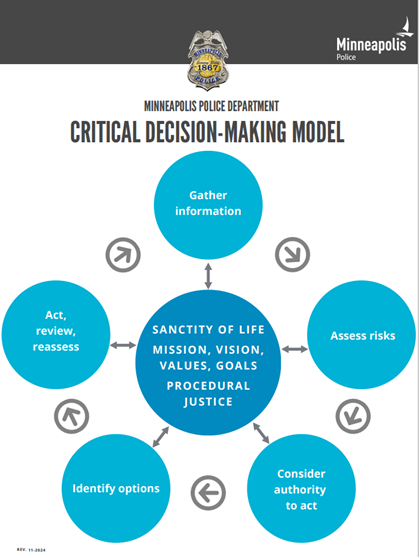
Introduction to the Concept
The critical decision-making model (CDM) outlines five steps that are part of the decision-making process and that are guided by a set of core values.
The CDM is simply a visual model that provides structure and vocabulary to help members better understand how they make decisions.
- The CDM is not a checklist or worksheet that members need to complete after calls or incidents. Members should see it as a visual reminder of the steps they naturally take to make decisions.
- The steps are circular, not linear, and are repeated or returned to as needed (see section [D] on spinning the model).
The Critical Decision-Making Model Core
The middle or “core” of the CDM represents the overall philosophy of the MPD and helps to guide the actions of members in all situations. These principles should be at the core of members’ considerations and decisions in each of the five steps.
The core of the CDM includes:
- Sanctity of Life (P&P 0-102).
- Mission, Vision, Values, Goals (P&P 0-102).
- Procedural Justice (P&P 5-109).
Steps of the Critical Decision-Making Model
Gather information
- Members will continually gather and process information as they apply each step of the CDM.
- Separating facts from assumptions is the foundation of effective decision-making.
- This includes assessment of the completeness, accuracy and credibility of information. Members should consider the information of this incident, information from previous incidents, and the sources of the information.
- Examples of questions members can ask themselves include:
- What is happening or has happened?
- What do my training and experience tell me about this incident?
- What additional information do I want or need?
Assess risks
- In assessing risk, the member should consider whether there is an immediate need to take action to address a threat of imminent harm (see P&P 7-804), or if the member can use de-escalation techniques and tactics to slow down and stabilize the situation (see P&P 7-802).
- Members should consider the potential risks of taking or not taking the action, including the likelihood and degree of risks to members, suspects or arrestees, victims, and the public.
- Members should consider whether the assessment of risk suggests additional resources may be necessary to assist in handling the situation.
- Examples of questions members can ask themselves include:
- What is the threat or risk?
- Is there an immediate need to take action?
- Is anyone in imminent danger of harm?
- If immediate action is not necessary, am I trained or equipped to handle the situation?
Consider authority to act
- Members must consider how applicable policies and laws authorize or restrict their actions, based on the totality of the circumstances (including the information they have gathered).
- Examples of questions members can ask themselves include:
- What is my legal authority to act?
- Does this situation require police action (by policy or law)?
- Are there policies that guide or restrict my response?
Identify options
- Members should identify what they are trying to achieve, and what options are available to best facilitate that outcome.
- Members should determine the best course of action, based on the assessment of risks and consideration of their authority to act. This includes considering whether tactical disengagement may be appropriate (P&P 7-802).
- Members should consider if they have enough information and resources and a need to act right away, or if getting more information and resources would produce a better outcome.
- Examples of questions members can ask themselves include:
- What am I trying to achieve?
- What options do I have?
- What option would have the greatest likelihood of success with the least potential for harm?
- Do I need to act now or should I wait?
Act, review, reassess
- Members should implement the option they determined to be the best course of action.
- After taking action, members should assess whether the action achieved the intended outcome and whether the action generated new information.
- Examples of questions members can ask themselves include:
- Did I achieve the desired outcome?
- Did the action generate new information, create new risks, or make new options available? (see section [D] on spinning the model)
- Is there anything more I need to do or consider?
Spinning the Model
Information collection is ongoing. As new information becomes available, members should “spin the model,” re-assessing the new information and fine-tuning their decision-making through the steps of the CDM.
7-802 De-Escalation
- Summary: Establishes protocols for setting up and managing SWAT command posts during critical incidents.
- Effective Date: 01-01-2026
- Last Review Date: 01-01-2026
Policy Change Notice:
MPD and its members shall uphold the sanctity of life (P&P 0-102 and P&P 5-301) by striving to protect and preserve human life in all situations and keep the community and MPD members safe from harm.
The purpose of this policy is to ensure that members use de-escalation techniques and tactics to reduce threats, gain people’s voluntary compliance, and safely resolve a situation. Using de-escalation techniques and tactics can reduce the need for force and allow members to provide for their own safety as well as the safety of the public.
Duty to De-escalate
- Sworn members have a clear affirmative duty to de-escalate and use de-escalation techniques and tactics whenever feasible, to minimize the need to use force, to resolve incidents without the use of force when possible, and to increase the likelihood of voluntary compliance with legitimate and lawful orders.
- Members shall respect the humanity, dignity, and civil rights of people, including community members and Department members, when using de-escalation techniques and tactics and when identifying the proper use of such techniques and tactics.
- Members' duty to de-escalate continues throughout the entire encounter.
- Encounters with vulnerable populations such as minors and people experiencing a crisis or a behavioral health challenge require a more nuanced and individualized response with particular emphasis on de-escalation techniques and tactics (P&P 5-301 and P&P 7-803), as such situations may be more unpredictable and a typical approach may not work or be appropriate.
Avoid Escalation and Unnecessary Risk
- Members shall not use tactics that unnecessarily escalate an encounter or create a need for force. Members shall use tactical positioning, other sound tactics and other available options during encounters to maximize the likelihood that they can safely control the situation.
- Members shall not use words or actions that a reasonable person would conclude are intended to incite or escalate reactive behavior. Prohibited conduct includes but is not limited to taunting people.
Procedures/Regulations
- As with all situations, members should implement the steps of the critical decision-making model to inform their actions (P&P 7-801).
- Members shall consider, based on their actual observations and the totality of the circumstances, whether the person’s lack of compliance is a deliberate attempt to resist or whether the person may be noncompliant due to factors such as:
- Mental health or medical conditions.
- Behavioral health challenges.
- Developmental or intellectual disabilities or conditions.
- Visual or hearing impairments.
- Language barriers.
- Drug or alcohol use.
- A crisis situation (P&P 7-803).
- Whether a person is acting out of fear.
The person may not comply with commands immediately, and members may need to try multiple times without resorting to force or the threat of force.
- The foundations of de-escalation are patience, flexibility, and the desire to resolve each situation peacefully. De-escalation techniques and tactics include, but are not limited to:
- Talking to the person using a tone of voice and language that is not aggressive or confrontational.
- Explaining the member’s actions and responding to questions (e.g., directly answering questions about why the police are there or taking action).
- Having one member take the lead in verbal communication.
- Giving clear commands to be followed and affording the person a reasonable opportunity to comply.
- Verbal persuasion such as explaining, without threats, how the person would benefit from cooperation.
- Providing warnings in an effort to reduce the intensity of a situation.
- Attempting to slow down or stabilize the situation.
- Using additional members, Behavioral Crisis Response (BCR), specially trained members or units (such as negotiators), and other resources to help minimize the overall force used and make more force options available (P&P 7-801 Critical Decision Making and P&P 7-803 Crisis Intervention).
- Delaying contact, delaying custody, planning to make contact or pursue enforcement at a different time or under different circumstances.
- Waiting out the person when there is no immediate need for enforcement action or escalation of the encounter.
- Considering tactical positioning to optimize the reactionary gap, including by using distance, cover or concealment.
- Placing barriers between the person and a member.
- Attempting to isolate the person and contain the scene.
- Physical disengagement.
- Tactical disengagement.
- Members may choose to tactically disengage to avoid resorting to physical force, if continued contact with a person may result in an unreasonable risk to the person, the public or members, consistent with the critical decision-making model (P&P 7-801).
- Members should make the decision to tactically disengage based on the information gathered, the risks assessed and the authority to act. The decision to tactically disengage must be based on the level of offense and risk to public safety.
- In crisis situations, members shall only tactically disengage in accordance with P&P 7-803, including the approval requirements in that policy.
De-Escalation Reporting Requirements
Any time a Use of Force details page is required for an incident, the member shall also complete the de-escalation section in the Use of Force details page (P&P 5-302) and shall document their de-escalation efforts in the Narrative Text.
7-803 Crisis Intervention
- Summary: Outlines procedures for safely and effectively responding to people in crisis using de-escalation, community resources, and alternatives to arrest.
- Effective Date: 06-10-2026
Policy Change Notice:
Purpose
People in crisis, including people who may be struggling with substance use, or people with mental health conditions, behavioral health challenges, or intellectual or developmental disabilities, may require tailored response and support.
MPD and its members shall uphold the sanctity of life (P&P 0-102) by striving to protect and preserve human life in all situations and keep the community and MPD members safe from harm.
The purpose of this policy is to provide all sworn members with clear and consistent policies and procedures to recognize signs of crisis and appropriately interact with people in crisis. These procedures foster:
- Improving the safety of people in crisis, members, and the Minneapolis community.
- Promoting community solutions to assist people in crisis.
- Using all available resources to reduce or avoid police-involved response to people in crisis, consistent with community safety.
- Working with mental health professionals and forming community partnerships to assist in crisis response.
- Minimizing law enforcement interactions with and arrests of people in crisis.
- Diverting people in crisis away from the criminal justice system.
- Using de-escalation techniques and tactics to achieve peaceful resolutions to incidents and eliminate unreasonable, unnecessary, and disproportional uses of force against people in crisis (P&P 5-301 and P&P 7-802).
Procedures/Regulations
To maximize the likelihood of positive outcomes in all situations members encounter, MPD has adopted the Critical Decision-Making Model (CDM). (P&P 7-801) Members responding to crisis situations should apply the following steps, which are encompassed in this policy’s procedures:
- Gather information.
- Assess risks.
- Consider authority to act.
- Identify options.
- Act, review, reassess.
The core of the CDM includes these principles:
- Sanctity of Life (P&P 0-102).
- Mission, Vision, Values, Goals (P&P 0-102).
- Procedural Justice (P&P 5-109).
These principles should be at the core of members’ considerations and decisions in each step.
Recognizing Crisis Situations
MPD strives to safely resolve issues for those experiencing a crisis or mental health issue. Mental health conditions are similar to physical health conditions in many ways, as both can have biological causes, be multifaceted and complex, and require support and treatment.
A person’s mental health can be impacted by various additional factors such as economics, cultural experiences, access to resources, etc.
Having mental health conditions, physical health conditions, neurological conditions or other similar conditions does not automatically mean the person is in crisis, and people often manage their symptoms.
Contributing factors
The following factors can contribute to a crisis. These are not exhaustive lists, and a diagnosis is not required for a crisis response.
- Substance misuse or abuse and related symptoms. Physical symptoms could include:
- Bloodshot, glassy or red eyes.
- Slurred, rapid or rambling speech.
- Unfocused or blurred vision.
- A sense of euphoria or depression.
- A heightened sense of visual, auditory and taste perception.
- A change in blood pressure or heart rate.
- Decreased coordination.
- Difficulty concentrating or remembering.
- Hallucinations or paranoia.
- Lack of inhibition.
- Physical, mental health and neurological conditions.
These include conditions such as:
- Autism spectrum.
- ADHD.
- Major depression.
- Acute anxiety.
- Bipolar.
- Schizophrenia.
- Post traumatic stress.
- Traumatic brain injuries.
- Medication side effects.
- Dementia or similar conditions.
- Sleep deprivation.
- Situational stressors.
These include stressors related to a person’s:
- Job or career.
- Relationships (break-up, death in the family, etc.).
- Financial situation.
- Lack of safe housing.
- Physical health.
- Previous traumatic experiences.
- Previous difficult or problematic experiences with police or other authority figures.
Effects of contributing factors
- Contributing factors can:
- Overlap or co-exist.
- Cause or worsen other factors.
- Be difficult to disentangle and treat, especially when more than one is present.
- Be magnified by a precipitating event.
- These factors can lead todifficulty regulating emotions, less clear or logical thinking, and difficulty responding appropriately to a situation. The person may feel completely overwhelmed and fall into a state of crisis.
Signs of a crisis
- A crisis could manifest as:
- Rapid changes in mood or emotions.
- Difficulty with concentration, memory, sleep or appetite.
- Heightened sensitivity (possibly described as “on edge”).
- Illogical thinking (ex. “If I hurt that person, I’ll be okay.”).
- Nervousness.
- Feeling disconnected, (from those around them or from reality).
- Signs of lack of self-control, which may include:
- Extreme agitation.
- Inability to sit still.
- Difficulty communicating effectively.
- Rambling incoherent thoughts and speech.
- Clutching oneself or objects to maintain control.
- Moving very rapidly.
- In accordance with P&P 2-503, members are prohibited from using “excited delirium” or similar terms to describe a person or their behavior in any manner or context.
Assessing risk
Examples of why risk assessments are important include:
- Most people in crisis are not violent, but under certain circumstances may present behavior that is dangerous to themselves, the public or to members.
- Some people looking to harm themselves may take actions, such as jumping into traffic, from a structure, or in front of a train, that can also cause harm to other people physically and psychologically.
- Jail does not generally help people with mental health conditions. Alternative response, community resources or transport holds may be more appropriate (see section [II-E] below).
Members should assess the potential danger to the person, the member, or others by usings indicators such as, but not limited to:
- The person’s access to weapons.
- The person’s statements or conduct that suggest the person will commit a violent or dangerous act.
- The person’s history, which may be known to the Department, the member, family, friends, or neighbors. This includes indications that the person lacks self-control, (such as over rage, anger, fright or agitation). This information may also come from the person’s public social media.
- The volatility of the environment.
- Agitators who may upset the person, create a combustible environment, or incite violence should be carefully noted, and separated from the person in crisis or otherwise controlled (when appropriate).
Crisis Intervention Response
People in crisis need support. MPD aims to provide the most appropriate response to support the person, which could include routing to community or health-based resources.
When responding to a crisis situation, members should make reasonable efforts to gather information to better understand the crisis and respond appropriately, such as:
- Past occurrences of this or other crisis-related situations.
- Information about the person, family, or support system that may aid in using de-escalation techniques and tactics and lead to effective resolution (such as the person’s preferences, strengths, and interests, factors that led to the crisis, and examples of past effective strategies with the person).
- Past incidents involving injury or harm to the person or others, including suicide risk.
- Information suggesting whether the person has failed to take prescribed medications.
- Indications of substance misuse or abuse, or related symptoms.
- Contact information for relatives, friends, or neighbors to assist members.
- Any other information that might assist in effectively assessing and peacefully resolving the situation using the least-intrusive measures.
Two-member response
When feasible, police response to a person in crisis call should have a two-member response.
Additional resources
If best to manage the response, members should consider requesting additional resources.
- If the situation does not involve a weapon or threat of violence, or if the member otherwise determines that a Behavioral Crisis Response team (BCR) response would be appropriate, members should request that BCR respond to the scene (see [II-K]).
- Members should consider requesting additional members as appropriate, however, members should be mindful that in some cases additional members could escalate the situation.
Be prepared for behavior changes
People affected by a behavioral health condition or crisis may rapidly change from being calm and responsive to physically active and agitated or non-responsive. This may result from an external trigger, such as hearing, “I have to handcuff you now,” or from internal stimuli, such as delusions or hallucinations.
- Members should be observant and prepared for a rapid change in behavior, however, such changes do not automatically indicate potential violence or threats.
Calm the situation
As emotions escalate, the ability to think rationally goes down. This applies to all people (including responding members) and is especially true for people in crisis.
When feasible (in accordance P&P 7-802 De-escalation), members shall take steps to calm a situation when responding to a person in crisis, including:
- Be aware of how noise or the chaotic nature of the scene (such as police radio volume, lights and sirens) may impact the person’s decision making, especially in incidents involving a heavy police presence.
- When feasible, members should attempt to remove things or people that appear to be upsetting the person or escalating the situation.
- When possible, avoid physical contact and continue to take time and assess the situation using the Critical Decision-Making Model (CDM) (P&P 7-801). In most cases, time and distance are allies and there is no need to rush or force the situation.
- Assume a quiet, non-threatening tone and manner while approaching or conversing with the person.
- Communicate clearly.
- Make every effort to speak slowly and calmly.
- Express concern for the person’s feelings and allow the person to share feelings without expressing judgment.
- Use active listening skills. For example: restating what the person says “what I hear you saying is…” or “If I understand you correctly…”.
- Consider how commands are given.
- Only one member should speak at a time when possible. Having one member or unit take the lead in verbal communication reduces the likelihood of overwhelming the person and can help avoid the potential for conflicting commands.
- Consider asking questions rather than issuing orders, such as “How can we help you?” or “Is there a family member or someone you trust that we can call?”.
- Keep commands simple and concrete.
- Consider rewording, varying or altering the commands. If the same command does not work the first few times (e.g., “get out of the car now”), it is unlikely to be successful, so consider varying it (e.g., “we want to ensure no one gets hurt so we need you to get out of the car”).
- When feasible, move slowly to avoid surprising, exciting or agitating the person. Whenever possible, members should inform the person of what they are going to do before doing it, unless unsafe to do so.
- Members should try to manage their own emotions and reactions to stay in control and think rationally. This can include focusing on slow breathing, using eye contact when talking and listening, and moving slowly.
- Provide reassurance that the police are on-scene to help.
- Members should not threaten the person with arrest or physical harm, as this may create additional fear, stress, and may unnecessarily escalate the situation.
- Members should avoid or steer the conversation away from topics that seem to agitate or stress the person.
- Members should avoid making promises that cannot be kept and should not validate or participate in a person’s delusion or hallucination.
Inform person of steps being taken
- When practical, members should inform the person and their family (if on-scene) of the steps being taken while assisting the person to a treatment facility, making referrals, or making an arrest, including providing information such as contact numbers and the reasons for the actions.
- When it is necessary to apply handcuffs (P&P 5-305), and when safe to do so, every effort should be made to explain why handcuffs are needed, and to explain the process. This can be a traumatic experience, and knowing in advance the reason why and what to expect can reduce trauma.
Offer resources
- Members shall offer appropriate care, assistance, and resources to the person. This could include calling BCR when appropriate (see [II-K]).
- Members shall provide the Community Resources List to the person in crisis or to supportive people who may be on-scene.
Minors in crisis
- Members responding to a call involving a minor in need of psychiatric care (whether or not the minor is under arrest- P&P 8-300) may contact the Hennepin County’s 24/7 Mobile Mental Health Child Crisis Services (612-348-2233) for assistance.
- In accordance with MN Statute section 260E.06, members shall report the incident to Child Protection Services Intake at 612-348-3552.
In crisis situations, members should consider whether continued contact with the person may cause unreasonable risk to the person, the public, or members. Members may choose to tactically disengage to avoid resorting to physical force, subject to these requirements:
- If the person in crisis is not posing a danger of harming themselves or others, members may tactically disengage without supervisor approval.
- If the person in crisis is only posing a danger of harming themselves and not others, members may tactically disengage when the danger of self-harm is no longer imminent and the person has not committed a serious or violent crime.
- Prior to tactically disengaging, members shall notify their supervisor and await their supervisor’s response to the scene.
- The notified supervisor shall respond to the scene and assess whether tactical disengagement is appropriate under the circumstances.
- When tactically disengaging, members should consider whether a non-law enforcement resource such as BCR ([II-K]) should be contacted to assist.
- The supervisor and involved members shall document the tactical disengagements, the reasons supporting it, and the supervisor approval, in a Police Report.
Non-engagement
- In limited circumstances, members may be aware of the identity and behavior of a person prior to contact, indicating the person is not currently a threat to others, and that police contact may only escalate the situation.
- In these circumstances, a supervisor may approve non-engagement. The supervisor shall report non-engagement decisions to the Watch Commander or Inspector of the affected precinct.
- For non-engagement, members should consider whether a non-law enforcement resource should be contacted to provide assistance, such as BCR ([II-K]).
- The supervisor and involved members shall document the non-engagement, the reasons supporting it, and the supervisor approval, in a Police Report.
Use of force in crisis situations
If force becomes necessary, members shall follow the force guiding principles in P&P 5-301, including the requirement that force shall be objectively reasonable, necessary and proportional.
In accordance with P&P 7-350, members are prohibited from suggesting or directing sedation to anyone, for any person, including any person who is acting agitated, disorganized, or behaving erratically.
Emergency Admission Procedures and Transport Holds
A transport hold is when a peace officer or health officer takes a person into custody and the person is transported to a hospital for emergency admission and held until they are evaluated, under the authority from MN Statute section 253B.051, Subd. 1. After the evaluation, the facility may release the person or place them under a 72-hour hold.
- A peace officer or health officer may take the person into custody and transport the person to a hospital, only if the officer has reason to believe that both of the following apply:
- The person is believed to have a mental health condition or developmental disability, or is believed to be chemically dependent or intoxicated in public.
and
- The person is in danger of harming self or others if not immediately detained.
- Members should consider their own observations first; however, the member or health officer does not need to directly observe the behavior or other facts justifying the transport hold and may consider information from reliable and reasonably trustworthy sources, when they have a credible reason to believe the information is true.
- The sources can be based on the statements of the person, witnesses, family members, or on the physical scene itself.
- Anonymous tips must be corroborated through direct observation or identifiable, reliable sources.
- Members should consider whether the person might be willing to voluntarily receive treatment.
- The member has the authority to sign a transport hold based on the factors above, but may also assist in executing a transport hold that is written by a health officer (on or off-site) and presented to the member. When a member responds to a health officer’s call to transport a person, the member should verify that the health officer is qualified under the statute to write a transport hold. If the member believes that enforcing the transport hold may result in an unreasonable risk to the person, the public or members, or that the required elements do not apply, they may decline with supervisor approval.
- The member shall complete the Application by Peace Officer for Emergency Evaluation Form (MP-9094), also known as the MPD “transport hold” form, when taking a person into custody under MN Statute section 253B.051 Subd. 1 and transporting the person to a hospital for evaluation.
- The form can be found on MPD’s internal site under Forms.
- The form can be completed online but must be printed for distribution.
- The member completing the form shall provide a copy of the completed form to all of the following:
- The hospital.
- The person taken into custody.
- The transporting agency, if the person is not transported by the member.
- The member’s statement shall specify the facts establishing the member’s belief that both required elements are applicable.
- Members shall use their precinct desk number as the contact phone number on the form.
Transportation for emergency admission
- People under a transport hold shall be taken to a hospital (e.g. HCMC, Fairview Riverside, NMMC or Abbott).
- All searches of a person in custody and transported shall be in accordance with the Search and Seizure policy (P&P 9-201).
- Whenever feasible, members should attempt to gather any critical medications to accompany the person to the hospital.
- If the person to be transported is a minor, members shall make a reasonable attempt to notify the parent or guardian as soon as practical (P&P 8-305).
- Members shall consider what the most appropriate method of transportation is, based on the situation.
- The order of preference should generally be:
- EMS.
- EMS is especially preferred for transportation of a minor in crisis.
- If the person is combative, members shall call EMS to make the transport and shall ride in the ambulance.
- If the person requires physical medical attention (P&P 7-350), or is unable to walk, members shall call EMS to make the transport.
- BCR, if appropriate for the circumstances.
- Unmarked and non-uniformed resources.
- Marked squad.
- Members should consider the person’s preference regarding method of transport, as long as it would not present a safety issue.
- MN Statute section 253B.051 Subd. 1(e) states that “as far as practicable, a peace officer who provides transportation for a person placed in a treatment facility, state-operated treatment program, or community-based treatment program under this subdivision must not be in uniform and must not use a vehicle visibly marked as a law enforcement vehicle.” If a transport is required and unmarked and non-uniformed resources are available, members should use those to make the transport.
- In the event a dispute arises regarding the MPD’s Transportation for Emergency Admission section, a supervisor will be called to the scene.
Handcuffing People in Crisis
- During crisis situations, members may only use handcuffs in accordance with P&P 5-305, and the use of handcuffs must be objectively reasonable, necessary and proportional. This includes when members are taking custody of the person solely for a transport hold.
- When feasible, prior to handcuffing, members should explain why the person will be handcuffed and the steps in the process (P&P 5-305). Explanations should be tactful and age-appropriate (P&P 8-100), and should also be given to parents or family members if present.
- If a person in crisis is handcuffed, members shall keep the person under close observation, and shall continue using de-escalation techniques and tactics as necessary.
Members should avoid citations and arrests for people in crisis when appropriate, and aim to help people in crisis and divert them from the criminal justice system.
Reporting Procedures
For person in crisis calls, members shall complete reports as follows:
Reporting transportation for emergency admission
- When a person is involuntarily transported under a transport hold, the transporting members shall complete a Police Report including the code ‘CIC’.
- When MPD is the primary responding agency and determines that a transport by ambulance is necessary (see section [II-E-2] above), the members shall complete a Police Report including the code ‘CIC’.
- Members should avoid references to the mental health of a person in any report synopsis available for public disclosure. Members shall document such information in the nonpublic narrative section.
- When MPD is not the primary responding agency, and the person is placed under a transport hold and is transported by ambulance (or means other than MPD), the members shall request that MECC change the nature code to ‘PIC’ prior to clearing the call.
- When members complete a transport hold requested by a health officer, the members shall upload the completed hold form to Evidence.com under the incident number and shall note the transport hold in added remarks in CAD.
Nature code
If an original incident (e.g. CKWEL, SUSPP, DIST) is later determined to involve a person in crisis, members shall request that MECC change the nature code to ‘PIC’ prior to clearing the call.
Crisis Intervention Data Collection form
When the nature code of a call is ‘PIC,’ the primary squad handling the call shall complete the Crisis Intervention Data Collection form in MDC prior to clearing. This form does not replace any required reports.
Early Release from a Transport Hold or 72-Hour Hold
If a treatment facility releases a person from a transport hold placed by members or a 72-hour hold placed by the treatment facility, before the hold period expires, members who receive the notification from the facility shall forward it to the precinct supervisor of the member who completed the transport hold. The supervisor shall review the case and make the determination regarding further actions.
Referral Options
Additional referral options for behavioral health and social service agencies, veteran and homeless resources, child and adolescent services, and hospital systems are provided on the MPD’s Sharepoint site under Crisis Intervention Resources.
Behavioral Crisis Response (BCR) Teams
MN Statute section 403.03 Subd. 1b requires that the 911 system include a referral to mental health crisis teams, where available.
BCR response
When on duty and when safe to do so, BCR teams will respond to 911 calls with a mental health component. Calls for service are reviewed by MECC and routed to BCR teams when appropriate. BCR does not have a crisis line; they are assigned calls by dispatch.
BCR transports
BCR teams can transport people on a voluntary basis only. They will not transport people who are placed on a transport hold.
Call types and screening
- When BCR teams are on duty, MECC screens calls to determine if BCR response is appropriate. Such calls will use the nature codes:
- BCR (Behavioral Crisis Response).
and
- BCRW (Behavioral Crisis Response Welfare).
- If a BCR team is not on duty or is unavailable to respond, or if the call changes to require sworn response, MECC will change to the appropriate MPD nature code (‘PIC,’ ‘CKWEL,’ etc.) and will dispatch a squad. BCR teams will defer to responding members’ instructions upon arrival.
- In accordance with MECC protocol, a sworn member must be dispatched to incidents involving a person in crisis who is believed to have a mental health condition, behavioral health challenges, or an intellectual or developmental disability, in the following situations:
- Firearms(s) or access to firearm(s) involved.
- Weapons(s) currently in their possession or threatening the use of weapon(s).
- Physical violence has occurred or threats of physical violence toward others.
- When life threatening injury has occurred (example: someone has ingested pills, taken more than prescribed medication, alcohol, etc.).
- Situations involving physical intervention to secure safety (e.g. someone on a bridge or ledge).
- When a BCR team is on-site and determines that the scene is unsafe.
7-804 Evaluating and Responding to High-Risk Situations
- Summary: Establishes a decision-making framework to assess threats and guide tactical, team-based responses that prioritize de-escalation and safety.
- Effective Date: 01-01-2026
- Last Review Date: 01-01-2026
Policy Change Notice:
Purpose
The purpose of this policy is to establish a standardized decision-making framework that guides members in evaluating and responding to high-risk situations.
By training all members to this standardized process, the MPD seeks to instill the principles of critical thinking, the Duty to De-escalate (P&P 7-802), the principle of Avoiding Escalation and Unnecessary Risk (P&P 7-802), and the pursuit of the Department’s Mission, Vision, Values and Goals (P&P 0-102).
High-Risk Threat Response
Members (including non-tactical members involved in initial response) can apply the critical decision-making model (CDM) (P&P 7-801) and can generally use the following strategies in addressing high-risk threats.
High-Risk Threat Assessment
The purpose of a high-risk threat assessment is to evaluate the nature of a volatile and potentially dangerous situation and determine the best course of action to uphold the sanctity of life.
The following categories can be generally used to evaluate the urgency of action in addressing threats:
Isolated
A threat is isolated when the person or people who pose a threat of harm are known to be alone and do not currently pose an imminent threat to the public.
Developing
A threat is developing when the person or people who pose a threat of harm are in the presence of others, and there is a potential risk of imminent harm to those nearby.
Immediate
A threat is immediate when actions of a person or people create a threat of imminent harm to others. An immediate threat requires action by members without delay.
Resource Organization
After assessing the threat, members should consider the following tactics or actions:
- Creating or strengthening the perimeter of the incident to further isolate the person or people posing a threat.
- Identifying safe routes for moving resources to and from the scene.
- Evacuating the surrounding area of people who might be in danger, to the extent reasonably possible.
- Maintaining clear communication:
- Between members.
- With any additional resources on scene.
- With the person or people posing a threat, when appropriate.
Building teams
As resources arrive or become available, teams should be organized to handle a variety of tasks and functions. Teams should be formed to prepare for addressing the different categories of potential threats, including but not limited to:
- Immediate response teams.
- Perimeter teams.
- Evacuation teams.
Task organization
When establishing teams, functions should be assigned to account for actions and capabilities that may be needed to address the threat categories. These functions may include:
- Primary communicator.
- Arrest and control.
- Intermediate weapons (P&P 5-300).
- Ballistic shields.
- Breaching tools.
- Lethal cover.
Additional support resources
Members should stage Emergency Medical Services (EMS).
Members should also consider whether resources such as the following may be necessary and should be requested:
- UAS (drones) (P&P 4-226).
- Air support (State Patrol helicopter).
- Crisis negotiator.
Contingency Planning
Members should develop plans that account for a variety of behaviors or actions by the person or people posing a threat.
These contingencies may include the following:
- Compliance.
- Fleeing.
- Opposition.
- Barricade.
- Rescue.
7-805 Crowd Management
- Effective Date: 01-01-2026
- Last Review Date: 01-05-2023
Purpose
- The First Amendment to the Constitution of the United States of America states, "Congress shall make no law respecting an establishment of religion, or prohibiting the free exercise thereof, or abridging the freedom of speech or of the press, or the right of the people peaceably to assemble and to petition the Government for a redress of grievances."
- The Bill of Rights in Article 1 of the Minnesota Constitution addresses the rights of free speech and the liberty of the press. However, neither the state nor federal constitutions protect criminal activity or threats against citizens, businesses, or critical infrastructure.
- The Minneapolis Police Department supports all people's fundamental right to peaceably assemble and their right to freedom of speech and expression.
- The purpose of this policy is to provide guidelines to MPD employees regarding the application and operation of law enforcement actions during public assemblies and First Amendment Activity.
Policy
Facilitating Exercise of Rights
- MPD employees shall not unlawfully interfere with people engaged in the lawful exercise of their rights.
- The MPD will uphold the constitutional rights of free speech and assembly while using the minimum amount of physical force and authority required to address a crowd management or crowd control issue.
- The policy of the MPD regarding crowd management and crowd control is to apply the appropriate level of direction and control to protect life, property, and vital facilities while maintaining public peace and order during a public assembly or First Amendment activity.
Policy Application
This policy concerning crowd management, crowd control, crowd dispersal, and police responses to violence and disorder applies to:
- Spontaneous demonstrations,
- Spontaneous crowd event situations, and
- Planned demonstration or crowd events regardless of the permit status of the event.
Use of Force
- Nothing in this policy prohibits officers’ abilities to use appropriate force options to defend themselves or others as defined in P&P 5-300.
- Use of any crowd control weapons shall be reported and reviewed in accordance with the sections on Force Reporting and Supervisor Force Reviews in P&P 5-301.
Supervisor Responsibility for Oversight
Supervisors shall be responsible for:
- Ensuring that officers assigned launchers or munitions have completed relevant training and certification as applicable.
- Describing to on-scene officers the rules of engagement for the deployment of munitions, including a review of the applicable use-of-force policy sections.
- Maintaining responsibility for the munitions issued and deployed.
- Ensuring appropriate radio notification of deployments where practical and ensuring subsequent reporting.
- Ensuring officers complete proper written documentation for the deployment of less-lethal weapons after deploying such tools.
Incident Commander
In some cases, the Incident Commander role in this policy may be the same person as the on-scene supervisor.
Annual Policy Review
This policy is to be reviewed annually.
Procedures/Regulations
Uniform
- All officers responding to public assemblies shall at all times, including when wearing protective gear, display their agency name and a unique personal identifier in accordance with P&P 3-100.
- The Chief or the Chief’s designee shall maintain a record of any officer at the scene who are not in compliance with this requirement due to exigent circumstances.
Officer conduct
- Officers shall maintain professional demeanor and remain neutral in word and deed despite unlawful or anti-social behavior on the part of crowd members.
- Verbal abuse against officers does not constitute a reason for an arrest or for any use of force against such individuals.
- Officers shall not take action or fail to take action based on the opinions being expressed.
- Officers shall not interfere with the rights of members of the public to observe and document police conduct via video, photographs, or other methods unless doing so interferes with on-going police activity (P&P 9-202).
- Officers shall not use a weapon or munition unless the officer has been trained in the use and qualified in deployment of the weapon/munition (P&P 5-302).
- This policy does not preclude officers from taking appropriate action to direct crowd and vehicular movement; enforce ordinances and statutes; and to maintain the safety of the crowd, the general public, law enforcement personnel, and emergency personnel.
Responses to Crowd Situations
Spontaneous disturbances
Officers responding to large-scale disturbances, or those that are likely to become violent, shall notify their supervisor. The responding supervisor shall assume the role of Incident Commander and determine the need for additional assistance, equipment, and tactics to be used.
- The Incident Commander shall inform the Watch Commander, who shall contact MECC with information of the situation. MECC shall contact the Chief of Police and the appropriate Bureau Head, with information of the situation.
- The first level of additional assistance shall be precinct officers and designated response cars. The Incident Commander shall establish a field command post with a designated staging area. The Incident Commander shall designate officers for security details for police vehicles and equipment.
- The Incident Commander may request the activation of the SWAT team to provide additional demonstration management resources. Upon activation, the SWAT team will be deployed and directed by the SWAT Lieutenant in consultation with the Incident Commander.
- The Incident Commander shall be in charge of the incident as a whole, however, the SWAT Lieutenant shall direct the specific actions of SWAT members once they have been activated, consistent with the mission outlined by the Incident Commander.
Lawful assembly
Individuals or groups present on the public way, such as public facilities, streets or walkways, generally have the right to assemble, rally, demonstrate, protest, or otherwise express their views and opinions through varying forms of communication including the distribution of printed matter. These rights may be limited by laws or ordinances regulating such matters as the obstruction of individual or vehicle access or egress, trespass, noise, picketing, distribution of handbills, leafleting and loitering.
Unlawful assembly
- The mere failure to obtain a permit, such as a parade permit or sound permit, is not a sufficient basis to declare an unlawful assembly.
- The fact that some of the demonstrators or organizing groups have engaged in violent or unlawful acts on prior occasions or demonstrations is not grounds for declaring an assembly unlawful.
- Whenever possible, the unlawful behavior of a few participants shall not result in the time, place or manner of expression being impacted for majority of peaceful protestors, unless other participants or officers are threatened with dangerous circumstances.
- Unless emergency or dangerous circumstances prevent negotiation, crowd dispersal techniques shall not be initiated until after attempts have been made through contacts with the police liaisons and demonstration or crowd event leaders to negotiate a resolution of the situation so that the unlawful activity will cease, and the First Amendment activity can continue.
Declaration of Unlawful Assembly
- If the Incident Commander has declared an unlawful assembly, the reasons for the declaration and the names of the decision maker(s) shall be recorded.
- The declaration and dispersal order shall be announced to the assembly.
- The name(s) of the officers announcing the declaration should be recorded, with the time(s) and date(s) documented.
- The dispersal order shall include:
- Name, rank of person, and agency giving the order.
- Declaration of Unlawful Assembly and reason(s) for declaration.
- A minimum of two egress routes that may be used.
- Specific consequences of failure to comply with dispersal order.
- How long the group has to comply.
- Whenever possible, dispersal orders should also be given in other languages that are appropriate for the audience. Officers shall recognize that not all crowd members may be fluent in the language(s) used in the dispersal order.
- Dispersal announcements shall be made in a manner that will ensure that they are audible over a sufficient area.
- Dispersal announcements shall be made from different locations when the demonstration is large and noisy.
- The dispersal announcements should be repeated after commencement of the dispersal operation so that people not present at the original broadcast will understand that they must leave the area.
Crowd Dispersal
- Crowd dispersal techniques should not be initiated until officers have made repeated announcements to the crowd, or are aware that repeated announcements have been made, asking members of the crowd to voluntarily disperse and informing them that, if they do not disperse, they will be subject to arrest.
- Unless an immediate risk to public safety exists or significant property damage is occurring, sufficient time will be allowed for a crowd to comply with officer commands before action is taken.
- If negotiations and verbal announcements to disperse do not result in voluntary movement of the crowd, officers may employ additional crowd dispersal tactics, but only after orders from the Incident Commander, and by using the minimum amount of physical force and authority needed to address the issue.
- If, after a crowd disperses pursuant to a declaration of unlawful assembly and subsequently participants assemble at a different geographic location where the participants are engaged in non-violent and lawful First Amendment activity, such an assembly cannot be dispersed unless it has been determined that it is an unlawful assembly, and a new declaration of unlawful assembly has been made.
Authorization for Crowd Control Weapon Use
- Except as provided in [E] below, during civil disturbances or assemblies (as defined in this policy), authorization for use of crowd control weapons shall only come from the Chief of Police, or if the Chief is unavailable, the Chief's designee at the rank of Deputy Chief or above.
- Such authorization shall be given over the police radio via radio transmission to personnel on scene, whenever possible.
- The Incident Commander shall ensure that any authorization for crowd control weapons (which must come from the Chief of Police or if the Chief is unavailable, the Chief’s designee at the rank of Deputy Chief or above) is documented in the Police Report, including the person who authorized the use of crowd control weapons. MPD shall retain such documentation for a period of not less than seven years.
- Sworn MPD employees shall not use crowd-control weapons in a civil disturbance or an assembly until they have been authorized under this policy, unless there is an immediate need to protect oneself or another from objectively imminent physical harm, as detailed in [E] below.
- Crowd control weapons shall not be authorized for peaceful gatherings or assemblies (such as peaceful protests and demonstrations).
- In situations not involving civil disturbances or assemblies, the use of weapons listed in this policy shall be in accordance with the other sections in P&P 5-300 specific to those weapons.
Objectively Imminent Physical Harm to Oneself or Another
- If there is an immediate need to protect oneself or another from objectively imminent physical harm and crowd control weapons have not been authorized under [D] above:
- Crowd control weapons, excluding chemical munitions, smoke munitions and light sound distraction devices, may be used without prior authorization in order to stop the assaultive conduct or act of violence.
- In these circumstances, crowd control weapons may only be used against specific people who are posing a threat of objectively imminent physical harm to another person.
- Chemical munitions, smoke munitions and light sound distraction devices may not be used in these circumstances.
- The sworn officer using crowd control weapons under such circumstances must notify their supervisor of the use of crowd control weapons as soon as it is safe to do so.
- The supervisor shall notify the Incident Commander or Watch Commander as soon as it is safe to do so.
- Any sworn officer who uses crowd control weapons under this section (against specific people in an assembly without prior authorization) shall document and detail in the Police Report the specific circumstances establishing that there was an immediate need to protect themselves or another from objectively imminent physical harm. MPD shall retain such documentation for a period of not less than seven years.
- The Incident Commander or Watch Commander who is notified shall email a brief notification before the end of their shift that an officer used crowd control weapons without prior authorization, including the case number and circumstances establishing the need to use the weapon, to the Chief of Police, Assistant Chief, Deputy Chiefs, and the Commander of Internal Affairs, for further review and handling.
Crowd Control and Crowd Dispersal Tactics
Crowd control weapons may only be authorized and used during civil disturbances and assemblies in accordance with P&P 5-300 and the conditions set forth in this policy, including the authorization requirements in section [D].
Canine use prohibited
Canines shall not be used for crowd control, crowd containment, or crowd dispersal.
Fire hoses prohibited
Fire hoses shall not be used for crowd control, crowd containment, or crowd dispersal.
FSDDs prohibited
FSDDs (also known as “flash-bangs”) shall not be used for crowd control, crowd containment, or crowd dispersal.
Electronic Control Weapons (ECWs) prohibited
Electronic Control Weapons (ECWs) shall not be used for crowd control, crowd containment, or crowd dispersal. This provision does not limit the use of ECWs under the conditions of [E] regarding objectively imminent physical harm.
Vehicles
- Motorcycles and police vehicles shall not be used for crowd dispersal.
- Vehicles may be used for purposes of observation, visible deterrence, traffic control, transportation, and area control during a crowd event.
Bicycles
- Bicycles may be used to control and move people as appropriate. Bicycles may be authorized for crowd escorts by the Incident Commander.
- Strikes with bicycles and other uses of a bicycle as a weapon shall follow the policies and procedures for impact weapon use.
Horses
- When authorized by the Incident Commander, horses may be used to contain, control, and direct groups in nonviolent demonstrations as appropriate.
- Horses shall not be used against passively resistant demonstrators, including those who are sitting or lying down.
- Unless exigent circumstances exist, horses should not be used when chemical agents are used or use is anticipated, or in icy or snowy conditions or when similar lack of footing may jeopardize the animal, rider, or others.
Munitions and 40mm Launchers
40mm launchers
In accordance with the section on 40mm launchers in P&P 5-302, during civil disturbances or assemblies:
Carrying 40mm launchers
Only officers working in a certified SWAT capacity shall carry 40mm launchers, unless authorization is given by the Chief of Police, or when the Chief is unavailable, the Chief’s designee at the rank of Deputy Chief or above, for other officers who have been trained in the use of 40mm launchers to carry them.
Coordination of 40mm launcher use
Once use of 40mm launchers is authorized in accordance with section [D], and the SWAT supervisor is on scene, the supervisor shall coordinate all use of 40mm launchers on scene, including by any officers who were authorized to carry prior to the SWAT supervisor’s arrival. Nothing in this provision limits the use of 40mm launchers authorized by section [E] regarding objectively imminent physical harm.
Less-lethal impact munitions
Use of less-lethal impact munitions
- Less-lethal impact fired munitions shall never be used indiscriminately against a crowd or group of people.
- Less-lethal impact munitions shall be used only against a specific individual who is engaging in conduct that poses an immediate threat of objectively imminent physical harm (as covered by section [E]).
- When circumstances permit, the Incident Commander shall make an attempt to accomplish the policing goal without the use of less-lethal impact munitions as described above, and, if practical, an audible warning shall be given to the subject before use of the weapon.
Areas to avoid targeting
In accordance with the P&P 5-302, officers shall intentionally not discharge less-lethal impact munitions at a person’s head, neck, throat, face, armpit, spine, kidneys, or groin unless deadly force would be justified.
Chemical munitions
Sufficient egress
Chemical munitions may not be used unless sufficient egress exists to safely allow the crowd to disperse.
Prohibition on CN chemical munitions
CN chemical munitions are prohibited.
Announcements and area notifications
- When feasible, additional announcements warning of the imminent use of chemical munition should be made prior to the use of chemical munitions in a crowd situation.
- Where extensive use of chemical munitions would reasonably be anticipated to impact nearby residents or businesses, the MPD should consider proactively notifying impacted individuals of safety information related to the munitions use as soon as possible, even if after the event.
Emergency medical services available
When chemical munitions are used, emergency medical services will be on standby at a safe distance near the target area when feasible.
Documenting chemical munition use
In addition to the use of force and de-escalation documentation requirements in P&P 5-301, the following information shall be documented for all chemical munition use:
- The name of each chemical munition used in an incident.
- The location and time of use for each munition use (as accurately as possible).
Safety data sheet
The safety data sheet (SDS) shall be saved and maintained for all chemical munitions used by the MPD.
Impact weapons
Display of batons or riot sticks
Batons and riot sticks may be visibly displayed and held in a ready position during squad or platoon formations.
Crowd movement
Impact weapons (such as batons, riot sticks and riot shields) may be used as tools for crowd escorts when authorized by the Incident Commander.
Use of impact weapons
- Impact weapon strikes shall not be used indiscriminately against a crowd or group of people, but only against specific individuals who are physically aggressive or actively resisting arrest.
- Impact weapon strikes should not be used in a crowd control situation against an individual who is attempting to comply but is physically unable to disperse or move because of the press of the crowd or some other fixed obstacle.
Areas to avoid targeting
Officers shall not strike a person with any baton to the head, neck, throat, kidneys, spine, or groin, or strike with force to the armpit unless the person has created an imminent threat of great bodily harm to another.
Use against a person in handcuffs
Impact weapons shall not be used against a person who is handcuffed except when permissible under P&P 5-300 and state law.
Aerosol hand-held chemical agents
Use of aerosol hand-held chemical agents
- Aerosol hand-held chemical agents shall only be used against specific individuals who are engaged in conduct that poses an immediate threat of objectively imminent physical harm. Aerosol, hand-held, pressurized, containerized chemical agents that emit a stream shall not be used indiscriminately for crowd management, crowd control, or crowd dispersal.
- Officers shall use the minimum amount of the chemical agent necessary to overcome the subject's resistance.
Subject exposure treatment
- When possible, people should be removed quickly from any area where hand-held chemical agents have been used. Officers shall monitor the subject and pay particular attention to the subject’s ability to breathe following the application of a chemical agent.
- A subject who has been sprayed with a hand-held chemical agent shall not be left lying on their stomach once handcuffed or while restrained with any device.
Arrests
Encircle crowd
If the crowd has failed to disperse after the required announcements and sufficient time to disperse, officers may encircle the crowd or a portion of the crowd to make multiple simultaneous arrests.
People seeking to be arrested
- People who make it clear (e.g., by non-violent civil disobedience) that they seek to be arrested may be arrested and shall not be subjected to other dispersal techniques, such as the use of impact weapons or chemical agents.
- People refusing to comply with arrest procedures may be subject to the reasonable use of force.
Arrests of non-violent people
Arrests of non-violent people shall be accomplished by verbal commands and persuasion, handcuffing, lifting, carrying, the use of dollies and/or stretchers, and/or the use of soft empty hand control holds.
Arrestee injuries
- Officers shall document any injuries reported by an arrestee, in accordance with P&P 5-301.
- As soon as practical, officers shall obtain professional medical treatment for the arrestee, in accordance with P&P 5-301 and P&P 7-350.
Juvenile arrests
Juveniles arrested in demonstrations shall be handled consistent with MPD policy on arrest, transportation, and detention of juveniles (P&P 8-300).
Arrests of people with disabilities and Limited English Proficiency
- Officers arresting a person with a disability affecting mobility or communication shall follow the MPD policy on arrest, transportation, and detention of people with disabilities (P&P 5-602 and P&P 5-603).
- Officers shall follow P&P 5-601 for providing services to people who are Limited English Proficiency.
Handcuffing arrestees
Handcuff policies
All people subject to arrest during a demonstration or crowd event shall be handcuffed in accordance with MPD policy, orders, and training bulletins (including P&P 5-301, P&P 5-302 and P&P 9-109).
Flex-cuffs
- Officers should be cognizant that flex-cuffs may tighten when arrestees hands swell or move, sometimes simply in response to pain from the cuffs themselves.
- When an arrestee complains of pain from overly tight flex cuffs, officers shall examine the cuffs and ensure proper fit.
- Arrestees in flex-cuffs shall be monitored to prevent injury.
- Each unit involved in detention or transportation of arrestees with flex-cuffs should have a flex-cuff cutter and adequate supplies of extra flex-cuffs readily available.
News Media.
News media have a First Amendment right to cover public activity, including the right to record video or film, livestream, photograph, or use other mediums.
- News media shall not be restricted to an identified area, and shall be permitted to observe and shall be permitted close enough access to view the crowd event and any arrests. An on-scene supervisor or the Incident Commander may identify an area where media may choose to assemble.
- Officers shall not arrest members of news media unless they are physically obstructing lawful efforts to disperse the crowd, or efforts to arrest participants, or engaged in criminal activity.
- News media shall not be targeted for dispersal or enforcement action because of their media status.
- Even after a dispersal order has been given, clearly identified news media shall be permitted to carry out their professional duties unless their presence would unduly interfere with the enforcement action.
Legal Observers
- Legal observers, including unaffiliated self-identified legal observers and crowd monitors, do not have the same legal status as news media, and are subject to laws and orders similar to any other person or citizen.
- Legal observers and monitors must comply with all dispersal orders unless an on-scene supervisor or the Incident Commander chooses to allow such legal observers and monitors to remain in an area after a dispersal order.
- Legal observers and crowd monitors shall not be targeted for dispersal or enforcement action because of their status.
Documentation of Public Assembly and First Amendment Activity
- Public assembly or first amendment activity shall not be visually documented, except under the following circumstances:
- Documentation of the event for the purposes of debriefing,
- Documentation to establish a visual record for the purposes of responding to citizen complaints or legal challenges (including through required BWC or MVR activations in accordance with P&P 4-223 and P&P 4-218), or
- Creating visual records for training purposes.
- When authorized under MN Statute section 626.19 Subd. 4 regarding UAV use.
- Any authorized video or photo documentation shall be done in a manner that minimizes interference with people lawfully participating in First Amendment activities.
- Videotaping and photographing of First Amendment activities shall take place only when authorized by an on-scene supervisor or the Incident Commander.
- Individuals should not be singled out for photographing or recording simply because they appear to be leaders, organizers, or speakers.
- Unless evidence of criminal activity is provided, videos or photographs of demonstrations shall not be disseminated to other government agencies, including federal, state, and local law enforcement agencies. If videos or photographs are disseminated or shared with another law enforcement agency, a record should be created and maintained noting the date and recipient of the information.
- If there are no pending criminal prosecutions arising from the demonstration or if the video recording or photographing is not relevant to an Internal Affairs or citizen complaint investigation or proceedings or to civil litigation arising from police conduct at the demonstration, the video recording and photographs shall be destroyed in accordance with MPD policies, City Retention Guidelines and State law.
- This policy shall not prohibit employees from using these videos or footage from such videos as part of training materials for officers in crowd control and crowd dispersal techniques and procedures.
Training
Initial and ongoing training
- All officers should receive yearly training on appropriate responses to crowd control and crowd management.
- Officers assigned to specialty units that respond to crowd control situations should receive additional training on appropriate responses to crowd control and crowd management, in addition to the yearly department-wide training.
Joint training
Joint training should also be conducted with all agencies who are involved in crowd management activities.
Less-lethal 40mm launcher and munition training
- The MPD shall ensure that officers assigned the weapons or munition have completed relevant training and certification as applicable, ideally well in advance of an incident.
- The training shall describe the rules of engagement for the deployment of munitions, including a review of the applicable use-of-force policy sections.
7-806 Reserved for Future Use
- Effective Date: 01-01-2026
- Last Review Date: 01-01-2026
7-807 Authorized Use of Canines
- Summary: This policy governs the ethical and controlled use of MPD canines, outlining permissible deployments, safety protocols, and handler responsibilities.
- Effective Date: 01-01-2026
- Last Review Date: 01-01-2026
Purpose
Police canines are valuable assets to the MPD because of canines’ superior sense of smell, hearing, agility and loyalty. Use of canines requires adherence to procedures that properly control their use and to channel their specialized capabilities into legal and ethical law enforcement tools.
Policy
Sole Responsibility of Handler
The Canine Handler shall be solely responsible for the best practical application and deployment of their dog in all instances.
Report to Ranking Officer at the Scene
- During operational deployment, the assigned canine handler will report to the ranking officer at the scene.
- The canine sergeants and canine officers are all active canine handlers.
Permissible Uses
Department canines may be used for the following situations, when the associated conditions in this policy are met:
- Searching for or apprehending suspects.
- Locating missing or lost persons.
- Searching for explosives, narcotics or other evidence.
- Security of MPD and City equipment and property.
- Public relations demonstrations, with the prior approval of the Canine unit supervisor.
Prohibited Uses
Department canines shall not be used for any of the following purposes:
- Crowd control purposes at protests or demonstrations.
- Searching for animals.
- Punitive purposes against suspects.
- For off-duty employment (in accordance with P&P 3-800).
Dangerous Situations
Canines should not be put in dangerous situations needlessly.
Procedures/Regulations
Searching For or Apprehending Suspects
- Department canines may be used to search for or apprehend a suspect if:
- The canine handler reasonably believes that the individual has either committed or is about to commit a serious offense, and
- Any of the following conditions exist:
- There is a reasonable belief that the individual poses an immediate threat of violence or serious harm to the public, any officer, or the handler.
- The individual is physically resisting arrest or attempting to evade arrest and the use of a canine is reasonably necessary force under the circumstances to overcome such resistance or prevent the escape of the suspect.
- The individual is believed to be concealed in an area where entry by other than the canine would pose a threat to the safety of officers or the public.
- When canines are used for apprehensions, handlers shall disengage their canines as soon as reasonably possible after the suspect is able to be controlled or secured.
Warnings
- If feasible, a verbal warning shall be given loud enough to be reasonably heard by the suspect or other persons prior to any deployment of a police canine. This warning shall include all of the following:
- The identification of the MPD.
- That the canine is being released.
- That the subject is under arrest.
- That the subject may be bitten by the canine.
- Circumstances may arise that make it unsafe for a canine handler to give a verbal warning if the handler’s safety or the safety of another is jeopardized.
Injuries and Apprehensions
Injuries by a canine
- In accordance with P&P 5-301 and P&P 5-311, officers are responsible for ensuring any person injured by an MPD canine receives medical treatment as soon as reasonably possible.
- Officers shall request an ambulance to the scene whenever a person is apprehended by a canine.
- Canine handlers shall photograph all injuries and ensure the images are uploaded in accordance with P&P 10-400.
Notify Sergeants of apprehension
The canine handler shall notify the Canine Sergeants immediately after any canine apprehension or accidental bite.
- Officers will be debriefed by canine unit supervisors and trainers as soon as possible following notification.
- If a Canine Sergeant is not available, another MPD sergeant may be asked to do the force review.
Review form
Upon notification of a bite or apprehension, a Canine Sergeant will complete the K-9 Unit Apprehension Review form (MP-9090) and will send it electronically to the members of the review panel.
Injuries to a handler or canine
- The handler shall notify a Canine Sergeant immediately if the handler or canine suffers a serious injury requiring immediate treatment.
- If a canine is injured in the Line of Duty, the handler shall complete a report using the code K9ASLT.
Handler unable to command canine
All officers shall consider the following course of action in the event a handler is injured and unable to command their canine:
- Request another Canine Handler or Canine Sergeant to the scene, or
- Place the Canine Officer’s squad car near the injured Officer, and:
- Command the Canine to “kennel,” or
- Lure the canine into the back of the squad with one of the Canine toys in squad car such as a Kong, Tug Toy or Bite Sleeve commonly stored in the rear of the Canine squad car.
Building Searches
- Using a canine to search a structure minimizes risk to officers. Regular patrol units should not search a structure if a canine unit is responding.
- In addition to the other conditions in this policy, the following requirements apply to building searches for a suspect:
- Before the canine is deployed, the handler will attempt to ensure the area is clear of civilians and police personnel.
- Canine handlers shall give verbal warnings inside a building prior to deployment, if tactically feasible.
- Canine handlers shall repeat warnings in large or multi-level buildings as necessary and as feasible.
- Canine handlers shall not routinely search buildings on alarm calls where there is no evidence of forced entry. If officers determine a canine search is necessary, the canine should remain on a lead.
Area Searches
In addition to the other conditions in this policy, the following requirements apply to area searches for a suspect:
- If a suspect has fled and is to be tracked using a canine:
- Personnel at the scene shall secure the scene until the arrival of the canine team.
- All personnel shall stay clear of the area where the suspect was last seen.
- While the canine is being used, all personnel except those assigned to assist the handler shall stay away from the handler and the canine. Personnel shall not do things that will distract the canine.
- The canine shall remain on a long lead during area searches, whenever it is reasonable and does not jeopardize officer safety.
Narcotics Searches
- Officers must have a reasonable, articulable suspicion that narcotics are involved before conducting a narcotics search using a canine. Random narcotics searches are prohibited.
- Any MPD canine used for narcotics detection shall have completed the MPD Canine Narcotics Detection Training Course.
- Any MPD canine used for narcotics detection shall be narcotics certified by the approved certifying entity.
- The canine handler shall complete a statement about the search in the offense report any time narcotics are located by a canine.
Explosives Searches
- Any MPD canine used for explosives detection shall have completed the MPD Canine Explosives Detection Training Course.
- Any MPD canine used for explosives detection shall be explosives certified by the approved certifying entity.
- In the event of a bomb threat, the procedures in P&P 7-800 shall be followed.
- If a canine is used for an explosives search, the handler will determine the most practical way to proceed.
- The MPD Bomb Squad shall be called if a suspicious device is found. A canine will not be used if a suspicious device is found, unless requested by the Bomb Squad.
Searching For Lost or Missing Persons
- Canines may be used to track or search for non-suspects, including but not limited to, lost children, missing persons, or individuals who may be disoriented or in need of medical attention. The canine handler shall determine the canine’s suitability for such assignments based on the conditions and on the abilities of the canine.
- In addition to the other conditions in this policy, the following requirements apply to searching for or tracking non-suspects:
- Absent a change in circumstances that presents an immediate threat to officers, the canine or the public, such deployments shall be conducted on-lead or under conditions that minimize the likelihood the canine will bite or otherwise injure the individual, once located.
- Throughout the deployment, the handler should periodically give verbal assurances that the canine will not hurt or bite the individual and should encourage the individual to make themselves known.
Canine Handler Duties and Responsibilities
- The canine handler shall be responsible for the best practical application and deployment of their dog in all instances.
- When a canine is not involved in a police function, the handler shall secure the dog in the police vehicle.
- Canine handlers shall keep their canine secure while inside of their vehicle.
- The emergency alarm temperature monitoring system shall be activated at all times during their shift.
- Handlers shall not allow the kennel divider between the rear cage and front seat of the squad to be open, while the vehicle is occupied by a canine.
- Canine vehicles shall not be used to detain, interview or transport suspects or arrestees without the prior approval of a supervisor. Canine vehicles should not be used to transport witnesses or injured persons unless emergency circumstances exist.
- The canine will be kept on a lead in areas where the public has ready access, unless the dog is being used for a specific police purpose.
- The handler shall notify a Canine Sergeant immediately if they are ordered to perform in a way that may be contrary to policy or to unit training.
- The handler is responsible for the health, care and feeding of their canine. The handler shall not permit anyone other than the handler, their immediate family or authorized personnel to care for or feed the canine.
Canine Sergeant Duties and Responsibilities
- The Canine Sergeant shall immediately remove a canine team from service that fails to certify through the approved certifying entity’s regional field trial, and shall ensure the team demonstrates competence prior to returning to service.
- Canine Sergeants have the authority to remove any Canine Team from service immediately if the supervisors determine the canine team does not perform satisfactorily. Canine teams that certify through an approved field trial but demonstrate weakness in control areas will be removed from patrol work for retraining.
- The Canine Sergeant shall handle canine-related issues and concerns as directed.
- The Canine Sergeant shall organize and facilitate critical incident debriefing involving canine teams.
Training
- All patrol canine teams will be required to certify annually through an approved regional field trial.
- Any canine team that fails to certify through an approved regional field trial will be removed from service immediately.
- The team will not be returned to service until completing retraining and then demonstrating competence in all areas of patrol work.
- The team will be required to participate in the next available approved regional field trial, or an approved mini trial if there is no regional trial available.
- Any canine team that fails to certify in two consecutive approved regional field trials, or fails an approved mini trial after failing an approved regional field trial, will be removed from the Canine Unit after the situation is reviewed by the Canine Administration.
- All patrol canine teams shall be required to train their canine in either explosives or narcotics detection within one year of graduating from the twelve-week MPD Basic Patrol Canine School, and shall certify their canine in their detection specialty annually through a Detection Certification Course from the approved certifying entity.
- Handlers shall ensure all handler and canine training is documented, in accordance with P&P 2-501.
7-807.01 Canine (K9) Unit
- Summary: Explanation of Canine (K9) Unit availability and request limitations.
- Effective Date: 01-01-2026
- Last Review Date: 01-01-2026
Policy
The Canine Unit will be available on a 24 hour basis. K9 personnel will perform regular police duties between calls for assistance from other officers.
Requests for canine assistance shall be made by officers in charge of a scene via MECC. The situation shall be explained to the canine officer and area secured of all personnel to preserve evidence and scent.
Requests for canine assistance by outside agencies will be referred to an on duty canine supervisor or senior canine officer in the canine supervisor is not available. The agencies will be advised of Department policies and procedures, and that there is a fee for canine use outside Hennepin County and St. Paul. The canine officer will make a written report of the incident. (05/21/96)
7-807.02 Injured Canine Handler
- Summary: Establishes protocols for responding to and documenting incidents where a canine handler is injured in the line of duty.
- Effective Date: 01-01-2026
- Last Review Date: 06-01-1988
If a handler is injured and unable to call the dog, the officers should follow the following procedure:
- After requesting medical assistance and securing the scene, attempt to call the dog into the rear of an open squad.
- If the above has failed, notify another canine officer. Officers who have been canine officers may also be able to help. As a last resort, contact a member of the officer's family that is familiar with the dog.
7-808 Procedures for Operation 100
- Summary: List of procedures to be followed for Operation 100
- Effective Date: 01-01-2026
- Last Review Date: 05-03-2013
- The primary responsibility in all tactical situations is to prevent the loss of human life and to contain the threat. Whenever possible, efforts will be directed towards peaceful resolution.
- Officers confronting a sniper, armed, barricaded person or hostage situation shall first provide for their own safety and the safety of others. If the situation has turned into an active shooter scenario, responding personnel shall act in accordance with the Active Shooter policy (see P&P 7-904).
- In situations where an Operation 100 may be necessary, the on-scene supervisor shall contact the Watch Commander via MECC.
- If the Watch Commander concurs that an Operation 100 may be necessary, the Watch Commander shall contact the SWAT Commander or Executive Officer (XO) via MECC.
- If no Watch Commander is on duty, the on-scene supervisor shall contact the SWAT Commander or Executive Officer (XO) via MECC.
- If the SWAT Commander concurs that an Operation 100 is necessary, the SWAT Commander shall immediately notify MECC and the Deputy Chief of Patrol that an Operation 100 will be called.
- The SWAT supervisor, upon arrival at the scene, will assume command with complete authority and responsibility of the tactical operation.
- Overall incident command is the responsibility of the on-duty Watch Commander or non-SWAT supervisor. Incident command responsibility may include managing the media, perimeter, crowd control, non-SWAT logistics and equipment needs.
- The on‑duty Watch Commander shall report to the incident staging area and assist at the command post with expediting and coordinating assistance from within the MPD and other public and/or private agencies. The Watch Commander will continue to have citywide responsibilities and authority.
- Tactical decisions in Operation 100’s shall be made by a member of SWAT. Watch Commanders may assume tactical command only if they are a SWAT supervisor or circumstances necessitate removing tactical command from the SWAT supervisor. Reasons for removing tactical command from SWAT supervisor shall be documented to the Chief of Police.
- MECC will activate the PDVIP page notifications.
7-808.01 Designating a SWAT Field Command Post
- Summary: Details regarding designation of a SWAT Field Command Post, and recommendations.
- Effective Date: 01-01-2026
- Last Review Date: 05-03-2013
It is the responsibility of the SWAT supervisor or the Mobile Command One supervisor (whoever arrives first), or their designee, to coordinate with the Patrol Supervisor the location of the SWAT Field Command Post area.
When selecting the SWAT Field Command Post area, the area should be:
- Out of sight of the perpetrator
- Close enough to be practical
- Upwind from the incident site
- Large enough to accommodate parking for 20 vehicles (including large specialty vehicles such as Mobile Command One, SWAT Negotiators van, SWAT Equipment van, the Bomb Squad truck and TCV) as well as a separate area large enough to accommodate the staging and deployment of 50 SWAT personnel within that secured area.
Remember: When selecting a SWAT Field Command Post area it is best to select a larger area than may be needed and scale it back, rather than an area which is too small.
These areas shall be cordoned off and secured with green Tactical Staging Area scene tape and blue Command Post scene tape. The Tactical Command Post Area will have a designated point of entry to the tactical area. All tactical and Bomb Squad personnel shall enter and exit the scene at the designated point of entry, sign in with logistics, and wait for assignment within the confines of the Tactical Staging Area, designated with the green Staging Area scene tape.
Police personnel not assigned in some capacity to SWAT (Command, Tactical, Negotiations, or Mobile Command One) or Bomb Squad shall not enter the Command Post area or Mobile Command One without receiving entry from the Tactical Commander or their designee.
Blue Command Post Scene Tape:
Mobile Command One personnel will maintain rolls of blue Command Post scene tape. The blue tape will be placed around the designated area around the Tactical Command Post portion(s) of the scene that will accommodate Mobile Command One and the SWAT Negotiators vehicle. Only SWAT and Bomb Squad personnel will be allowed to cross the blue tape. Blue tape usage will be at the discretion of SWAT Command Staff or Mobile Command One personnel. Once the Operation 100 is complete, Mobile Command One personnel will remove the blue tape.
Green Tactical Staging Area Scene Tape:
Mobile Command One personnel will maintain rolls of green Staging Area scene tape. The green tape will be placed around the designated Tactical Staging Area within the Tactical Command Post portion(s) of the scene. The Staging Area should be large enough to accommodate the staging and deployment of 50 SWAT and Bomb Squad personnel. Only SWAT and Bomb Squad personnel shall be allowed to cross the green tape. Green tape usage will be at the discretion of SWAT Command Staff or Mobile Command One personnel. Once the Operation 100 is complete, Mobile Command One personnel will remove the green tape.
7-809 Bomb Threats
- Summary: Outlines procedures for assessing, responding to, and reporting bomb threats.
- Effective Date: 01-01-2026
- Last Review Date: 12-01-2008
Officers responding to a bomb threat shall advise the person in-charge (contact person) of the involved business or building, that it is their decision to evacuate. If asked for a recommendation, officers shall advise that in all instances of bomb threats the Minneapolis Police Department recommends an evacuation of the building, and a search of the building by employees/staff (on a voluntary basis) to look for suspicious item(s).
Prior to the search being conducted officers shall also advise the contact person:
- Not to use portable radios or cell phones while conducting the search;
- Not to handle any suspicious item(s);
- If a suspicious item is discovered immediately evacuate the area and call 911.
All requests for building searches utilizing MPD employees and/or canines to look for suspicious packages or suspected explosives must be approved by the Bomb Squad supervisor, in advance.
Responding officers shall complete a CAPRS report. Bomb threats should be coded BOMBT. If a suspicious package or suspected explosive is discovered subsequent to the bomb threat, CAPRS code BOMB shall be used in addition to BOMBT.
7-809.01 Suspicious Packages, Explosives, and Explosions
- Summary: Guidelines for potential hazards with suspicious packages, explosives, suspected explosive packages and explosions.
- Effective Date: 01-01-2026
- Last Review Date: 12-01-2008
Policy
Sworn personnel should be aware of the potential for secondary devices and other potential hazards when responding to any scene involving a:
- Suspicious package
- Suspected explosive
- Suspected explosive package or device
- Suspected weapon of mass destruction (WMD)
- Chemical bomb
- Military ordnance
- Clandestine lab
- Explosion
Sworn personnel shall not handle or open any device, or utilize a canine to survey any suspicious package. Responding officers shall establish a perimeter and evacuate all persons (including EMS personnel) to a minimum distance of 500 feet. Portable radios and cell phones shall not be used in the immediate vicinity of the suspected threat. Only personnel assigned to the Bomb Squad shall cross the established perimeter.
Officers shall complete a CAPRS report coded BOMB.
7-810 Critical Incidents
- Effective Date: 06-10-2026
7-810Critical Incidents
Purpose
- The MPD and its employees understand that the performance of law enforcement duties is inherently demanding and that certain situations create a significant risk of physical and emotional harm to the officer. It is therefore important to the department to develop standards and procedures for responding to Critical Incidents that ensure the safety and well-being of its employees and that provide a means by which employees may seek assistance in dealing with the effects of critical or traumatic events.
- This policy shall be administered in a manner that is consistent with the department's desire to treat affected employees with dignity and respect under such circumstances and to provide information and assistance to them concerning their involvement in critical/traumatic events, their recovery, and their return to duty.
- The department also recognizes that having established standards and procedures for responding to Critical Incidents is necessary to facilitate the prosecution of suspects, and to give the public a sense of safety and to promote public confidence in the department’s response to Critical Incidents.
- It is the purpose of this policy to establish investigative and administrative procedures that ensure the safety and well-being of officers while promoting public safety and confidence at Critical Incidents.
Policy
Report Timing
Involved and Witness Officers shall complete their Police Reports, or statements in the Police Report, as soon as practical, unless the Chief has relieved the Officer of the obligation. Any authorization to relieve the Officer of the obligation must come from the Chief.
Police Reports and review of audio or visual data
To capture and document the Officers’ perceptions and recollections uninfluenced by outside sources, Involved and Witness Officers shall not review audio or visual data prior to completing their Police Reports, or statements in the Police Report, and shall not review such data afterward without the Chief’s authorization.
Procedures
On-Scene Procedures
Notification of a Critical Incident
- As soon as a Critical Incident occurs, a Witness or Involved Officer shall immediately notify their supervisor and the MECC dispatcher that a Critical Incident has occurred.
- MECC shall immediately send out a text message pursuant to MECC protocol and notify the Watch Commander.
Incident Commander’s Duties
The Incident Commander shall:
- Announce on-air that they are the Incident Commander.
- Make sure the scene is safe.
- Render first aid if necessary.
- Set up crime scene boundaries and keep the crime scene secure.
- Determine the identity of Involved and Witness Officers.
- Determine the identity of Witness Officers.
- Take a Public Safety Statement from Involved Officers.
- Assign Escort Officers to Involved and Witness Officers.
- Keep the Involved and Witness Officers separated from each other.
- Identify civilian witnesses and keep them separate from each other.
- Designate an officer to complete the Police Report.
- Protect the quality and integrity of audio and visual data by ensuring MVR recordings are not played or reviewed in squad cars and BWC data are not reviewed prior to collection by Crime Lab Unit personnel.
- Remain on the scene to meet with and brief Investigators upon their arrival at the scene. Identify all Involved Officers, Witness Officers, other witnesses, and other known evidence at the scene for the Investigators.
Public Safety Statements
- The Incident Commander shall ask the Witness and Involved Officers questions to:
- Determine the direction of fire to locate anyone who may be injured.
- Determine the location of any known firearms or dangerous weapons.
- Determine if there are any outstanding suspects, their description, direction of travel, vehicle, weapons they possess and crimes they have committed.
- Provide details to enable the primary responders or investigators to secure the scene.
- Facilitate the commencement of the investigation.
- Allow for officer or civilian safety at the scene.
- Due to the immediate need to take action, the officer does not have the right to wait for representation before answering the limited Public Safety questions.
Scene Investigation
- MPD Homicide unit Investigators and Internal Affairs Investigators shall have equal access to the scene and should jointly view the scene and any evidence at the scene.
- MPD Crime Lab personnel shall collect identified evidence at the direction of Investigations Bureau and Internal Affairs Investigators, including MVR recordings from all squads at the Critical Incident scene (in accordance with P&P 4-218) and Body Worn Camera data (in accordance with P&P 4-223).
- All Investigators at the crime scene shall complete a statement in the Police Report.
Procedures for Involved and Witness Officers
Supporting Officers following a Critical Incident
Officers involved in Critical Incidents, whether Witness or Involved Officers, can be profoundly affected by the incident. How a Witness or Involved Officer is treated during the time following a critical incident can minimize or aggravate the psychological effect on them. Therefore, first and foremost, anyone dealing with a Witness or Involved Officer should keep in mind the following guiding principles at all times:
- Be sensitive to individual officer needs. Physical contact with the officer must be evaluated on an individual basis. Often officers feel overwhelmed by people wanting to console them. Before attempting to speak with an officer, please ask the Escort attending to the officer to inquire if the officer would like to meet with you. If the officer declines to meet with any particular person, please honor their decision.
- Because Witness or Involved Officers can be profoundly affected by Critical Incidents, they should not be left alone or ignored.
- Avoid making the officers feel like a suspect.
Managing Involved Officers
Involved Officers at the scene
- The MPD Incident Commander shall determine which officers are Involved Officers. The Incident Commander at the scene shall promptly assign an Escort to stay with each Involved Officer until relieved by a Homicide Investigator. One Escort shall be assigned for each Involved Officer. Whenever possible, Escorts assigned to Involved Officers shall be of the rank sergeant or above and shall not be the Incident Commander.
- Involved Officers shall not talk to anyone at the scene about the incident, except to the Incident Commander, Lead Investigator or legal counsel and to provide a Public Safety Statement to the Incident Commander.
- The Involved Officers shall not be unreasonably denied access to legal counsel at the scene.
- As soon as practical, the Escorts shall take the Involved Officers from the scene to the designated drug and alcohol testing collection site in accordance with P&P 4-701. After test samples are obtained, the Escorts shall transport the Involved Officers to Headquarters-Involved Officer’s Room.
- Escorts shall keep the Involved Officers separate from other Involved and Witness Officers.
- Unless a supervisor has a reason to believe that the officer may pose a threat to self or to others, or unless directed by the Investigators, the Involved Officers’ firearm should not be taken at the scene.
- Involved Officers should not be placed in the back seat of a police vehicle.
At Headquarters- Involved Officer’s Room
- If Involved Officers request, they shall not be unreasonably denied access to:
- Food and drink
- Restroom facilities
- Telephone to contact loved ones
- A representative from the Federation or other legal counsel
- A representative from the MPD Employee Resource Program or the responding peer support team member
- A Community Chaplain or other clergy
- If requested by Investigators, Involved Officers shall make themselves available for a firearms inspection and shall surrender their firearm and any other requested equipment to the Investigators. Homicide Investigators will take custody of the Involved Officer’s firearm, place it in a paper bag, and put it in the evidence locker in Investigative Headquarters if Crime Lab personnel are unavailable to take immediate custody of the weapon. The evidence locker will be locked immediately after the firearms are placed inside. Crime Lab personnel will remove the officer’s handgun from the locker and process in accordance with P&P 10-400.
- Involved Officers shall be provided with replacement firearms and equipment as soon as reasonably possible.
- Involved Officers shall be allowed a reasonable opportunity to consult with Federation representatives, legal counsel, Community Chaplain or other clergy, and MPD Employee Resource Program personnel.
- After consultation with legal counsel, the Involved Officers or legal counsel will inform the Lead Investigator or designee if the Involved Officers are willing to give a Voluntary Statement.
- Voluntary Statements should be given as soon as possible, but in all cases within 48 hours of the Critical Incident to ensure the continuity of the investigation unless the involved officer is not able to do so.
- Involved Officers’ statements shall be given at Investigative Headquarters or such other location chosen by the Lead Investigator.All statements from involved officers will be taken in question and answer (Q&A) format.
Administrative Leave
- Involved Officers shall be placed on a mandatory paid administrative leave for a minimum of three calendar days and a maximum of seven calendar days following the Critical Incident unless otherwise requested by the officer and approved by the Chief or the Chief’s designee. Such administrative leave does not relieve the Officer of the requirements of this policy.
- An officer shall not work a uniformed off-duty job or buyback while on Administrative Leave (in accordance with P&P 3-800). An officer may work an approved non-uniform, non law-enforcement off-duty job while on a “pending investigation” administrative leave at the sole discretion of the Chief or their designee.
After Incident Care for Involved Officers
Peer Debriefing
All Involved Officers may take part in a group peer debriefing facilitated by the MPD Employee Resource Program or other Mental Health Professional and after care as necessary.
Psychological Debriefing
All Involved Officers shall be required to meet with a Mental Health Professional selected by the officer from the approved list.
- Such meeting or meetings shall be considered on-duty time, and the City shall pay the fees of the Mental Health Professional as stated in the Collective Bargaining Agreement.
- If, after consultation, the Mental Health Professional renders an opinion that the Involved Officer is not yet fit for duty, the Involved Officer shall be placed on Injured on Duty (“IOD”) status, pursuant to Minneapolis Civil Service Rule 15.19(A). If the Mental Health Professional determines that the officer is not able to return to work in any capacity after the officer has exhausted IOD benefits, the officer may continue to be eligible for paid time off pursuant to MN Statute section 299A.411 and applicable provisions of the Labor Agreement and other Civil Service Rules.
- Any disputes concerning the officer’s ability to return to work shall be resolved in accordance with the Collective Bargaining Agreement.
- A return to duty determination and documentation will be presented to the Chief of Police by the Mental Health Professional prior to the Involved Officer being returned to duty.
Managing Witness Officers
Witness Officers at the scene
- The Incident Commander shall determine which officers are Witness Officers. As soon as possible, the Incident Commander shall assign an Escort to each Witness Officer. If possible, one Escort shall be assigned to each Witness Officer. Witness Officers shall be separated from each other and other witnesses and shall not talk to anyone at the scene about the incident other than the Incident Commander, Lead Investigator or legal counsel and to provide a Public Safety Statement.
- The Witness Officers shall be allowed a reasonable opportunity to consult with legal counsel at the scene.
- As quickly as possible after the Public Safety Statement, Witness Officers will be released from the scene by the Lead Investigator and advised to proceed to Investigative Headquarters. The Lead Investigator will inform the Incident Commander of any officers released from the scene. Witness Officers shall be advised that they are to wait at Investigative Headquarters for an opportunity to meet with legal counsel, a Community Chaplain or other clergy, or MPD Employee Resource Program personnel.
Witness Officers at the Investigative Headquarters
- Witness Officers shall be afforded an opportunity to meet with a Community Chaplain or other clergy, the responding MPD Employee Resource Program representative and to consult with legal counsel or Federation representatives.
- After such consultations, statements from Witness Officers are to be taken by Homicide Investigators prior to the officers being released from duty unless otherwise directed by Homicide Investigators. All statements by Witness Officers will be taken in a question and answer (Q & A) format.
- If requested by Investigators, Witness Officers shall make themselves available for a firearms inspection and shall surrender their firearm and any other requested equipment to them. Homicide Investigators will take custody of the Witness Officer’s firearm, place it in a paper bag, and put it in the evidence locker in Investigative Headquarters if Crime Lab personnel are unavailable to take immediate custody of the weapon. The evidence locker will be locked immediately after the firearms are placed inside. Crime Lab Personnel will remove the officer’s handgun from the locker and process (in accordance with P&P 10-400).
- Witness Officers shall be provided with replacement firearms and equipment as soon as reasonably possible.
Administrative Leave
- A Witness Officer may request to be placed on paid administrative leave for up to three calendar days following the Critical Incident. The decision to grant the request shall be made at the sole discretion of the Chief or their designee. The decision on whether to grant paid administrative leave shall be promptly communicated to the Witness Officer by their commander or the commander's designee. Such administrative leave does not relieve the Officer of the requirements of this policy.
- If an officer is granted a paid leave, the officer shall not work a uniformed off-duty job or Buy Back while on Administrative Leave. An officer may work an approved non-uniform, non law-enforcement off-duty job while on a “pending investigation” administrative leave at the sole discretion of the Chief or their designee.
After Incident Care for Witness Officers
Peer Debriefing
All Witness Officers shall take part in a group peer debriefing facilitated by the MPD Employee Resource Program representative or other designated Mental Health Professional and shall take part in any after-care, if appropriate.
Psychological Debriefing
- Witness officers granted a paid leave shall be required to meet with a Mental Health Professional selected by the officer from the approved list.
- Witness officers not on a paid leave shall be encouraged and allowed to meet with the Mental Health Professional selected by the officer from the approved list. Such meeting or meetings shall be considered on-duty time, and the City shall pay the fees of the Mental Health Professional pursuant to the Collective Bargaining Agreement.
- If, after consultation, the Mental Health Professional renders an opinion that the Witness Officer is not yet fit for duty, the Witness Officer shall be placed on Injured on Duty (“IOD”) status, pursuant to the Labor Agreement. If the Mental Health Professional determines that the officer is not able to return to work in any capacity after the officer has exhausted IOD benefits, the officer may continue to be eligible for paid time off pursuant to applicable provisions of the Labor Agreement.
- Any disputes concerning the Officer’s ability to return to work shall be resolved in accordance with the Labor Agreement.
- After consultation, a return to duty determination and documentation will be presented to the Chief of Police by the Mental Health Professional. In the case of a Witness Officer on paid administrative leave, their fitness for duty determination and documentation will be presented to the Chief of Police prior to being returned to duty.
Consultation with Legal Counsel
- Involved and Witness Officers are entitled to consult with their legal counsel during the pendency of the Critical Incident investigation, up to and including any grand jury proceedings.
- Such reasonable and necessary meeting or meetings shall be considered on-duty time and the fees of the legal counsel may be eligible to be paid by the City pursuant Chapter 466 of the Minnesota State Statutes and the City’s legal fees policy.
- Officers shall be personally responsible for payment of any legal fees that exceed the hourly rate provided for in the City’s legal fees policy.
- It is common for Critical Incidents to result in civil lawsuits being filed against the City and the officers. Pursuant to the City’s adopted defense and indemnity policy, the Minneapolis City Attorney’s office, as the legal counsel for the City of Minneapolis, defends the City and its employees in such suits. Therefore, it is very important in order to properly prepare to defend any potential lawsuit following a Critical Incident that the City Attorney’s office be able to fully investigate the Critical Incident as soon as possible. For that reason, both Witness and Involved Officers shall be required to meet with and otherwise cooperate with the Civil Division of the City Attorney’s office when appropriate in its investigation and subsequent defense of any case that may arise.
Internal Affairs
The Internal Affairs unit shall be responsible for conducting an Administrative Investigation of all Critical Incidents and will investigate the Critical Incident simultaneously with Homicide Investigators. The IAU Commander or the Commander’s designee will be the Chief’s Proxy on scene.
Scene Access
MPD Homicide Investigators and Internal Affairs unit Investigators have equal access to the scene, evidence, civilian witnesses and all investigative data obtained at the scene.
Suspect and Witness Interviews
Homicide Investigators shall ensure that all suspect and critical witness interviews are done in the monitored and recorded interview rooms at Investigative Headquarters. IAU will be notified of the interviews and may observe the interviews from the monitors in Investigative Headquarters.
Investigative Data and Additional Evidence
Homicide Investigators shall notify in a timely manner and provide investigative data to IAU Investigators from sources not on scene, investigative reports or additional evidence as the investigation proceeds. IAU will have full access to all investigative records, statements and evidence that is collected during the criminal investigation. Evidence collected during any Critical Incident shall not be released without IAU approval.
7-901 Emergency Response – General Objectives
- Summary: Establishes general objectives for emergency responses, prioritizing safety and legal adherence.
- Effective Date: 06-24-1988
- Last Review Date: 06-24-1988
Policy
Although emergency situations vary in nature and scope, they have common police objectives:
- Life safety - protection of life and injury reduction
- Preservation of property and the environment
- Incident stabilization - restoration of order
- Proper notification of appropriate authorities
- Incident command responsibility
- Collection and preservation of evidence
- Proper recording of all actions and reporting
The ranking officer or supervisor at the scene of any emergency is the on-scene Incident Commander until relieved of this responsibility by a higher authority. At the scene of multi-agency or multi-department responses, the ranking Fire Department officer will most often be the on-scene Incident Commander, with police functions being traffic control, security and evacuation assistance, in accordance with the City’s Emergency Operations Plan, Annex F.
7-902 Emergency Response – General Responsibilities
- Summary: Outlines responsibilities of personnel during emergency responses to ensure effective coordination.
- Effective Date: 11-02-2001
- Last Review Date: 11-02-2001
Policy
Sworn personnel called in for an emergency callback shall report to the location of their duty assignment with uniforms and equipment. Further assignments will be made from the precinct or duty assignments by supervisory personnel, as determined by the on-scene Incident Commander or the Emergency Operation Center Commander. Those officers on-duty at the time of a critical incident or emergency shall continue their existing assignments until reassigned by precinct or division commanders.
Supervisors at the precincts will take measures to secure their buildings, vehicles and facilities. All personnel will stand by at their duty assignment stations until further assignment is requested by the Watch Commander, the on-scene Incident Commander or the Emergency Operations Center Commander. If the precinct designated response cars and supervisors were not initially called out to the emergency scene, the designated squads and officers will also stand by at the precinct for further assignment by the on-scene command officers.
The ranking officer or supervisor at the scene of any emergency is the on-scene Incident Commander until relieved of this responsibility by a higher authority. The responsibilities of the on-scene Incident Commander will be passed to a higher level of command if relieved. If the emergency situation involves a multi-agency/department response, the incident command will be assumed by the ranking Fire Department officer at the scene. The Police Department responsibilities will include traffic control, on-scene security and assistance with any evaluations ordered. In any emergency response situation, police personnel will take orders from police supervisors only. (11/02/01)
7-903 MPD Response to Homeland Security Threat Levels
- Summary: Defines MPD's response to varying Homeland Security threat levels, including readiness procedures.
- Effective Date: 01-01-2026
- Last Review Date: 06-30-2005
Purpose
This policy establishes procedures for responding to changes in the U.S. Department of Homeland Security’s national terrorism threat levels. These procedures ensure a consistent and coordinated approach to preparedness, operational readiness, and the safety of personnel and the community during heightened security conditions.
Policy
The U.S. Homeland Security Department maintains national terrorism alert levels. The levels indicate the level of threat nationwide of a terrorist attack. The current threat level is updated real time on the MPD Net. The MPD will respond as indicated below for the listed threat levels. The steps listed build upon each level meaning that when a threat level is raised, all of the steps taken in lower threat levels are to be continued as well as taking additional steps indicated for the higher threat level.
Green- Low Condition
Normal business practices- Maintain existing protective measures including call back lists, sound security practices and awareness.
Blue- Guarded Condition
- Check communications and response plans for accuracy and completeness.
- Provide the public with information as necessary.
- Report any unusual or suspicious activity at or near potential target sites.
Yellow-Elevated Condition
- All sworn personnel shall have full uniform available at work.
- All sworn and Crime Lab personnel should have their PPE equipment in their squad.
- Riot helmets/batons should be carried in each marked squad.
- Increase surveillance and patrols should be conducted around potential target sites.
Orange- High Condition
- All sworn personnel shall wear full uniform unless otherwise directed by a Bureau Head.
- Non-sworn will wear and have their ID visible at all times.
- All sworn and Crime Lab personnel shall have their PPE equipment in their squad.
- Riot helmets/batons shall be carried in each marked squad.
- Schedule and assignment changes for sworn and non-sworn will be announced as needed.
- Personnel shall make contact with potential target sites in their area and verify contact information.
- Personnel shall conduct proactive surveillance for suspicious activity at or near potential target sites on each shift.
- Precincts and Units shall verify location and number of chemical protective gear available assigned to Precinct or Unit.
- Precincts should have plans in place for immediate distribution of chemical protective gear to members.
- Precincts should pre-plan for response to emergencies/crowd control situations.
- Commanders should review the City of Minneapolis Emergency Plan.
Red- Severe Condition
- MPD Administration will pre-designate Incident Commanders (separate from Watch Commanders) to be available for EOC or Field Operations.
- All police facilities shall be locked down and entry limited to police personnel only.
- Parking and traffic restrictions will be imposed and strictly enforced around city hall and potential target sites throughout the city.
- MPD may post uniformed security within city hall.
- MPD may staff a 24-hour ERU response team for immediate tactical response needs.
- Supervisors shall review emergency response procedures and related MPD policies and procedures with members at roll calls.
- Minimum sworn staffing levels shall be raised, and vacations/off days will be limited, and staffing of non-sworn personnel will be in compliance with current applicable labor contracts.
- Watch commanders will go on an alternate schedule, which will provide for 24 hour/ 7 day coverage.
- All callback lists shall be checked and verified for accuracy.
- Precincts shall pre-plan for response to emergencies/crowd control situations.
- Precincts shall have plans in place for immediate distribution of chemical protective gear to members.
- Traditional response plans should be altered when responding to suspicious calls or to calls at potential target sites.
- MPD Administration will pre-plan for EOC activation and incident command procedures.
- Commanders shall review the City of Minneapolis Emergency Plan.
- Based upon staffing and security needs, commanders of non-patrol units shall be prepared to establish skeleton staffing assignments for their units and advise their bureau head of personnel who would be available for emergency re-assignment.
- In the event that 12-hour shifts become necessary, commanders shall pre-designate and notify all personnel what shift and hours (0600-1800 or 1800-0600) they will be expected to work keeping in mind that this may be subject to change depending on MPD staffing needs.
- Schedule/assignment changes for sworn/non-sworn will be announced as needed.
7-904 Active Shooter Policy - ERU Personnel
- Summary: Provides guidance for Emergency Response Unit (ERU) personnel responding to active shooter incidents.
- Effective Date: 09-07-2001
Policy
In response to a nationwide increase of active shooter incidents, and incidents where suspects use high-powered, high-capacity assault rifles while committing crimes, qualified MPD Emergency Response Unit (ERU) personnel shall be required to carry with them the following equipment in addition to standard squad equipment.
- ERU assigned tactical weapon
- Ballistic helmet
- Level III tactical vest
This equipment shall be placed in the trunk of the ERU officer’s police vehicle at the start of his/her patrol shift and removed at the end of the shift. If the equipment is needed at a scene, the ERU officer will advise MECC of his/her arrival at the scene with tactical weapons and equipment. If an Operation 100 has been called, the tactical decisions will be made by the on-scene ranking ERU member in concert with incident command. If an Operation 100 has not been called, the highest ranking department member at the scene shall command the incident. The equipment shall not be removed unless at least one of the following circumstances is present:
- The ERU officer is responding to an “active shooter” situation where gunfire is present at the time of the officer’s arrival at the scene. An active shooter situation is defined as an ongoing or continuing act where the perpetrator is actively assaulting others with a firearm or deadly weapon.
- The ERU officer is responding to, or is present at, an Operation 100.
- The ERU officer is requested to participate in a high-risk search warrant entry or high-risk building search during their patrol shift.
MPD personnel shall remain cognizant of the fact that in many active shooter incidents, innocent lives are lost within the first few minutes of the incident. In some situations, this dictates the need to rapidly assess the situation and act quickly in order to save lives.
7-905 Incident Command System
- Summary: Establishes the Incident Command System model for managing large-scale emergency incidents.
- Effective Date: 01-01-2026
- Last Review Date: 02-16-2023
Purpose
The purpose of this policy is to ensure that MPD employees respond to potentially large-scale threats to life and property in accordance with Incident Command System principles and priorities, and to ensure the response is done in an effective, comprehensive and appropriate manner in coordination with other responding agencies.
Policy
Incident Command System Model
The Incident Command System is a model for the management of critical incidents and other emergencies that provides a common, uniform approach to the command and management of emergencies at the local, county and state levels. The incident command system will be used for single-agency responses, single-jurisdiction/multi-agency responses, and multi-jurisdiction/multi-agency emergency and disaster responses.
Command types
Some critical incidents involve only a police tactical response (Single Command) while other emergencies or disasters will require a planned, coordinated response from several departments, agencies or jurisdictions (Unified Command). A small-scale police incident may also escalate into an emergency requiring county, state and federal assistance.
ICS priorities
All emergencies or critical incident management plans must have the same incident priorities:
- Life safety;
- Incident stabilization;
- Property conservation.
ICS situation examples
Examples of critical incidents and emergencies are described as, but not limited to, public safety incidents that escalate beyond existing resources (large shooting scene; multiple shooting scenes, multiple emergency events); civil disturbances, riots, barricaded suspects, snipers, terrorist activities, hostage situations, hazardous materials accidents, major fires and explosions, aircraft crashes, weather disasters and nuclear, chemical and biological emergencies. This is not an all-inclusive list. The incident command system is designed to be used in any such situation.
Adhere to ICS Principles
MPD employees shall adhere to Incident Command System principles in an emergency or crisis.
Procedures
As a major emergency is reported, or a small incident escalates beyond existing resources, the following incident command responses will be observed.
Incident Commander responsibilities
When arriving at the scene of an emergency event, the on-scene Incident Commander shall:
- On the radio, identify yourself as the Incident Commander.
- Rapidly assess:
- What is the problem?
- What are the objectives needed to bring this to a positive resolution?
- What resources will be needed?
- Will responding personnel need Personal Protective Equipment (PPE)?
- Quickly determine or identify:
- Perimeter locations….cold zone, warm zone, hot zone
- Do people need to be evacuated or sheltered-in-place?
- Is there a need for a separate radio frequency for the event?
- Will weather conditions affect response plans? What is the wind direction?
- Systematically:
- Identify a Command Post location.
- Identify Staging Area and Evacuation Area.
- Request necessary personnel and resources to handle the event.
- Insure that perimeters are adequate and held to prevent escalating the event.
- Delegate:
- Perimeter Control Officer
- Staging Officer
- Any other functions necessary for incident command or unified command operations, such as incident planning or incident logistics.
Police Supervisor (Sergeant or Lieutenant) Response
- The Supervisor will announce on the radio that they have arrived, and if the Supervisor will be taking over as Incident Commander.
- The Supervisor will assess the situation and any potential for escalation of the incident.
- The Supervisor will provide MECC with a description and assessment of the situation and request additional resources as needed, such as Precinct response cars, additional supervisors, SWAT or other specialized units, or Fire/EMS services to respond.
- The Supervisor should consider the need for a designated radio channel for incident management.
- The Supervisor in charge will then notify the on-duty Watch Commander or a Deputy Chief of Field Services.
Watch Commander / Deputy Chief Response
- The on-duty Watch Commander or Deputy Chief will announce on the radio that they have arrived and if the Watch Commander or Deputy Chief will be taking over as Incident Commander.
- The Watch Commander or Deputy Chief will again make an assessment of the incident, and advise MECC of any changes in the situation.
- The Watch Commander or Deputy Chief should consider the need for a designated radio channel for incident management.
- If additional police personnel are needed for life safety or containment of the incident, the Watch Commander or Deputy Chief should consider the use of Police Reserves and the Emergency Response Unit (ERU).
MPD-SWAT (ERU) Activation
- When activated through MECC by the Watch Commander, Precinct Supervisor or Deputy Chief, the MPD SWAT (ERU) will provide a mobile command vehicle, and the SWAT Commander will assume command of tactical police operations involving SWAT personnel.
- The Watch Commander or Deputy Chief will assist as necessary, but will retain citywide supervisory responsibility.
- Incident command responsibilities include:
- Assessments of incident priorities;
- Determination of the strategic objectives for the incident;
- Directing the activities of police personnel;
- Developing an appropriate incident management structure;
- Deployment of resources to specific objectives;
- Coordination of all incident activity;
- Providing for personal safety of responding personnel; and
- Authorization of information to be released to the media.
Unified Incident Command / Multi-Agency Incident Command
Police and Fire Department Response (with Public Works or other emergency agencies)
Fire Department
At most multi-agency/department emergencies, the Fire Department will assume the on-scene incident command with a designated on-scene Incident Commander, under a Unified Command System.
Police Department responsibilities
At this time the Police Department responsibilities will include traffic control, incident/area security, and evacuation assistance when required.
Single command post and IC
Although separate departments or agencies may use mobile communications vans and operations centers, there will be only one incident command post under the direction of one single Incident Commander.
Command of police personnel
- The Police Field Commander will maintain command of all police personnel and will use police communications as necessary, but will coordinate all police activity under the direction of the Fire Department on-scene Unified Incident Commander.
- Police personnel will receive direction and orders from police supervisors only, to insure unity of command and the police chain of command.
- When activated and assembled at a designated staging area, Police Reserve officers will receive assignments through the Police Reserve Coordinator for traffic control, security or evacuation assistance. The Police Reserve unit may utilize their own mobile communications van with a separate radio net, but will coordinate with established police and fire channels used.
Activation of an EOC
The on-scene Incident Commander may request the activation of an Emergency Operations Center (EOC) when field responsibilities exceed the capabilities of on-scene personnel. When established, the EOC will be staffed with City officials and department heads to assume the overall incident command. The on-scene Incident Commander will then report directly to the EOC Commander.
7-906 Phase I Alert
- Summary: Details procedures for initiating a Phase I Alert in response to potential threats.
- Effective Date: 01-01-2026
- Last Review Date: 11-02-2001
Purpose
The purpose of this policy is to ensure that MPD members understand and follow the appropriate protocol in response to large disturbances or events within a Phase I Alert.
Policy
Supervisors called to a large disturbance or event requiring resources beyond the capabilities of a single precinct may request a Phase I Alert. Only a Watch Commander, or in their absence the ranking supervisor, may declare a Phase I Alert. The appropriate Deputy Chief of Field Services shall be notified by MECC as soon as possible. General duties of personnel in a Phase I Alert are:
Members:
- If already at the scene of a disturbance, remain on the perimeter and await arrival of sufficient help.
- Those at the scene shall give a preliminary evaluation to the ranking member.
- Other available members within the precinct where the disturbance or emergency occurs shall proceed to the precinct station to obtain the necessary equipment and assignments.
- Designated precinct response cars and supervisors shall await instructions for reporting to the scene of the disturbance or emergency.
Supervisors:
- On-scene supervisors shall assume incident command of the situation and provide MECC an evaluation of the disturbance or emergency. A request for a separate radio channel should also be considered at this time.
- The on-scene supervisor shall notify the Watch Commander or other ranking member of the situation and any additional resources required.
Precinct Commander or Ranking Member:
- The Precinct Commander, Bureau Head or other ranking member will assume incident command and establish a Field Command Post (FCP).
- The incident commander will then decide the course of action and the appropriate incident command model/structure.
- The incident commander shall order the necessary personnel and equipment, beginning with the designated precinct response cars and supervisors.
7-907 Phase II Alert
- Summary: Outlines the activation and escalation criteria for a Phase II Alert.
- Effective Date: 11-02-2001
Policy
A Phase II Alert is a heightened state of readiness and alert due to a large disturbance or event that may threaten the welfare of the city. The Chief or a Bureau Head may call a Phase II Alert. In his/her absence, the on-duty Watch Commander may call a Phase II Alert, however the Chief or a Bureau Head must be notified as soon as possible.
Under a Phase II Alert, the following additional steps shall be initiated:
- Notification of Mayor and MECC of the Phase II Alert.
- The Chief of Police or a designee will notify the Minnesota Duty Officer, who will notify the National Guard and federal law enforcement agencies of the Phase II alert.
- Normal service calls will be limited to emergencies, and those squads responsible for handling calls in the precinct will be designated by the supervisor in charge of the precinct.
- Security will be established at all police facilities. All doors and windows will be closed and locked. Only City employees will be allowed in police facilities. Two officers will be assigned security at the front of each facility.
- If City Hall is threatened, a security detail shall be assigned for its protection. Security details shall also be assigned to protect squad vehicles and equipment at the Royalston Maintenance Facility and the Haaf Ramp.
- Available personnel will stand by at their assigned precinct, unit or division until assigned by the FCP.
- Emergency callback lists should be available in the event a Phase III Alert is called.
- The Hennepin County Medical Center and the Hennepin County Medical Examiner shall be notified of the emergency. Two officers shall be assigned at each precinct to ready emergency equipment.
- Personnel reporting to the FCP shall go to the staging area and shall be transported in as few vehicles as possible.
- Officers reporting to the staging area for assignments will be logged in for assignments by a staging officer for accountability and safety.
7-908 Phase III Alert
- Summary: Specifies protocols for full deployment under a Phase III Alert scenario.
- Effective Date: 11-02-2001
Policy
A Phase III Alert is a large-scale disturbance or event that requires resources beyond on-duty MPD personnel and affects the welfare of the city. A Phase III Alert may only be initiated by the Chief of Police, or in his/her absence, the next highest command officer. Under a Phase III Alert, the following additional steps shall be initiated:
- An Emergency Operations Center (EOC) shall be established and commanded by the Chief or his/her designee for those critical incidents involving only the Police Department.
- The mayor shall be notified of the Phase III Alert.
- The Minnesota Duty Officer shall be notified of the Phase III Alert status in order to contact the State Patrol, National Guard and other Federal agencies.
- For those large-scale disturbances or events involving the Fire Department and multiple city departments, an EOC will be established in room B-911 in City Hall and will be commanded by the Mayor. Command assistance will be provided by the Chief of Police and Deputy Chief of Field Services or other command staff designated by the Chief of Police.
- During a Phase III Alert, the on-scene incident commander shall remain at the scene and take direction from the EOC. Police on-scene operations will be directed by the on-scene Incident Commander.
- All police personnel will go on 12-hour shifts and immediate callbacks will be initiated. All days off will be canceled with the exception of vacations of more than four days.
- Neighboring law enforcement agencies shall be notified of the disturbance or event and mutual aid will be requested if it is needed.
- The Emergency Operations Center (EOC) shall inform other agencies of their reporting instructions.
- In the event of a Phase III Alert, police responsibilities will include traffic control, on-scene and perimeter security, and evacuation assistance.
7-909 Emergency Callback Roster
- Summary: Establishes procedures for activating the emergency callback roster in critical incidents.
- Effective Date: 05-02-2001
- Last Review Date: 05-02-2001
Policy
Commanders shall maintain an emergency callback roster that includes all employees under their command. A copy of the roster shall be distributed by the commanders to all employees who will be responsible for calling personnel back to work. The roster must be kept at the home and the work place of those employees subject to making callbacks.
The callback roster shall be updated by January 15th and July 15th each year. A copy of the updated callback roster shall be forwarded to the Operations Development Unit, who will coordinate distribution to MECC, the Watch Commander’s Office, and Administration. (10/22/96) (05/02/01)
7-909.01 Callback Procedures
- Summary: Defines steps for recalling off-duty personnel in emergency situations.
- Effective Date: 11-27-1996
- Last Review Date: 11-27-1996
Policy
Immediate callbacks will be initiated with a Phase III Alert. The following procedures shall be followed:
- On-duty personnel shall remain at work until relieved.
- The callback roster shall be utilized to contact all personnel not on duty. When an employee is contacted, the time he/she was notified, the estimated time of arrival or the time they were told to report to work shall be noted on the callback roster.
- If an employee cannot be contacted on the first try, a second attempt will be made to contact them. If they still are not contacted, a notation shall be made on the callback roster as to the time and manner of the attempted contacts (i.e., message left on answering machine).
- If an employee was not contacted by a person doing a callback, but learns of the callback via other sources, the employee shall immediately call their place of assignment, let it be known they are aware of the callback and find out when and where they are to report to work.
- The MPD will go to two twelve-hour shifts during a Phase III Alert. Day Shift uniform personnel at the precincts will begin working an emergency shift from 0700 hours to 1900 hours. Night Shift uniform personnel at the precincts will be assigned to work 1900 hours to 0700 hours. Depending upon the time of announcement of twelve-hour shifts, shifts may be held-over until either 0700 or 1900 hours. Hours for all other personnel will be set at the time of the callback. (11/27/96)
- All sworn personnel are to report to work in uniform unless directed otherwise. (04/01/93)
7-910 Emergency Operations Center – MPD
- Summary: Details MPD's role in activating and managing the Emergency Operations Center.
- Effective Date: 11-02-2001
Policy
For large-scale disturbances or events involving only the MPD, the Emergency Operations Center (EOC) may be established in the police administrative offices and the Chief shall be the EOC Commander. When requested by the Incident Commander or on-scene Deputy Chief/Director, the EOC will be activated and staffed by the following personnel:
- Chief of Police
- A Deputy Chief
- Director of the Emergency Communications & Technology Bureau
- Administrative Assistant to the Chief
- MPD Legal Advisor
- MPD Public Information Officer
- Additional personnel as needed
Responsibility for recording all information coming in and directions leaving the center belongs to the Administrative Assistant to the Chief. Other staff assignments may be made as necessary for planning, logistics, finance and media relations.
Incident command models require that the on-scene incident commander retain direct control and authority over all on-scene activity. The on-scene Incident Commander shall take direction from the EOC and will report all situational developments to them. All requests for additional personnel, equipment, and support of other City departments and outside agencies shall be forwarded to the EOC.
The EOC Commander will determine the incident command structure to be used and will establish the procedures required for the following:
- Mass arrests and transportation arrangements
- Arrest processing center location and teams for staffing
- Video taping
- Intelligence gathering
- Use of weapons and force
- Mutual aid requests and liaison with the Minnesota Duty Officer
The on-scene Incident Commander, whether a Police or Fire Department commander, may elect to designate on-scene operations, logistics, planning, and finance officers for large scale or complex emergency situations. These officers shall report directly to the on-scene Incident Commander. An officer assigned at the incident scene as a staging officer will be responsible for the recording of all reporting personnel, assignments made, and the inventory of available equipment and vehicles.
7-910.01 Emergency Operations Center – City
- Summary: Outlines citywide coordination efforts through the Emergency Operations Center.
- Effective Date: 11-02-2001
Policy
When a large-scale disturbance or event involves multiple City departments or agencies, the on-scene Incident Commander shall request the activation of an Emergency Operations Center in MECC through the Chief or Deputy Chief. The Phase III Alert may require a larger incident command structure and may be of a longer duration. The Mayor shall be notified when a Phase III Alert escalates, to report to the EOC in room B-911 in City Hall. The Chief of Police shall report to the EOC with the Deputy Chief of the Central Services Bureau until staffing requirements are later decided.
See Volume 6 - Procedures for requesting assistance under Mutual Aid and for requesting National Guard Assistance.
7-911 Multi-Jurisdictional Radio Channels
- Summary: Provides guidance on utilizing multi-jurisdictional radio channels during emergency responses.
- Effective Date: 01-01-2026
- Last Review Date: 07-15-2003
Purpose
The purpose of this policy is to substantiate radio channel details and procedures when used in a multi-jurisdictional incident or emergency.
Policy
There are several multi-jurisdictional radio channels and 800 MHz talk groups that are currently available and may be activated by an incident commander for use in a major inter-jurisdictional incident or emergency within Hennepin County. MECC must be notified when using any of these resources so that they may notify the other radio system users as per Metro Radio Board requirements.
Available multi-jurisdictional radio resources:
HTAC-3 (Talk Group): MPD Portable Radio Zone A-13 (Mode 1 on mobile radios)
MINSEF (Talk Group): MPD Portable Radio Zone C-15 (Mode 2 on mobile radios)
- Contact MECC if communication with non 800 MHz users is needed.
Metro Emergency (Talk Group):MPD Portable Radio Zone C-14 (Mode 2 on mobile radios)
- Contact MECC if communication with non 800 MHz users is needed.
PTAC Talk Groups: MPD Portable Zone C-1 thru C-4 (Mode 2 on mobile radios)
Mettac-P Talk Group:MPD Portable Zone C-5 (Mode 2 on mobile )
- Mettac-P will likely become the standard for incidents involving multiple agencies. It is actually a combination of several VHF/UHF and three different 800 MHz systems (Eden Prairie, Bloomington and Minneapolis).
MIMS (155.37 MHz):Contact MECC for patch to an 800 MHz talk group.
7-912 Weapons of Mass Destruction (WMD)
- Summary: Defines response protocols for incidents involving weapons of mass destruction.
- Effective Date: 01-01-2026
- Last Review Date: 11-27-2002
Purpose
The purpose of this policy is to outline the necessary awareness of the possible presence of weapons of mass destruction (WMD) or WMD Threat during any emergency. WMDs can include Chemical Weapons, Biological Weapons, Radiological Weapons, Explosive/Incendiary Weapons, and nuclear materials.
Policy
Weapons of Mass Destruction (WMD) pose a great threat to first responders and requires a unique and extraordinary police response. Often times, officers may not know that they are responding to such an incident when dispatched. Members should be aware of signs and symptoms of any victims and should be mindful that any emergency could involve a weapon of mass destruction, particularly unknown trouble, explosions or medical emergencies. It is imperative that the responding member solicit as much information as possible from MECC and/or victims and witnesses in order to properly ascertain whether the call may involve WMD materials.
7-912.01 Weapons of Mass Destruction – Initial Response
- Summary: Details the immediate actions required when responding to a suspected WMD event.
- Effective Date: 01-01-2026
- Last Review Date: 11-27-2002
Purpose
The purpose of this policy is to give parameters to protocol and procedure around the necessary awareness of the possible presence of weapons of mass destruction (WMD) during any emergency.
Policy
Responsibilities of first responding member:
If a member responds to an incident which involves Chemical Weapons, Biological Weapons, Radiological Weapons, Explosive/Incendiary Weapons, or nuclear materials he/she should do the following:
- Notify MECC immediately that you suspect WMD materials and the type of material you suspect may be present.
- Relay signs and symptoms of victims to MECC.
- Be alert for visual signs of clouds of dust, liquid or gaseous materials in the area.
- Do not enter an area you believe to be contaminated.
- Take appropriate self-protection measures. Squad windows and air vents should be closed prior to responding to a suspected WMD incident. The squad PA system when possible, should be used to direct victims fleeing the incident to decontamination locations or areas where initial triage can safely occur outside the hot zone(s).
- Be aware of secondary devices that may be designed to kill/incapacitate first responders.
- Isolate area if possible.
- Stay upwind and uphill if possible.
- Do not perform first-aid on persons who you believe may have been exposed to chemical or radiological materials because you may become a victim yourself.
- Solicit as much information as possible from victims and/or witnesses.
- Take note of your surroundings and any suspicious persons, vehicles, aircraft, or incidents that may be present or occurring.
MECC Responsibilities:
If MECC believes that an incident may involve materials consistent with a weapon of mass destruction, an MPD supervisor shall be dispatched to the area with responding squads. MECC shall immediately make the below notifications and relay that there is a “potential WMD incident” and the type of incident if known.”
MECC required notifications are:
- Minneapolis Fire Department
- MPD Bomb Squad
- Watch Commander/Police Chief and Administration
- Local FBI Office
- State Duty Officer
- 55th WMD Civil Support Team (directly or through State Duty Officer)
The following information should be relayed as soon as it becomes available:
- Location of the incident
- Command post location
- Type and number of casualties if known
- Victim signs/symptoms if known
- Type of material suspected (i.e. chemical, biological, radiological, etc.)
Other notifications should be made as necessary consistent with the City of Minneapolis Emergency Plan.
Responsibilities of first responding supervisor:
Generally, the Minneapolis Fire Department will have overall command of a WMD incident until the scene is stabilized and victims are removed and/or decontaminated. The first responding MPD supervisor will be responsible for managing police resources until relieved by a higher ranking MPD official. The primary responsibility of the Minneapolis Police Department in response to a WMD incident is to establish and maintain a perimeter outside the contaminated area in order to accomplish the following objectives:
- Prevent other persons from entering the contaminated area.
- Prevent contaminated or potentially contaminated persons from leaving the area.
- Maintain crowd and traffic control outside the contaminated area.
- Preserve and protect the crime scene to the best of our ability.
MPD supervisors will work with the MFD incident commander to establish the following:
- Location of command post.
- Location of perimeter and hot, warm, and cold zones.
- Location of decontamination area and decontamination procedures.
- Location and availability of first aid.
- Necessary safety precautions for responding members such as personal protective equipment and the potential for secondary devices. Position personnel and vehicles appropriately.
Any incident involving a weapon of mass destruction will be managed using the City of Minneapolis Emergency Plan and the Minnesota Incident Management System (MIMS), which utilizes the principles and structure of the Incident Command System or ICS.
Note: Although the FBI is charged with crisis management for a WMD incident, they will rely on local first responders for initial management and response. The MPD will work with the FBI on additional considerations as necessary.
Decontamination Procedures:
If a member believes that he/she may have been contaminated and/or is exhibiting symptoms of chemical or radiological material, he/she should notify dispatch or other first responders in the area if possible. The member should proceed to a safe decontamination area if possible. Normal decontamination procedures include:
- Removal of all clothing.
- Showering with large amounts of water.
- Administration of prophylactics and/or drugs which can counter act the effects of chemical agents.
7-912.02 Weapons of Mass Destruction – Threats
- Summary: Establishes reporting and investigation procedures for WMD-related threats.
- Effective Date: 01-01-2026
- Last Review Date: 11-27-2002
Policy
An officer may be dispatched to an incident in which the use of weapons of mass destruction (WMD) has been threatened (a WMD Threat); however, no known event has occurred and there are no known casualties. If a suspicious substance or device is present and a threat has been received, officers should follow the guidelines listed below when responding to such incidents:
- Isolate the area and do not enter an area where a suspicious substance/device may be present.
- Notify MECC and request that a supervisor and the Bomb Squad respond.
- MFD HAZMAT should be requested if necessary.
- Keep those who have been potentially exposed to a suspicious substance isolated and at the scene until medical personnel have evaluated them or the incident has been deemed safe.
- If possible, those exposed should wash exposed areas with soap and water.
- Solicit as much information from witnesses about the threat and suspicious substance (i.e., suspect actions, substance color, odor, and form such as liquid, gas, solid, powder).
- If there is no suspicious package or device present, but a threat of a WMD incident has been received, the officer shall notify his/her supervisor and MECC. MECC shall notify the Watch Commander. An offense report titled “BOMBT” shall be completed immediately and forwarded to the Bomb/Arson Unit for investigation and further notification of the FBI if required.
7-913 Gas Masks/Respiratory Protective Equipment Program
- Summary: Provides guidelines for issuing, maintaining, and using gas masks and respiratory protection.
- Effective Date: 01-29-2004
Policy
All MPD officers will be in enrolled in the department’s Respiratory Protective Equipment Program. Officers will go through a medical evaluation and a fit-testing procedure before being issued an Air Purifying Respirator (APR)/Gas Mask.
Only MPD-approved and issued APR’s/Gas Masks will be used by officers. Officers must have their MPD-issued APR/Gas Mask available at all times. Officers on patrol shall carry the APR/Gas Mask with them in their squad. Officers will use their APR/Gas Masks whenever they feel it is needed to protect themselves or when ordered to do so by a supervisor.
APR/Gas Masks will only protect the respiratory system against a limited number of hazards. Officers must keep in mind that many agents such as nerve gas, mustard gas, anthrax, small pox and chlorine gas, to name a few, can also enter a person’s system through contact with their skin or open wounds. Officers must keep these facts in mind when they are at a scene where chemical and/or biological agents may be present. Only a full chemical/biological suit can offer protection against most chemical/biological agents.
For the complete policy & procedure on the MPD’s Respiratory Protection Program, it can be found on the MPD Net under “Manuals.”
Definitions
- 40mm Round: A direct fire impact projectile round used in situations where maximum deliverable kinetic energy is desired for the incapacitation of a person.
- Accidental Bite: Any time a canine bites a person who is not the subject of a search or a directed canine apprehension.
- Actively Resisting:
The person’s actions are intended to prevent a member from placing the person in custody or taking control of the situation but are not directed at harming the member. A person’s reaction to pain caused by a member, and a person’s purely defensive reactions to force, do not constitute active resistance. Oral statements alone do not constitute active resistance.
Examples include:
- Walking or running away after being informed they are not free to leave, are detained, or are under arrest.
- Forcefully resisting the member’s grip.
- Holding onto a fixed object after being given a lawful command to move or let go, in a situation other than a protest or demonstration (P&P 7-805).
- Acute Medical Crisis: When a person is suffering from a medical event in which any delay in treatment could potentially aggravate the severity of the medical crisis. These events typically develop quickly, can be severe, and demand urgent care to prevent further harm or death. They can arise from conditions such as heart attacks, strokes, severe allergic reactions, respiratory failure, trauma, medical side effects related to a mental health condition, or any other situation where the person's health is rapidly deteriorating.
- Aggravated Aggressive Resistance or Aggravated Assault:
The person displays the intent to imminently harm the member, themselves or another person, and the person’s actions are likely to result in great bodily harm or death.
Examples include:
- Use of a firearm.
- Use of a blunt or bladed weapon.
- Extreme physical force.
- Air Support: For the purpose of this policy, it shall mean a Minnesota State Patrol Helicopter. (See P&P 6-111 Minnesota State Patrol Helicopter)
- Amber Alert: Utilizes the State's Emergency Alert System (EAS) and Minnesota Crime Alert Network (MNCAN). It allows law enforcement agencies to collaborate with local broadcasters through the use of an early-warning system to alert the public when a child is in danger.
- Assembly: An assembly is a group of people gathered together in one place for a common purpose.
- Baton: A handheld, rigid, stick-like intermediate weapon. Batons are typically made of materials such as wood and metal, and come in various lengths and styles. (See the specifications section in P&P 5-310 for authorized types)
- Biological Weapons: Items or devices containing disease-causing microorganisms or toxins derived from or produced by living organisms.
- Bodily Harm: Physical pain or injury, illness, or any impairment of physical condition.
- Body Worn Camera: Portable audio-video recording equipment designed to be worn on a person.
- Canine Apprehension: When a police canine makes physical contact with the person or bites the person, in an effort to take them into custody.
- Canine Handler: A sworn member specifically trained to use a canine.
- CEW: An intermediate weapon ("Conducted Energy Weapon") that is designed to temporarily incapacitate a person from a distance, using an electrical current for neuromuscular incapacitation.
- Chemical Aerosol: Aerosol, hand-held, pressurized, containerized chemical aerosol agents that emit a stream or vapor. (P&P 5-308)
- Chemical Munition: Munitions designed to deliver chemical munition agents from a launcher or be propelled by hand. (P&P 5-313)
- Chemical Weapons:
Items or devices containing toxic chemicals designed to kill victims by attacking systems of the human body.
Chemical agents include:
- Nerve Agents
- Blood Agents
- Choking Agents
- Blister Agents
- Chief’s Proxy: The Commander of the Internal Affairs unit or their designee at the scene, acting on behalf of the Chief of Police, who has ultimate authority to intervene in the criminal and administrative investigations and direct the activity of all MPD personnel to protect the integrity of the investigations.
- Choke Hold: A method by which a person applies sufficient pressure to a person to make breathing difficult or impossible, including but not limited to any pressure to the neck, throat, or windpipe that may prevent or hinder breathing, or reduce intake of air. A choke hold also means applying pressure to a person's neck on either side of the windpipe, but not to the windpipe itself, to stop the flow of blood to the brain via the carotid arteries. (MN Statute section 609.06 Subd. 3 (b))
- CIC: CIC is the code, which stands for "Crisis Intervention Call," used on a Police Report for situations involving a transport hold, and when a Police Report is completed in other situations involving a person in crisis.
- Civil Disturbance: A civil disturbance, also known as civil disorder or civil unrest, is when a gathering or assembly becomes violent or involves a collective threat of imminent violence, including but not limited to, assaults, significant property damage, arson fires, and bodily injury to people.
- Complaint of Injury or Pain: A person's claim or expression of pain or injury. The complaint does not necessarily have to be associated with a visible injury.
- Conducted Energy Weapon: An intermediate weapon ("CEW") that is designed to temporarily incapacitate a person from a distance, using an electrical current for neuromuscular incapacitation.
- Confidential Informant:
A person who cooperates with a law enforcement agency confidentially in order to protect the person or the MPD’s intelligence gathering or investigative efforts, and:
- Seeks to:
- Avoid arrest or prosecution for a crime; or
- Mitigate punishment for a crime in which a sentence will be or has been imposed; or
- Receive a monetary or other benefit;
- Is able, by reason of the person’s familiarity or close association with suspected criminals, to:
- Make a controlled buy or controlled sale of contraband, controlled substance, or other items that are material to a criminal investigation;
- Supply regular or constant information about suspected or actual criminal activities to a law enforcement agency;
- Otherwise provide information important to ongoing criminal intelligence gathering or criminal investigative efforts.
- Control or Escort Holds: Temporary holding of part of the person's body, such as the hand, wrist, arm or shoulder, to physically control or direct the person.
- Crisis: An event or situation where a person's safety and health may be threatened by behavioral health challenges, to include mental health conditions, intellectual or developmental disabilities, substance use, or overwhelming stressors. A crisis can involve a person's perception or experience of an event or situation as an intolerable difficulty that exceeds the person's current resources and coping mechanisms and may include unusual stress in their life that renders the person unable to function as they normally would.
- Crisis Intervention: An attempt by a member to use appropriate de-escalation techniques and tactics to manage the crisis situation, refer or divert the person to other services when appropriate, and ensure the safety of everyone involved.
- Crisis Intervention Data Collection Form: A data collection form that gathers required crisis intervention information for the MPD to track and assess gaps in crisis intervention responses and training.
- Critical Decision-Making Model: A tool that allows members to organize situational factors and inform their decisions as they respond to police incidents of all degrees of complexity. All sworn members are trained in using the critical decision-making model (CDM). (P&P 7-801)
- Critical Incident:
An incident involving any of the following situations occurring in the line of duty:
- The use of Deadly Force by or against a Minneapolis Police Officer
- Death or Great Bodily Harm to an officer
- Death or Great Bodily Harm to a person who is in the custody or control of an officer
- Any action by an officer that causes or is intended to cause Death or Great Bodily Harm
- Crowd Control: Techniques used to address unlawful public assemblies.
- Crowd Control Purposes: Using tactics or weapons to contain, control or disperse a crowd or assembly.
- Crowd Control Weapons: Crowd control weapons include any weapon (or tool used as a weapon) used to address a civil disturbance or other unlawful public assembly. These include chemical aerosols, chemical munitions or projectiles (CS or OC), smoke munitions or projectiles, marking rounds (40mm direct, exact or blunt impact projectiles or rounds), rubber bullets, impact weapons (ASP batons, riot sticks, bicycles or other items used as impact weapons), and light sound distraction devices (inert, CS or OC blast balls). Authorization for use of crowd control weapons is set forth in P&P 7-805 section [D].
- Crowd Management: Techniques used to manage lawful public assemblies before, during, and after an event. Crowd management can be accomplished in part through coordination with event planners and group leaders, permit monitoring, and based on the specific circumstances presented and in light of prior crowd events.
- Dangerous Weapon: Any gun, whether loaded or unloaded, or any device designed as a weapon and capable of producing death or great bodily harm, any combustible or flammable liquid or other device or instrumentality that, in the manner it is used or intended to be used, is calculated or likely to produce death or great bodily harm, or any fire that is used to produce death or great bodily harm.
- Deadly Force: "Force which the actor uses with the purpose of causing, or which the actor should reasonably know creates a substantial risk of causing death or great bodily harm. The intentional discharge of a firearm other than a firearm loaded with less-lethal munitions and used by a peace officer within the scope of official duties, in the direction of another person, or at a vehicle in which another person is believed to be, constitutes deadly force." (MN Statute section 609.066)
- De-escalation: Techniques and tactics to reduce the intensity of a situation. These strategies serve to increase the likelihood of voluntary compliance, minimize the need to use force, and uphold the sanctity of life by enabling members to resolve situations without the use of force or with the lowest degree of force necessary. (P&P 7-802)
- Demonstration: An assembly of people organized primarily to engage in First Amendment activity. They include, but are not limited to, marches, protests, and other assemblies intended to attract attention.
- Developmental Disability: A physical, cognitive, or emotional impairment often caused by a neurodevelopmental condition that results in a person's limited functions in areas such as self-care, language, learning, mobility, self-direction, comprehension, or capacity for independent living and economic self-sufficiency.
- Domestic Abuse: Physical harm, bodily injury, assault, or the infliction of fear of imminent physical harm, bodily injury or assault, terroristic threats, criminal sexual conduct, or interference with an emergency call, when committed between family or household members.
- Domestic Abuse No Contact Order: An order issued by a judge in a pending criminal case or during the probationary period following a conviction, prohibiting a defendant from having contact with a victim or their address. The Offense code to use for a violation of a Domestic Abuse No Contact Order is VDNCO.
- Domestic Assault by Strangulation: Intentionally impeding normal breathing or circulation of the blood by applying pressure on the throat or neck or by blocking the nose or mouth of a family or household member. The Offense code to use is DASTR.
- Escort Officer: An officer assigned by the Incident Commander at the scene to stay with an Involved Officer and any Witness Officers until relieved by Investigators. Whenever possible, Escorts assigned to Involved Officers shall be of the rank sergeant or above.
- Exigent Circumstances: the need to prevent imminent harm or to provide
emergency aid, to prevent imminent destruction or removal or evidence excluding
narcotics, when in hot pursuit of an individual who committed or is suspected of
committing a felony, or to prevent the imminent escape of a suspect
- Explosive/Incendiary Weapons: Items or devices that contain explosive or incendiary material and are designed to inflict injury and property damage.
- Family and Household Member:
MN Statute section 518B.01 Subd. 2b defines Family or Household Members as:
- Spouses and former spouses
- Parents and children
- Persons related by blood
- Persons who are presently residing together or who have resided together in the past
- Persons who have a child in common regardless of whether they have been married or have lived together at any time
- A man and woman if the woman is pregnant and the man is alleged to be the father, regardless of whether they have been married or have lived together at any time
- Persons involved in a significant romantic or sexual relationship
- Feasible: Objectively reasonably capable of being safely done or carried out.
- Field Trials: Regional Field Trial: The certification field trial conducted and hosted by the approved certifying entity.
Mini-Trial: Small-size field trials hosted by agencies, but approved and sponsored by the approved certifying entity.
- Firearms/Ammunition/Firearm Accessories: A device that projects either single or multiple projectiles at high velocity. Ammunition is a term meaning the assembly of a projectile and its propellant. Accessories include but are not limited to holsters, gun cases, firearm optics, suppression devices, cleaning supplies, etc.
- First Amendment Activities:
First Amendment activities include all forms of speech and expressive conduct used to convey ideas and/or information, express grievances, or otherwise communicate with others and include both verbal and non-verbal expression.
-
Common First Amendment activities include, but are not limited to:
- Speeches
- Demonstrations
- Vigils
- Picketing
- Distribution of literature
- Displaying banners or signs
- Street theater
- Other artistic forms of expression
-
All these activities involve the freedom of speech, association, and assembly and the right to petition the government, as guaranteed by the United States Constitution and the Minnesota State Constitution.
-
The government may impose reasonable restrictions on the time, place, or manner of protected speech, provided the restrictions are justified without reference to the content of the regulated speech, that they are narrowly tailored to serve a significant governmental interest, and that they leave open ample alternative channels for communication of the information.
- First Amendment-Protected Activity:
First Amendment activities include all forms of speech and expressive conduct used to convey ideas and/or information, express grievances, or otherwise communicate with others and include both verbal and non-verbal expression.
-
Common First Amendment activities include, but are not limited to:
- Speeches
- Demonstrations
- Vigils
- Picketing
- Distribution of literature
- Displaying banners or signs
- Street theater
- Other artistic forms of expression
-
All these activities involve the freedom of speech, association, and assembly and the right to petition the government, as guaranteed by the United States Constitution and the Minnesota State Constitution.
-
The government may impose reasonable restrictions on the time, place, or manner of protected speech, provided the restrictions are justified without reference to the content of the regulated speech, that they are narrowly tailored to serve a significant governmental interest, and that they leave open ample alternative channels for communication of the information.
- First Response: First Response (Community Based First Response) social workers are available 24 hours per day, 7 days per week. First Response handles emergency shelter placements, telephone assessments of families in crisis and takes child & adult protection reports.
- Flash Sound Distraction Device: A device (also called a "flash-bang" device) that deflagrates and produces a loud bang with a brilliant light that is intended to cause confusion and distraction to provide a tactical team with a few seconds of advantage. (P&P 5-314)
- Fleeing: An effort by the person to avoid arrest or capture through actions such as running, biking or driving away.
- Forfeiture: The process by which legal ownership of an asset is transferred to a government or other authority.
- Gender Identity: A person's actual or perceived self-image or identity as expressed through dress, appearance, behavior, speech or similar characteristics, whether or not traditionally associated with the person's physical anatomy, chromosomal sex, or sex at birth.
- Great Bodily Harm: Bodily injury which creates a high probability of death, or which causes serious permanent disfigurement, or which causes a permanent or protracted loss or impairment of the function of any bodily member or organ, or other serious bodily harm (MN Statute section 609.02 Subd. 8).
- Harassment/Restraining Order: Violating any term of a Harassment/Restraining Order issued by a judge or referee. The Offense code to use for a violation of a Restraining Order is RORDER.
- Headquarters-Involved Officer’s Room: The location designated by the Lead Investigator at which Involved Officers gather immediately following a critical incident for purposes of relaxing, meeting with legal counsel, Police Chaplin, Police Assistance Program personnel, talking to investigators, and surrendering firearms or other equipment as deemed necessary.
- High-Risk Search Warrant: A search warrant in which known or suspected hazards have been identified and likely might be present during the service of the warrant. The identified hazards are of such significant risk to the safety of individuals that the search warrant exceeds the capabilities of normal patrol and investigative functions. These hazards may include, but are not limited to, suspect factors such as weapon possession and use, and location factors such as obstacles and other approach difficulties.
- Identifying Information: Includes the person’s name, address, date of birth, gender, parent's or guardian's name regardless of the age of the person, and other nonclinical data which can be used to uniquely identify a person (MN Statutes section 144.291).
- Imminent Threat:
A threat is imminent when all of the following apply:
- It can be articulated with specificity.
- It is reasonably likely to occur absent action by the law enforcement officer.
- It must be addressed through the use of objectively reasonable, necessary, and proportional force without unreasonable delay.
A fear of future harm is only an imminent threat if it must be addressed without unreasonable delay, no matter how great the fear or likelihood of harm.
- Incident Commander:
The Incident Commander (IC) is the first officer or supervisor to arrive on the scene of a call for service where multiple units, scenes, or assisting agencies are dispatched. The Incident Commander has overall command of the incident, until properly relieved by a supervisor of higher rank if necessary, and will be based at the incident command post. The priorities of the Incident Commander include:
- Assess incident priorities.
- Determine strategic goals and tactical objectives, not related to the operations of SWAT or ESU personnel.
- Identify a staging area, if needed.
- Develop and implement incident action plan.
- Develop appropriate incident management structure.
- Assess resource needs.
- Coordinate overall on-scene emergency activities.
- Authorize information to be released to the media.
- Incident Logistics: Group or individual responsible for securing resources in order to support operations during the incident.
- Incident Planning: Group or individual responsible for planning and prioritizing the direction of the incident in order to accomplish the current mission of the operation.
- Incident Safety Officer: Responsible for evaluating the overall incident scene for potential hazards and makes recommendations to the incident commander during the incident operations.
- Informant: People who give information to another, including Confidential Informant, and Confidential Reliable Informant
- Intermediate Weapon: Weapons that are not intended to cause death or serious physical injury and are not empty hand techniques. These include CEWs, chemical aerosols, chemical munitions, impact projectiles, and batons.
- Intranasal: A method of medication administration where medication is sprayed into the nose and is absorbed by the mucus membranes in the nose.
- Investigation: A structured process of gathering, examining, and evaluating facts and evidence to determine what occurred, assess compliance with laws and policies, and support appropriate actions or decisions.
- Investigators: All persons from the MPD Homicide unit and Internal Affairs unit who are conducting an investigation of the Critical Incident, unless other Criminal Investigating and Administrative Investigating Entities have been designated by the Chief of Police or their designee.
- Involved Officer: A member who appears to have engaged in conduct constituting a Critical Incident.
- Juvenile: An individual who is under the age of eighteen (18) years.
- Lawful Order: Any written or oral directive issued by a supervisor or a proper authority in the
course of work that is in compliance with MPD rules and regulations.
- Lead Investigator: The Investigator in charge of the criminal investigation or their designee at the scene. The Lead Investigator shall be from the MPD Homicide unit, unless otherwise designated.
- Legal Observers: Individuals, usually representatives of civilian human rights agencies, who attend public demonstrations, protests and other activities. The following may be indicia of a legal observer: Wearing a green National Lawyers' Guild issued or authorized Legal Observer hat and/or vest (a green NLG hat and/or black vest with green labels) or wearing a blue ACLU issued or authorized legal observer vest.
- Less-Lethal Impact Munitions: Impact munitions which can be fired, launched, or otherwise propelled.
Direct Fired Munitions: Less-lethal impact munitions that are designed to be direct fired at a specific target.
Indirect-Fired Muntions: Less-lethal non-direct impact munitions that are discharged toward a surface in front of a target, intended to impact the subject following contact with the surface.
- Limited Duty: A temporary work assignment as the result of the affected member not being able to perform their essential job functions, according to a health care provider. Also known as "light duty."
- Limited English Proficiency: Designates individuals whose primary language is not English and who have a limited ability to read, write, speak, or understand English. LEP individuals may be competent in certain types of communication (e.g. speaking or understanding), but still be LEP for other purposes (e.g. reading or writing). Similarly, LEP designations are context specific. An individual may possess sufficient English language skills to function in one setting, but may find these skills are insufficient in other situations.
- Line-up: The process of presenting individuals to an eyewitness for the purpose of identifying or eliminating suspects.
- Lost Child: Any child who strayed from the supervision of the parent or guardian and is not considered abandoned, may be considered lost.
- MECC: Minneapolis Emergency Communications Center is the city's 911 center that answers emergency and non-emergency calls and coordinates the appropriate response by public safety services.
- Media Affiliate: Media means any person who is an employee, agent, or independent contractor of any newspaper, magazine or other periodical, book publisher, news agency, wire service, radio or television station or network, cable or satellite station or network, or audio or audiovisual production company, or any entity that is in the regular business of news gathering and disseminating news or information to the public by any means, including, but not limited to, print, broadcast, photographic, mechanical, internet, or electronic distribution. For purposes of this policy, the following are indicia of being a member of the media: visual identification as a member of the press, such as by displaying a professional or authorized press pass or wearing a professional or authorized press badge or some distinctive clothing that identifies the wearer as a member of the press.
- Mental Health Condition: MN Statute Section 245.462, Subd. 20 defines mental health conditions (referred to as "mental illness" in the law) as "an organic disorder of the brain or a clinically significant disorder of thought, mood, perception, orientation, memory, or behavior that is detailed in a diagnostic codes list published by the commissioner, and that seriously limits a person's capacity to function in primary aspects of daily living such as personal relations, living arrangements, work, and recreation." Mental health conditions may be characterized by impairment of a person's normal cognitive, emotional, or behavioral functioning, and caused by social, psychological, biochemical, genetic, or other factors.
- Mental Health Professional: A psychiatrist, psychologist or Police Assistance Program (PAP) contract consultant who is on the Federation and City's approved list to meet with officers involved in Critical Incidents. The Police Assistance Program (PAP) representative maintains the list.
- Mini-Trial: Mini-Trial: Small-size field trials hosted by agencies, but approved and sponsored by the approved certifying entity.
- Minnesota Peace Officer Standards and Training: Oversees law enforcement licensing and training requirements for law enforcement agencies and officers.
- Missing Child:
A person who is:
- Younger than 18 years of age and
- Whose whereabouts are unknown to the child’s parent, guardian or responsible party.
- MPD District: A geographical area within a sector usually determined by the precinct Inspector.
- Munitions: Types
- Chemical Agent Munitions: Munitions designed to deliver chemical agents from a launcher or be propelled by hand.
- Less-Lethal Impact Munitions: Impact munitions which can be fired, launched, or otherwise propelled.
- Direct Fired Munitions: Less-lethal impact munitions that are designed to be direct fired at a specific target.
- Indirect-Fired Munitions: Less-lethal non-direct impact munitions that are discharged toward a surface in front of a target, intended to impact the subject following contact with the surface.
- Naloxone Kit: This overdose kit includes (1) Naloxone pre-filled Luer-Lock (needleless) syringe containing 2mg/2ml, (1) mucosal atomization device, and (1) storage bag.
- National Crime Information Center: The National Crime Information Center database helps criminal justice professionals apprehend fugitives, locate missing persons, recover stolen property, and identify terrorists. It also assists law enforcement officers in performing their official duties more safely and provides them with information necessary to aid in protecting the general public.
- Objectively Imminent Physical Harm:
Aggressively Resisting or Assaultive:
The person displays the intent to imminently harm the member, themselves or another person.
- Taking a fighting stance (such as clenching and raising fists into a boxer pose or a substantially similar action).
- Punching, kicking, or otherwise striking.
Aggravated Aggressive Resistance or Aggravated Assault:
The person displays the intent to imminently harm the member, themselves or another person, and the person’s actions are likely to result in great bodily harm or death.
- Use of a firearm.
- Use of a blunt or bladed weapon.
- Extreme physical force.
- Operation 100: An Operation 100 is a SWAT callout where on or off-duty SWAT Tactical, Negotiators, and Tech Team members respond to a hostile event, such as an active shooter or a barricaded suspect, which exceeds the capabilities of traditional law enforcement first responders and investigators.
- Opioid: A medication or drug that is derived from the opium poppy or that mimics the effect of an opiate. Opiate drugs are narcotic sedatives that depress activity of the central nervous system; these will reduce pain, induce sleep, and in an overdose will cause people to stop breathing. Commonly called, but not limited to, Heroin, Morphine, Dilaudid, Oxycodone, Methadone, Hydrocodone, Fentanyl, and Codeine.
- Parent/Legal Guardian: "Parent" means the birth or adoptive mother or father of a child and does not apply to a person whose parental rights have been terminated in relation to the child. A legal "guardian" is a person who has been appointed by a judge or social services agency, to take care of a minor child (to include foster parents).
- PC Felony Enhanced List: The Minneapolis City Attorney's Office maintains a list of all defendants whom they know to be chargeable with a felony for assault, domestic assault or violation of an Order for Protection, violation of a Harassment/Restraining Order or violation of a Domestic Abuse No Contact Order. The list is on MPD's internal CityTalk page and in a physical book at the jail. The Offense code to use for an enhanced domestic assault is DOMEN, for an enhanced 5th Degree assault is ASLTEN, and for an enhanced violation of an Order for Protection, Restraining Order or Domestic Abuse No Contact Order is OFPEN.
- Peer Support: Mental and emotional wellness support provided by peers trained to help members cope with critical incidents and certain personal or professional stressors.
- Person in Crisis: The nature code, which stands for "person in crisis," for a call involving a person experiencing a crisis event or situation (as defined in P&P 7-803).
- Physical Disengagement: When physically engaged with a person, disengagement is breaking contact or physically creating space between the member and the person to allow for reassessment of the situation.
- Police Report: A report or statement in a report that sets forth the officer's account of an incident and is entered into the MPD's Records Management System.
- Police Vehicles:
-
Fully Marked Squad Car: Any vehicle used by the MPD that has clearly identifying police markings, emergency lights visible from front, sides and rear, siren, and a manufacturer's rating to make it suitable for pursuits. Currently, the Ford Crown Victoria, Ford Police Interceptor SUV, Chevrolet Caprice, and the Chevy Tahoe Police Pursuit Vehicle (PPV) are the only vehicles in the MPD Fleet with such a rating.
-
Low Profile Squad Car: Any vehicle used by the MPD that has a permanent or temporary MPD door marking, emergency lights visible from front, sides and rear, siren, and a manufacturer's rating to make it suitable for pursuits.
-
Unmarked Squad Car: Any vehicle used by the MPD not clearly identified with a shield, logo or department name that has emergency lights visible from the front, sides and rear, and a manufacturer’s rating to make it suitable for pursuits.
- POST Board: Oversees law enforcement licensing and training requirements for law enforcement agencies and officers.
- PPE: Personal Protective Equipment is specialized clothing or equipment used by workers to protect themselves from direct exposure to blood or other potentially infectious materials. It includes, but is not limited to, protective disposable gloves, masks, goggles, boots, gowns and resuscitation masks.
- Primary Aggressor:
The following criteria shall be considered as a guideline when attempting to determine the primary aggressor:
- Whether one person in the dispute was acting in self-defense
- Whether a violation of an Order for Protection or a Violation of a Domestic Abuse No Contact Order has occurred
- The extent of injuries, if any, to any person involved
- Who initiated the first act of physical violence
- The existence of a fear of physical injury, because threats were made
- The history of physical violence perpetuated by one party against the other
- The physical stature or physical ability of the persons involved
- Primary Pursuit Squad: The squad car that initiates the vehicular pursuit, or any squad that assumes control of the pursuit.
- Probable Cause: Having reasonable grounds for supporting the requested Court order, to include: search warrants, arrests or other legal process. Probable cause is required by the Fourth Amendment. Officers must have an objectively reasonable basis for believing that a crime may have been committed or that there is evidence of the crime present in the place to be searched.
- Prostitution: Hiring, offering to hire, or agreeing to hire another individual to engage in sexual contact, or being hired, offering to be hired, or agreeing to be hired by another individual to engage in sexual contact.
- Public Information Officer: Disseminates information to the public and media.
- Public Safety Statement: A mandatory statement from the Involved Officers which provides information necessary to ensure public safety. This may include questions about the direction in which the Involved Officer fired their firearm, injured people, location of dangerous weapons or information on any suspects still at large and any other information necessary to facilitate the commencement of the investigation.
- Pursuit Supervisor: The supervisor who monitors and manages the pursuit.
- Radiological Weapons: Items or devices that contain and emit radiation, causing immediate and long-term human tissue damage and health effects.
- Regional Field Trial: Regional Field Trial: The certification field trial conducted and hosted by the approved certifying entity.
- Reports and Statements: Police Report: A report or statement in a report that sets forth the officer's account of an incident and is entered into the MPD's Records Management System.
Public Safety Statement: A mandatory statement from the Involved Officers which provides information necessary to ensure public safety. This may include questions about the direction in which the Involved Officer fired their firearm, injured people, location of dangerous weapons or information on any suspects still at large and any other information necessary to facilitate the commencement of the investigation.
Voluntary Statement: A statement given by Involved or Witness Officers to Investigations Bureau Investigators which is voluntary and outlines details associated with the Critical Incident. Voluntary statements from officers are essential for bringing criminal charges against suspects, defending officers, and maintaining community trust by providing the Chief of Police with sufficient information to appropriately address community concerns. Voluntary statements will be taken in question and answer (Q&A) format.
- Responsible Occupant: A person in the vehicle, who after reasonable inquiry, appears to be in lawful possession of the vehicle.
- Restricted Kit: A kit that does not have an accompanying release form signed by the patient authorizing law enforcement to submit the kit to a forensic laboratory.
- Safekeeping: Any item of no known evidentiary value surrendered to an employee of the department for temporary custody. The person surrendering the property has the legal right to do so, and the property will be returned to the rightful owner(s), unless disposition by the department, in a manner prescribed by law.
- Safety Officer: Responsible for evaluating the overall incident scene for potential hazards, and makes recommendations to the incident commander during the incident operations.
- Search Warrant: A document issued by the Court authorizing the police to enter and search a person, premises, location or vehicle for purposes of evidence recovery.
- Secondary Squads: Police squad cars that provide direct support in the pursuit to the primary squad and follow the primary squad at a safe distance.
- Sexual Assault: Sexual contact or penetration with another person in a criminal manner as identified in MN Statute sections 609.342 to 609.3451.
- Sexual Assault Exam: A forensic medical examination of a sexual assault patient by a health care provider, ideally one who has specialized education and clinical experience in the collection of forensic evidence and treatment of these patients. The sexual assault exam may also be referred to as a Sexual Assault Resource Services (SARS) exam.
- Sexual Assault Examination Kit: A collection of evidence, including biological material, gathered from a patient by a health care professional.
- Sexual Assault Medical Forensic Examiner: The health care provider conducting a sexual assault medical forensic examination.
- Sexual Consent:
MN Statute section 609.341 states:
-
Words or overt actions by a person indicating a freely given present agreement to perform a particular sexual act with the actor.
Consent does not mean the existence of a prior or current social relationship between the actor and the complainant or that the complainant failed to resist a particular sexual act.
-
A person who is mentally incapacitated or physically helpless (as defined by MN Statute section 609.341 Subd. 7 and 9) cannot consent to a sexual act.
-
Corroboration of the victim's testimony is not required to show lack of consent.
- Sexual Orientation: Having or being perceived as having an emotional, physical, or sexual attachment to another person without regard to the sex of that person or having or being perceived as having an orientation for such attachment.
- Short Notice Incident: Incidents requiring a large-scale commitment of officers on typically 1 to 2 hour notice. These incidents are characterized by a short planning window and arise from events occurring which have just become known.
- Single Command: Critical incident that involves only a police tactical response.
- Social Media: An internet site or application where users create and share content and participate in online communities and conversations, in the form of a page, profile, account, group or other presence. These include, but are not limited to, blogs, forums, chat sites, Facebook, Twitter, Instagram, Nextdoor, LinkedIn, Reddit, and YouTube.
- Source Individual: Source Individual (SI) is an individual, living or dead, whose blood, tissue, or potentially infectious body fluids may be a source of bloodborne pathogen exposure to another person. Examples include, but are not limited to, a victim of an accident, injury or illness, or a deceased
person.
- Special Weapons and Tactics Team: A specialized police unit trained and equipped to handle high-risk situations beyond the scope of regular patrol, such as armed barricades, hostage rescues, and high-risk warrant service.
- Staging Officer: Responsible for identifying a single location or multiple locations, as needed, for resources to gather in preparation to respond to the emergency. Also keeps track of the availability of various resources for the incident.
- Substantial Bodily Harm: Bodily injury which involves a temporary but substantial disfigurement, or which causes a temporary but substantial loss or impairment of the function of any bodily member or organ, or which causes a fracture of any bodily member (MN Statute section 609.02 Subd. 7a).
- Suspicious Package or Device: Any package or device that is reported to be unusual in nature due to any of the following factors: location, size, shape, odor, wrapping, markings, no known origin, etc.
- Suspicious Substance: Any substance that is emitted from or contained within a suspicious package. These substances may be liquid, solid or gas.
- Tactical Disengagement: A strategic decision to leave, delay contact, or delay custody of a person when there is not an immediate need to detain them.
- Tactical disengagement: Tactical disengagement is a strategic decision to leave, delay contact, or delay custody of a person when there is not an immediate need to detain them.
- Tactical Positioning: A member's attempts to place themselves in the best tactical position possible to reduce unnecessary risk, plan for contingencies, allow for other de-escalation techniques and tactics, and allow for implementation of the critical decision-making model.
- Terminated Pursuit:
A pursuit is terminated when all participating squads do the following, without or prior to the apprehension of the offender:
- Turn off sirens
- Stop the squad cars completely, or slow to the posted speed limit and turn off the pursuit route at the next available intersection
- Turn off emergency lights (when feasible)
- Tire Deflation Devices:
Commercially manufactured law enforcement products which contain puncture devices to deflate vehicle tires. Also referred to as fleeing prevention devices. The devices are used on a vehicle that is stopped.
There are two styles of approved tire deflation devices officers are permitted to deploy, which both have a tire deflation rate of five seconds:
- The Patrol Terminator, which is generally preferred for fleeing prevention
- The Piranha, which is primarily intended as a covert option
- Totality of the Circumstances: All facts known to the member at the time, including the conduct of both the member and the person leading up to the action (such as the use of force).
- Training Records: Job-related training documentation received throughout an employee's career including, but not limited to, in-service training, firearms training, unit specific training, seminars/workshops, courses which are law enforcement related or for development of administrative, managerial or leadership skills taken at accredited colleges/universities.
- Transport Hold: When a peace officer or health officer takes a person into custody and the person is transported to a hospital for emergency admission and held until they are evaluated, under the authority from MN Statute section 253B.051, Subd. 1.
- Trauma: An emotional response that results from exposure to an incident or series of events that are frightening, distressing, or life threatening with lasting effects on a person’s or community’s functioning and mental, physical, social, emotional and/or spiritual well-being.
- Traumatic Incident: A single event, or series of events that may have a significant psychological and emotional impact on the mental health and well-being of a person, potentially leading to conditions such as posttraumatic stress (PTS), depression, anxiety, and/or substance misuse. Examples of traumatic incidents related to police work include, but are not limited to:
• A member being assaulted or seriously injured in the line-of-duty.
• Unsuccessful attempts at lifesaving efforts (CPR, suicides, fires, etc.)
• Observing violent acts of assault on a person.
• Exposure to victims with serious, life-threatening injuries or death.
• Exposure to a child, elderly, or vulnerable adult victim(s) of abuse, neglect, or violence.
• Members negatively impacted by a First Amendment event or civil disturbance.
- Unified Command: A planned, coordinated response from several departments, agencies or jurisdictions
- Universal Precautions: Precautions designed for infection control. Under Universal Precautions, blood and certain body fluids of all individuals are considered potentially infectious for HIV, HBV and other blood borne pathogens. Universal Precautions must be posted in a central area at all precincts and division locations.
- Unlawful Assembly:
According to MN Statute section 609.714, “When three or more persons assemble, each participant is guilty of unlawful assembly, which is a misdemeanor, if the assembly is:
- with intent to commit any unlawful act by force; or
- with intent to carry out any purpose in such manner as will disturb or threaten the public peace; or
- without unlawful purpose, but the participants so conduct themselves in a disorderly manner as to disturb or threaten the public peace.”
- Unmanned Aerial System: An unmanned aircraft of any type that is capable of sustaining directed flight, whether preprogrammed or remotely controlled without the possibility of direct human intervention from within or on the aircraft (UAV), and all of the supporting or attached systems designed for gathering information through imaging, recording, or any other means.
- Unmarked Squad Car: Any vehicle used by the MPD not clearly identified with a shield, logo or department name that has emergency lights visible from the front, sides and rear, and a manufacturer's rating to make it suitable for pursuits.
- Unrestricted Kit: A kit that has an accompanying release form signed by the patient allowing law enforcement to submit the kit to a forensic laboratory.
- Use of Force:
An intentional contact, directly or indirectly (such as through a weapon or force device), with someone’s body, that causes pain or injury or restricts, controls or directs someone’s movement. Intentionally placing someone in fear of such contact or threatening such contact can also constitute force. This includes, but is not limited to:
- The use of any weapon, substance, vehicle, equipment, tool, device or animal that inflicts pain or produces injury.
- Any physical strike to any part of the body.
- Any physical contact or threat of contact by the member or a weapon that causes or threatens to cause pain or injury.
- Any physical contact or threat of physical contact by the member that results in physical restriction or manipulation of movement.
- Unholstering or displaying a weapon when engaged with a subject or subjects, or pointing a weapon at a person.
- Vehicular Pursuit: A vehicular pursuit is a multi-stage process in which a peace officer initiates a vehicular stop and a driver resists the signal or order to stop by increasing speed, taking evasive action, extinguishing motor vehicle headlights or taillights, refusing to stop the vehicle or using other means with intent to attempt to elude the peace officer. Once the driver refuses to obey the peace officer's signal or order, this pursuit policy and procedure will determine the officer's and agency's actions.
- Victim Advocate: A Sexual Assault Counselor or a Domestic Abuse Advocate as defined by MN Statute 595.02 Subd. 1, who provides confidential advocacy services to victims of sexual assault and domestic abuse.
- Victim-Centered: A victim-centered approach prioritizes the safety, privacy and well-being of the victim and aims to create a supportive environment in which the victim's rights are respected and in which they are treated with dignity and respect. This approach acknowledges and respects a victims' input into the criminal justice response and recognizes victims are not responsible for the crimes committed against them.
- Violation of an Order for Protection: Violating any term of an Order for Protection issued by a judge or referee. The Offense code for violation of an Order for Protection is POVIOL.
- Voluntary Statement: A statement given by Involved or Witness Officers to Investigations Bureau Investigators which is voluntary and outlines details associated with the Critical Incident. Voluntary statements from officers are essential for bringing criminal charges against suspects, defending officers, and maintaining community trust by providing the Chief of Police with sufficient information to appropriately address community concerns. Voluntary statements will be taken in question and answer (Q&A) format.
- Vulnerable Adult:
As defined by MN Statute section 626.5572 Subd. 21, a Vulnerable Adult is any person 18 years of age or older who:
-
Is a resident or inpatient of a facility (as defined in MN Statute section 626.5572 Subd. 6);
-
Receives services at or from a facility required to be licensed to serve adults under MN Statute sections 245A.01 to 245A.15,
except that a person receiving outpatient services for treatment of chemical dependency or mental illness, or one who is committed as a sexual psychopathic personality or as a sexually dangerous person under MN Statute chapter 253B, is not considered a vulnerable adult unless the person meets the requirements of clause 4;
-
Receives services from a home care provider required to be licensed under MN Statute sections 144A.43 to 144A.482; or from a person or organization that exclusively offers, provides, or arranges for personal care assistance services under the medical assistance program as authorized under MN Statute sections 256B.0625 Subd. 19a, 256B.0651 to 256B.0654, and 256B.0659;
-
Regardless of residence or whether any type of service is received, possesses a physical or mental infirmity or other physical, mental, or emotional dysfunction:
-
That impairs the individual's ability to provide adequately for the individual's own care without assistance, including the provision of food, shelter, clothing, health care, or supervision; and
-
Because of the dysfunction or infirmity and the need for assistance, the individual has an impaired ability to protect the individual from maltreatment.
- Weapons of Mass Destruction: Weapons of Mass Destruction (WMD) are any destructive items/devices that incorporate explosives, toxic chemicals, biological materials, radiological materials, or nuclear materials, and are designed to inflict mass casualties and destruction of human life and/or property.
- Witness Officer: An officer who witnesses a Critical Incident, but did not engage in any conduct constituting a Critical Incident.
- WMD Incident: When a weapon of mass destruction has been used and/or a known chemical, biological, or radiological substance is present.
- WMD Threat: Any threat received whether verbal, non-verbal, or written that indicates the potential use of chemical, biological, radiological, explosive/incendiary or nuclear weapons of mass destruction.